Gorilla Permits Rwanda — 6 Years of Trusted Service
Deep in the far north-west of Rwanda, a chain of ancient volcanoes rises from the mist. The country meets the Democratic Republic of Congo and Uganda at this spot, and the mountains mark the border. At the heart of the range lies Volcanoes National Park, the most famous wildlife destination in Rwanda and one of the most extraordinary places on earth. For millions of travellers it is the reason they come to Rwanda at all. It offers the chance to stand face to face with the mountain gorilla.
The park covers a relatively compact area of around 160 square kilometres. It is packed with superlatives. The park protects the Rwandan slopes of the Virunga massif, home to roughly half of the world’s remaining mountain gorillas. It also sits on the front line of one of the great conservation success stories of the past century. A trek into these forests is consistently described as one of the most profound wildlife experiences available anywhere on the continent.
This guide covers everything you need to plan a visit to Volcanoes National Park. You will learn where the park is, how gorilla trekking works, and what permits cost. We also cover what else there is to do in the park, and how to combine the volcanoes with the rest of your Rwandan itinerary.
Volcanoes National Park lies roughly two and a half hours by road north-west of Kigali, in Rwanda’s Northern and Western provinces. It sits on the border with the Democratic Republic of Congo and Uganda. The park occupies the Rwandan portion of the Virunga mountain range, a chain of eight volcanoes shared between the three countries. A handful are officially classified as active, though none has erupted in living memory in a way that affects the park. The Volcanoes National Park website publishes the official visitor information, and our destination guide gives a quick overview for first-time readers.
The park’s headquarters are at Kinigi, a short drive from the town of Musanze. This is where every gorilla trek begins. Access is straightforward. A well-maintained road climbs from Kigali through the tea country of the north, and international visitors can also reach the park from the Uganda or DRC sides of the massif. At an altitude of around 2,500 metres, the park’s foothills are cool and cloud-wrapped. The higher you climb, the more the landscape shifts from farmland to bamboo to the dark, dripping forests of Hagenia and Hypericum trees that the gorillas call home.
The story of Volcanoes National Park is inseparable from the story of the mountain gorilla. In 1925 the Belgian colonial administration established the Albert National Park, the first national park in Africa, in large part to protect these great apes. Decades later, in 1967, the primatologist Dian Fossey arrived and set up the Karisoke Research Centre on the saddle between two of the volcanoes. Her study of the mountain gorillas changed the way the world understood them. Her book Gorillas in the Mist brought the Virunga gorillas to global attention, and her murder at the research site in 1985 made her a symbol of conservation’s hardest battles.
The 1980s were a dark period for the mountain gorilla. Poaching, war and the relentless expansion of farmland around the park drove numbers down. Estimates placed the entire population of the Virunga massif at little more than 250 animals. The turnaround since then has been remarkable. Long-term protection and veterinary care through programmes such as the Gorilla Doctors have all played their part. Habituated trekking groups generate revenue, and neighbouring communities stay steadily involved.
Today the mountain gorilla population of the whole Virunga massif has grown to well over a thousand individuals. The number living on the Rwandan side alone is larger than the entire global population was in the 1980s. A share of tourism revenue is invested in community projects around the park. That gives local people a tangible reason to protect the forest rather than clear it. In 2005 Rwanda introduced Kwita Izina, an annual ceremony in which newborn gorillas are given names. It is a public celebration of the park’s extraordinary recovery.
Mountain gorillas live in family groups led by a dominant silverback male. A group typically holds several adult females, their young, and sometimes subordinate males, usually between ten and thirty individuals in total. They are gentle giants by nature, spending their days feeding on leaves, stems, bamboo shoots and fruit. They rest through the heat of midday and build fresh nests of vegetation each evening.
Around a dozen families in the Rwandan sector of the massif are habituated to human presence, meaning years of careful, gradual exposure have accustomed them to researchers and visitors. Each family has its own character and history. Some are led by famously enormous silverbacks, others by unusually large numbers of babies. The park’s rangers decide the allocation of families to trekking groups on any given morning.
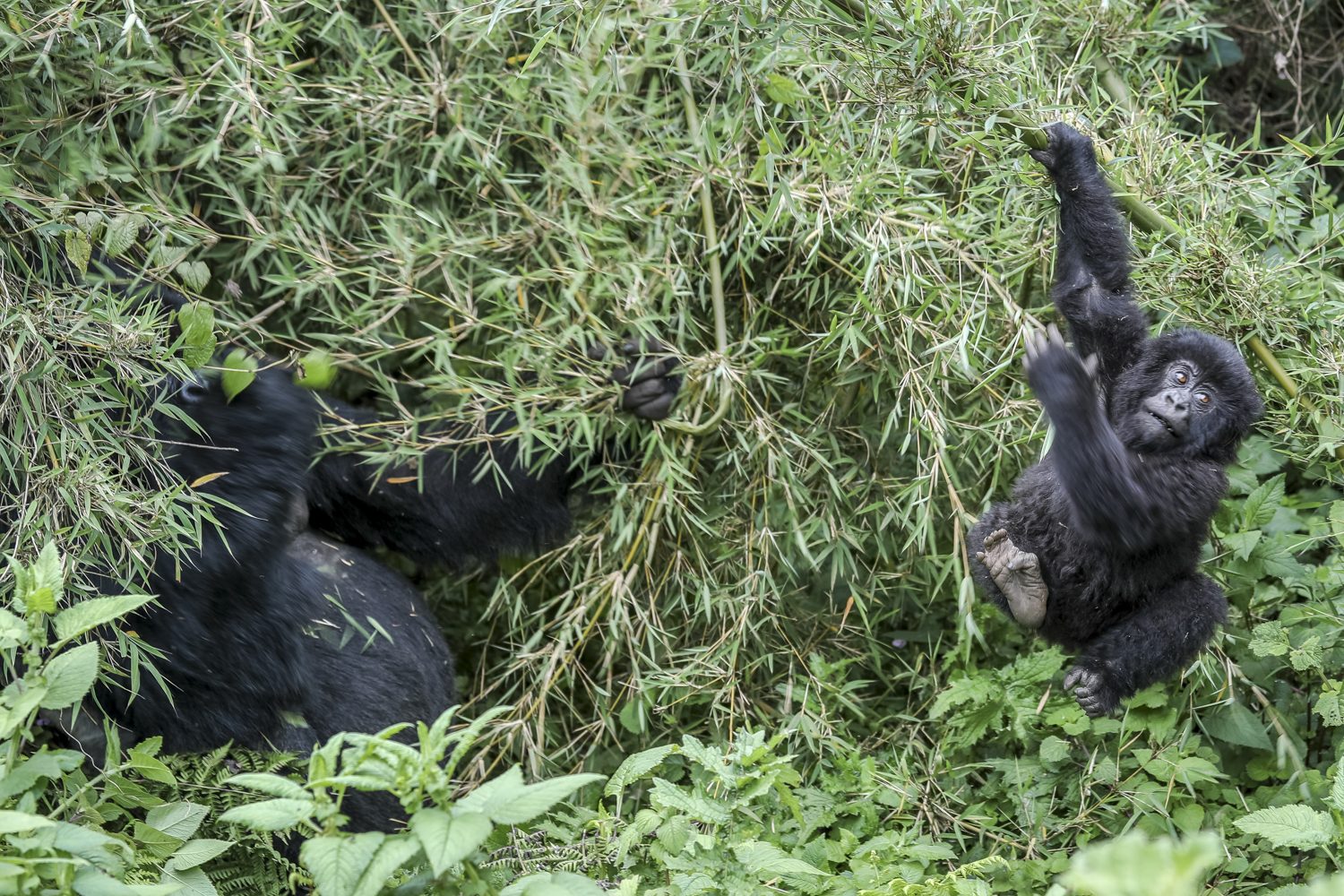
Visitors spend one precious hour with a family. It is an encounter that tends to be quieter and more contemplative than people expect. The gorillas feed, groom, play and nap while you sit a short distance away. Rules protect them: no food near the group, no flash photography, and no approach closer than roughly seven metres. For most people that hour is the single most moving wildlife experience of their lives.
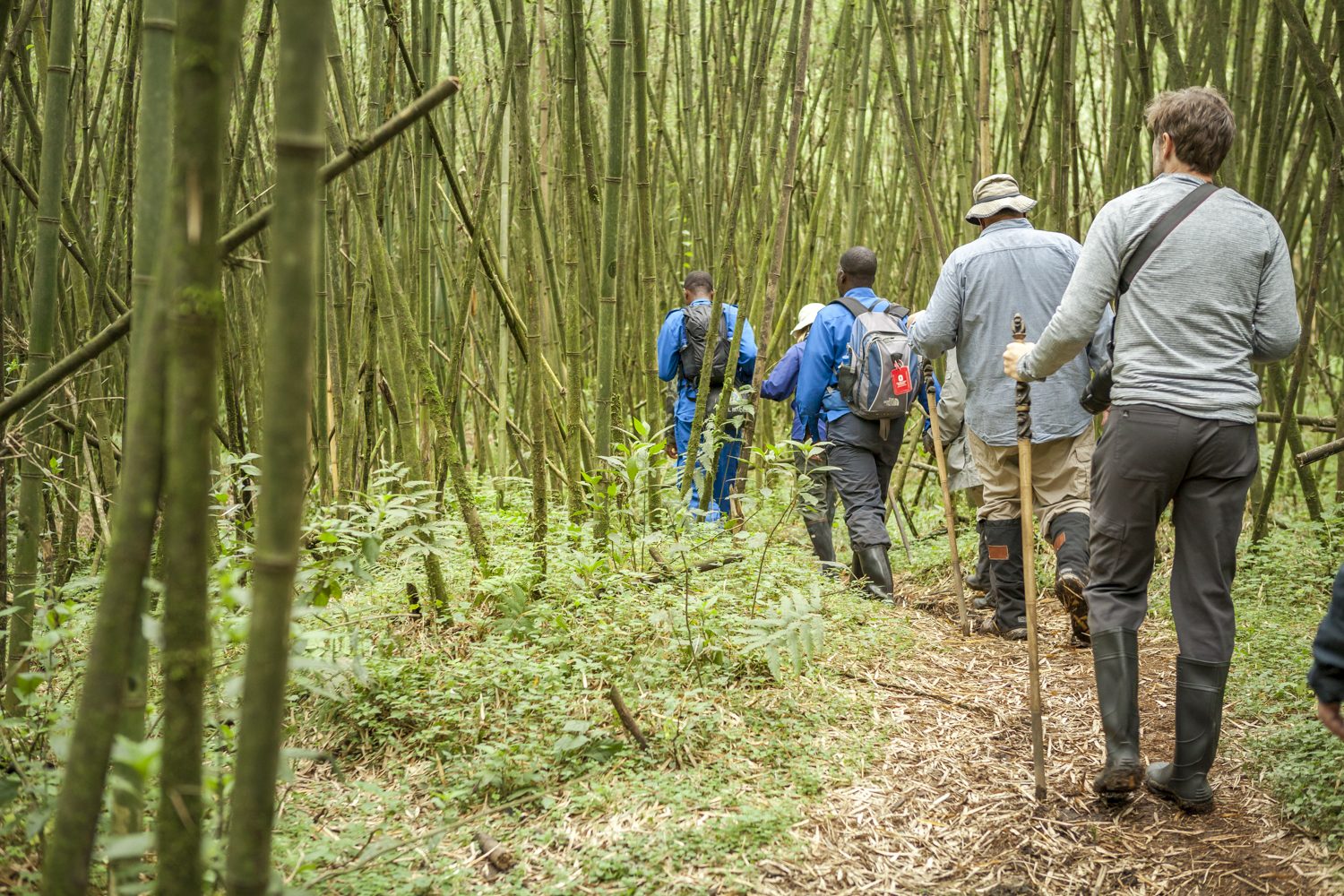
Gorilla trekking days begin early. Trekkers gather at the Kinigi headquarters in the dawn light. Guides assign them to families and brief them before driving to the trailhead. Depending on the family and the season, the walk can take from under an hour to three hours or more. It begins on cultivated hillsides and climbs through eucalyptus, bamboo and finally the dense, moss-draped forest of the volcano slopes.
The moment of encounter is signalled by the guides – the swish of vegetation, a deep chest-beating drum, the sight of a silverback feeding a few metres away. After the hour is up, rangers lead the group back down. Trekkers return to the headquarters for a certificate and, usually, a celebratory late breakfast. This is genuinely a demanding day in the mountains. A reasonable level of fitness and steady footwear matter more than athleticism.
What to bring on a gorilla trek:
Porters are available at the park headquarters and are well worth hiring – they carry your bag, steady you on steep sections, and their wages are a direct boost to local households. Walking sticks are provided, and your rangers will set a pace that suits the slowest member of the group.
A permit is mandatory for every gorilla trek. Only a limited number are issued each day, one per visitor per family, with families and treks carefully managed. Permits are booked by date and must be secured in advance, often weeks or months ahead during busy seasons. The Rwanda Development Board sets the permit prices and releases the annual calendar. Rwanda has periodically offered discounted rates during the rainy months of April and November, so budget travellers sometimes time their visit accordingly.
The permit price is the same wherever you book, so there is no advantage in cutting corners; it includes the trek itself, ranger guidance and the visitor’s direct contribution to conservation and community projects. The most reliable way to secure permits is through a licensed local tour operator, who will handle the paperwork, the date allocation and the logistics around the trek. Our gorilla permits guide explains the process in detail, and a 3-day Rwanda gorilla safari packages the trek together with transport and accommodation.
Be prepared for the possibility that your preferred date may already be sold out, particularly between June and September and around the December holidays. Booking three to six months in advance is the norm for those dates, and flexibility with dates makes a booking far easier to secure.
The gorillas may be the headline, but Volcanoes is not a one-animal park. The golden monkey, a striking, sunlit-coloured relative of the blue monkey, lives in large family troops in the bamboo zone. A half-day golden monkey trek is one of the park’s most charming experiences. The monkeys are endlessly active, leaping between bamboo stems, and their treks are shorter and gentler than the gorilla walks.
The forests also shelter buffalo, bushbuck and duikers, and although elephants wander through the massif from time to time they are rarely seen. Birders will find well over a hundred recorded species, including the striking Ruwenzori turaco and a host of other Albertine Rift endemics.
For travellers with time and fitness, the volcanoes themselves are the second great adventure. Mount Karisimbi, at 4,507 metres the highest of the range, takes two days as an expedition with an overnight camp near the summit. The reward is sunrise views across the whole massif. Mount Bisoke offers a one-day climb to its dramatic crater lake, while the sharp, tooth-shaped summits of Sabyinyo, Gahinga and Muhabura draw a smaller but devoted crowd.
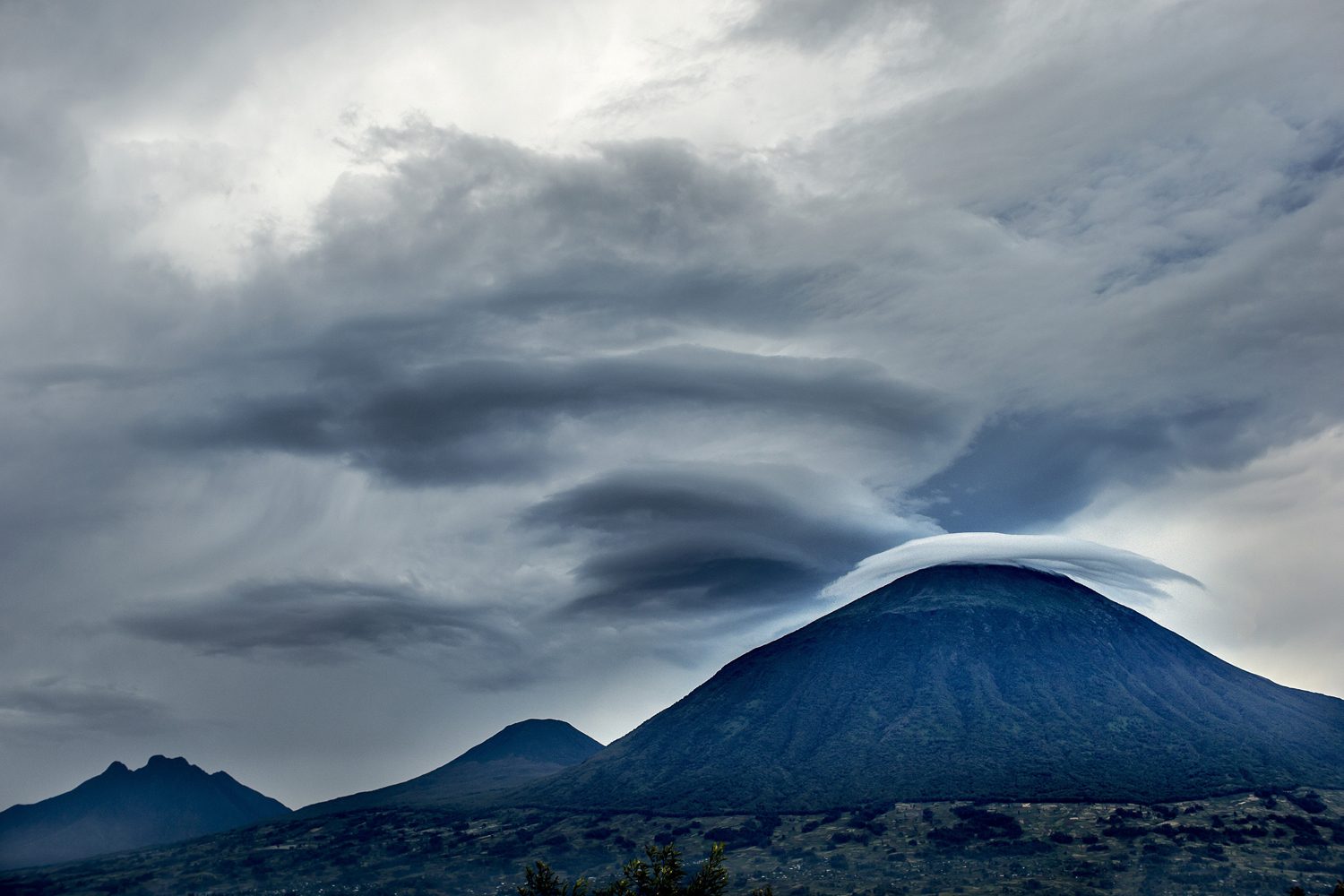
These climbs require mountain guides, proper clothing and a head for the thin air above 4,000 metres. They are physically demanding undertakings, and altitude sickness is a real consideration. The landscape of giant lobelias, bare craters and swirling cloud is unlike anything else in East Africa. Bookings are made through the park or licensed operators. It is wise to attempt the climbs only after the gorilla trek, which is the physical centrepiece of most visits.
The area around the park rewards a little extra time. The Musanze Caves, a vast lava tube formed by ancient eruptions, can be explored on a guided walk in the company of bats. Community tourism is a growing highlight. Village tours such as the Iby’Iwacu Cultural Village, run with former poachers turned conservation advocates, give visitors a window into rural Rwandan life. They also directly fund the people who live on the park’s edge.
These experiences are more than add-ons – they are part of the conservation model that keeps the gorillas safe. A 2-day Rwanda gorilla trekking itinerary is ideal if time is short, while longer tours give you the space to add climbs, community visits and the rest of the country.
Gorilla trekking is possible all year round, and the park is at its most beautiful in the rain, when the forest is green and the trails are quiet. The main dry seasons – roughly June to September and December to February – offer the best conditions underfoot, while the rainy months bring greener scenery, fewer crowds and sometimes discounted permits.
Wherever you stay, dress in layers, expect mud, and remember that altitude makes the air cool. Most visitors base themselves in Musanze or at one of the lodges that cling to the foothills of the volcanoes. Leave a day of flexibility in your schedule: if the trek is postponed by bad weather or a family moving deep into the forest, you will want the room to manoeuvre.
Gorilla trekking demands a level of fitness that is entirely achievable for the average active traveller, but it is worth being honest with yourself: the trails are steep, wet and often muddy, and you can be on your feet for several hours at an altitude that makes every step, literally, a little harder. The fastest way to spoil a once-in-a-lifetime day is to arrive exhausted; the best preparation is a few weeks of brisk walking or hill work before you fly.
Altitude is the other factor travellers underestimate. The park’s trails run at roughly 2,400 metres and above, where the air is noticeably thinner. Most visitors feel nothing more than breathlessness on the climbs, but anyone with a history of altitude or heart issues should travel with a doctor’s advice. Take the steep sections slowly, drink water, and let your guide set the pace. The rangers are used to helping every kind of trekker, and no one is expected to push beyond their comfort.
Etiquette with the gorillas is simple and taken seriously. Keep your distance, never eat or drink in front of them, and leave the camera flash off. If a gorilla approaches, stay still and let it pass; if you need to cough or sneeze, cover your mouth and turn away. These rules protect the animals from human diseases, to which they are extremely vulnerable. Following them quietly is the greatest service you can do the very families you have come to see.
Finally, take care of the people who make the trek possible. Your guides and trackers work the mountain year-round; gratuities are modest and genuinely appreciated. Hiring a porter at Kinigi is the easiest way to support local families while helping yourself on the steepest slopes. Warm thanks, a small tip and a smile cost nothing, and they are part of how this park keeps both its gorillas and its neighbours safe.
A visit to Volcanoes National Park slots naturally into almost any Rwandan itinerary. Combine it with the savannah and Big Five wildlife of Akagera. Add the chimpanzees and canopy walk of Nyungwe, or the beaches and islands of Lake Kivu. Our 4-day gorilla trekking package focuses on the park itself, while the 6-day Rwanda gorilla trekking and Lake Kivu itinerary pairs the trek with one of Africa’s most beautiful lake shorelines.
Planning a visit to Volcanoes National Park starts with the gorilla permit. Every day in Volcanoes National Park begins at the Kinigi headquarters. Most travellers spend two or three nights around the park, so the mountains and the forest get their due. Volcanoes National Park rewards preparation, and this guide gives you the essentials.
Whatever shape your trip takes, the essentials are the same: a permit booked well in advance, sensible packing, and a willingness to slow down and let the mountains do their work. For official travel planning, see the Visit Rwanda tourism board. Start planning with our team today – enquire through the booking form and we will take care of the rest.