Gorilla Permits Rwanda — 6 Years of Trusted Service
Rwanda’s newest national park tells the most hopeful story in African conservation. Gishwati-Mukura National Park, gazetted in 2016, protects two fragments of montane rainforest in the country’s west – forest that was nearly destroyed, then painstakingly restored, and now shelters chimpanzees, golden monkeys and a host of birds found nowhere else on earth.
It is a small park by African standards, and one of the least visited in Rwanda – precisely the reason to go. Here, instead of queues, you will find forest trails, chimp calls echoing through the mist, and a conservation story you can walk through in a single day.
This guide to Gishwati Mukura National Park covers its history, its wildlife, its trails and the practicalities of a visit.
The Gishwati forest was once part of a great belt of rainforest spanning the Congo-Nile Divide. In the 1980s and 1990s, resettlement and clearing reduced it dramatically – at its worst, Gishwati shrank to a fraction of its original size, a landscape of pasture and stumps where forest had stood for millennia.
Then the tide turned. A series of restoration initiatives – tree planting, erosion control, community engagement and, finally, formal protection – began to bring the forest back. In 2016 the government gazetted Gishwati and its neighbour Mukura as Gishwati Mukura National Park, and in 2020 the wider area was recognised as a UNESCO biosphere reserve. Today the forest is growing again, and so is the wildlife inside it.
The park is really two distinct forest blocks. Gishwati, the larger and more accessible, sits on a rolling plateau above the tea country, its canopy broken by ridges and streams. Mukura, smaller and more remote, is a fragment of near-primary forest clinging to a steep ridge, darker and wilder.
Between and around them lies a landscape in recovery: young plantation trees, regenerating bush, and community farmland that is now being woven back into the forest edge. Walking the park is literally watching restoration in progress.
Notably, chimpanzees are the flagship residents of Gishwati Mukura National Park. A small community survives in Gishwati, and while tracking here is less predictable than in Nyungwe, the experience of hearing chimps in a forest that was nearly lost is powerful. The park’s chimpanzee programme includes habituation work and constant monitoring by dedicated teams.
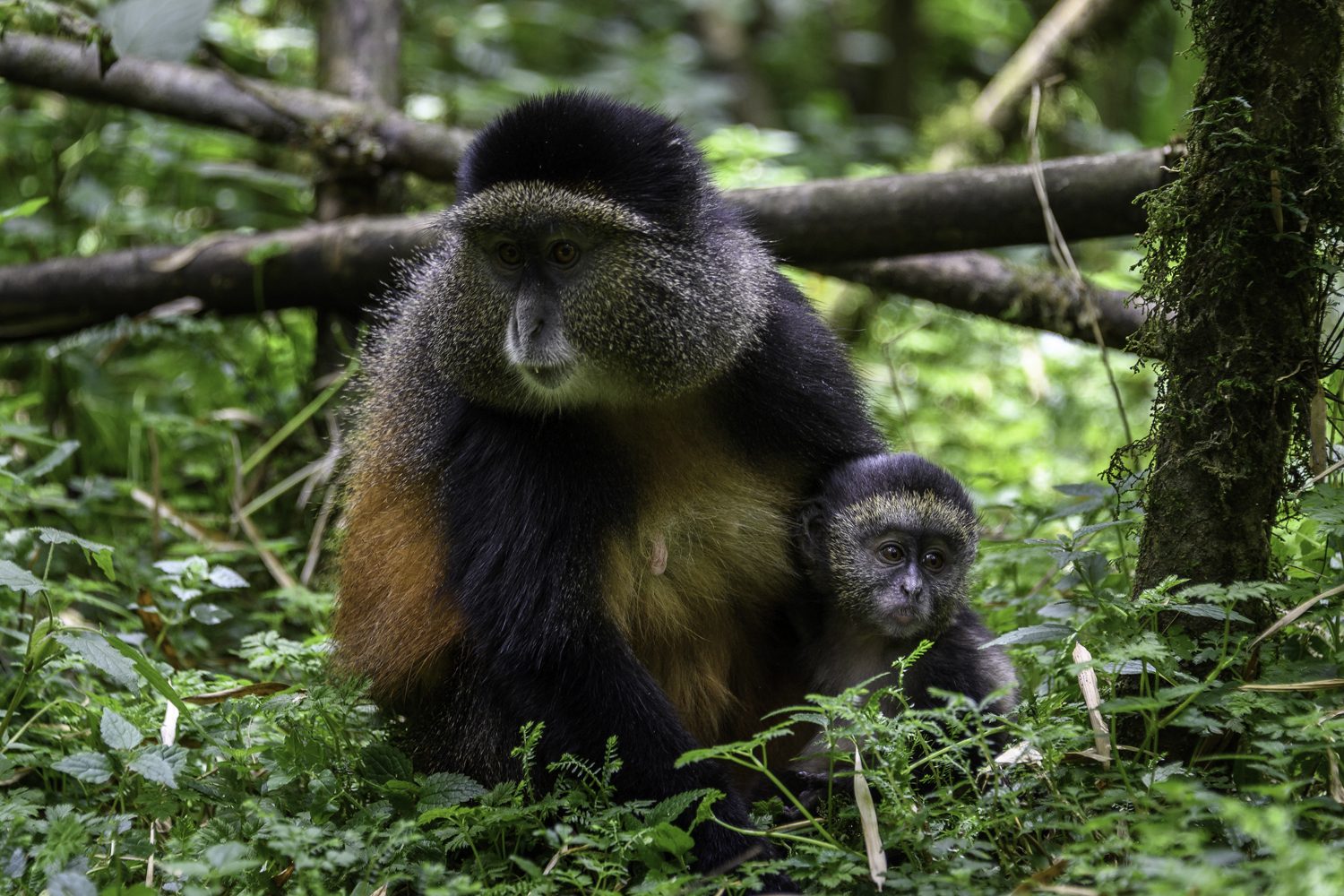
The forests also hold golden monkeys, L’Hoest’s monkeys and several other primates, along with forest duikers and, occasionally, golden cats. In Mukura, the rare owl-faced monkey has been recorded. Every encounter here feels earned – there are no guarantees, which is part of the appeal.
Gishwati Mukura National Park is a serious birding destination. The forest supports species typical of the Albertine Rift – the band of mountains and forests from which more endemic birds rise than almost anywhere else on the continent – including several that are hard or impossible to find elsewhere in Rwanda.
Bird surveys continue to add species to the park’s list; in addition, guided birding walks are among the park’s best activities. For birders who have already covered the classic Rwandan sites, Gishwati-Mukura offers something genuinely new.
A network of trails has been developed for visitors, most of them starting near the park’s visitor centre on the Gishwati side. Short forest loops, longer hikes to the park’s high points, and waterfall trails take walkers through the regenerating forest, with guides drawn from the local community along the way.

Meanwhile, the hills around Gishwati Mukura National Park are equally worth exploring: tea plantations roll over the hills, coffee farms welcome visitors, and the views across the Congo-Nile Divide – and down towards Lake Kivu – are spectacular. A full day of forest walking followed by a lakeside dinner is a perfect Gishwati day.
What makes Gishwati Mukura National Park special is how closely its future is tied to its neighbours. Reforestation here has gone hand in hand with community development – nurseries, cooperatives, beekeeping and jobs for local guides – so that protecting the forest pays the people who live around it.
Visitors contribute directly: entrance fees, guide fees and community projects, for example, all flow back into the landscape. The park is widely cited as proof that small protected areas can work when communities are partners rather than bystanders.
Gishwati Mukura National Park lies in western Rwanda, about four hours by road from Kigali and within easy reach of the shores of Lake Kivu. Roads are good but winding, and the park is most often visited as a day trip from the lakeside towns, or as a stop on a cross-country safari.
Accommodation is simple – guesthouses and community camps around the forest – and there are no luxury lodges inside the park. That keeps the experience intimate and affordable. There are no gorillas here; the park’s entrance fees and permits cover the forest walks, and bookings run through the park office or licensed operators. Additionally, entry fees and trail news are published on the Rwanda Development Board’s park pages.
Talk to anyone who works in Gishwati Mukura National Park and the conversation always comes back to the same thing: the nursery. These small greenhouses of seedlings – native trees raised in polythene bags and tended by villagers – are the physical engine of the park’s recovery. Every reforested stretch of hillside began as a tray of seedlings planted by a local hand.
The work is painstaking and highly localised. Instead of blanket planting, the restoration teams match species to microhabitats, close the gullies that push erosion, and let the regenerating natural forest do what it does best under the young canopy. Community members are paid, trained and monitored through the programme, so the planting is as much social enterprise as ecology.
For visitors, the nursery is where you can see – and, if you wish, join – the process. Some tours offer a seedling-planting moment, a small act that connects your visit to the forest’s future, and no one who plants a tree here forgets its name.
The hills around Gishwati Mukura National Park grow some of Rwanda’s finest coffee, and the park’s story is interwoven with the beans. The forests catch the rain that waters the hillsides of coffee and tea that ring the national park, and the farmers, careful of their water, have become among its most passionate guardians.
Visiting a local washing station gives you the full journey: red cherries picked at dawn, floated, fermented and dried on raised beds, and finally the green beans that find their way to roasters around the world. On the veranda of a station or the porch of a farm, with a view down the valley towards the lake, a fresh cup tastes like the whole landscape.
Buying coffee here – and taking home a bag – supports exactly the families whose stewardship keeps the forest healthy. It is the perfect way to make your visit to Rwanda’s newest park echo long after you leave.
Indeed, a proper visit to Gishwati-Mukura deserves a full day. Arrive at the visitor centre in the morning, join a guided forest walk on one of the short trails, and save the afternoon for the longer ridge paths, the views across the Congo-Nile Divide and a chance to spot the park’s wildlife.
Morning is best for chimpanzees and bird song, so build your walk early. Bring rain gear and warm layers; at these altitudes the mist comes quickly, and the trails are steep. An experienced local guide whose life and training are interwoven with the park will double the value of your hours.
If you plan to be here midday, the length of the walk, the availability of guides, and the best trails switch with the season – so chat to the park about what is on offer before you go. A flexible schedule around the forest pays dividends.
However, Gishwati-Mukura will never have the queues of its neighbours, and it does not need them. For travellers who have done the Big Five and the great apes, it offers something rarer: a place where conservation is still being made, in real time, and where every visitor’s entrance fee and enthusiasm is part of the machinery of recovery.
It is also the most affordable and least prescriptive national park in Rwanda – you can shape a visit around a two-hour walk, a full-day trek or a community stay, and nowhere else will you feel the country’s story of restoration so personally.
Bring an open heart and a pair of binoculars, and leave the souvenir shelf in the visitor centre, walking with the knowledge that the forest you walked in today is larger than the one mapped by rangers a decade ago. Few experiences in Africa produce that feeling.
A well-spent day at Gishwati-Mukura has a clear rhythm. Morning: arrive at the visitor centre, join a guided forest walk on the short trails while the birds and any chimpanzees are still active. Midday: visit the community nursery and, if the timing works, plant a seedling of your own. Afternoon: take the longer ridge trail for the views, and finish with coffee at a local farm.
The park office will help you match walks to the season and your fitness; the short trails take one to two hours, the full-day ridge routes considerably longer. Morning walks are the best value for wildlife, so plan your arrival early.
If you want to include Mukura, the smaller sister forest, allow a separate day: it is more rugged, less visited, and the access road needs time and patience. It is a destination for the committed, and it rewards them deeply.
Pace yourself at altitude: the forest sits high, the air is thin and the climbs are steep. The views from the ridges – across the divide and down towards the lake – are the reward, and they are worth every step.
Gishwati-Mukura does not stand alone. It is part of a family of protected areas that runs the length of Rwanda, from the volcanoes and their gorillas in the north to the great forests of Nyungwe in the south and the savannahs of Akagera in the east. Each park is a thread, and together they weave the country’s natural heritage.
For conservation scientists, the park matters as a corridor test case: can a restored forest fragment, surrounded by farmland, survive and grow? The answer so far is encouraging, and the methods developed here are studied across the region.
Its biosphere reserve status reflects that ambition – not just protecting what remains, but rebuilding what was lost, and doing it with the communities who live alongside the forest. Researchers, rangers and villagers all appear in the park’s daily work.
Rwanda is small enough that no park is ever far from another, which is exactly why a conservation-minded traveller can visit several in one trip – and why each one matters more than its size alone.
A walk in Gishwati is a conversation with a living forest. Within minutes of the trailhead you are inside the soundscape: the drip of water off leaves, the rustle of a duiker in the undergrowth, the fluted calls of birds you will never see, and – if you are lucky – the hooting of a chimpanzee announcing itself from a distant slope.
The trees themselves tell the story. Mature old growth stands tall where the forest survived, while shoulder-height pioneers mark the regenerating edges, and between them the guides read decades of effort in a single hillside. It is forest restoration made legible, kilometre by kilometre.
On the ridges, the view opens: gardens and tea plantations rolling away below, and on a clear day the distant glint of the lake reflecting the sky. The height lends the walk a sense of achievement that the steeper sections earn honestly.
Bring your patience and your senses. The forest does not cry out for attention the way the savannah does; it rewards the slow, the quiet and the curious – and it gives them back more than they brought.
To feel Gishwati Mukura National Park at its fullest, spend a night in the villages around it. Simple guesthouses and community camps offer clean beds, home-cooked meals of beans, potatoes and greens, and mornings that begin with the kettle and the forest mist. It is a humble, beautiful corner of Rwanda.
Pack practically: sturdy boots for the wet, rainforest trails, layered clothing for the altitude, a waterproof jacket, drinking water, and a small torch for the evenings. Leave the dress shoes at home; you will want everything hand-washable and quick-drying.
Mind your manners in the villages: ask before photographing people, greet in Kinyarwanda when you can, and take the offered coffee – it is the doorway to every conversation here. The welcome is open-minded and generous.
Spending locally is the point. Every guesthouse bed, every guide fee and every bag of coffee puts money into the households whose stewardship restores the forest – and a night here is, in its small way, part of the conservation story itself.
Gishwati Mukura National Park will probably never be Rwanda’s most-visited park, and that is its gift. Visitors come for the story – a forest brought back from the brink – and leave with the feeling of having witnessed conservation that is still happening, day by day, tree by tree.
It combines beautifully with the rest of the country: the chimpanzee tracking here is the wilder cousin of the Nyungwe experience, and Lake Kivu lies just down the hills. Our 2-day Nyungwe chimpanzee tracking safari is the classic way to see chimp country, and the Nyungwe National Park guide covers the neighbouring forest in detail. Our team can help you add Gishwati-Mukura as the wild card in your itinerary – contact us to plan a visit.