Gorilla Permits Rwanda — 6 Years of Trusted Service
In the far south-west of Rwanda lies one of the most remarkable forests on earth. The mountains of the Congo-Nile Divide stand against the sky there. Nyungwe National Park protects a vast swathe of ancient montane rainforest. Often described as the oldest rainforest in Africa, it has survived for millennia. It outlasted the ice ages and the shifting climates of the planet. Today the forest shelters chimpanzees, colobus monkeys and hundreds of bird species. A canopy walkway hangs suspended high above the forest floor.
Nyungwe is Rwanda’s best-kept secret in plain sight. This is a forest of waterfalls and mossy trails. Mist curls through the trees at dawn, so the air stays full of bird song. For many travellers it is the second great primate destination after Volcanoes National Park. It is the place to go looking for chimpanzees.
This guide covers the park’s natural history. It explains the chimpanzee tracking experience, the famous canopy walk and the trails. In addition, it covers the practicalities of planning a visit.
Nyungwe National Park lies in Rwanda’s Western Province, roughly five to six hours by road from Kigali. Indeed, it sits on the watershed between the Nile and Congo river basins. This position makes it one of the most biologically significant forests in Africa. The park’s official site details trails, permits and seasonal news for planning. The park covers close to a thousand square kilometres of rainforest. It is one of the largest surviving blocks of montane forest on the continent. Its altitude ranges from around 1,600 to nearly 3,000 metres, which creates an extraordinary range of habitats. Meanwhile, our Nyungwe National Park destination guide is a useful quick reference for planning.
The forest has been growing here for a very long time. Many tropical forests retreated during the ice ages, but Nyungwe stayed forested for tens of thousands of years. It remains a living link to an ancient Africa. That long history explains its astonishing biodiversity. As a result, the forest holds more than a dozen primate species and around 300 species of birds. Countless orchids, ferns and flowering plants grow nowhere else on earth.
In fact, Nyungwe National Park is one of Africa’s most reliable places to track wild chimpanzees. Guides have habituated a community of forest chimpanzees over many years. Treks leave in the early morning with experienced guides and trackers. They follow the chimps’ calls and trails through the forest. Encounters never come with a guarantee, because chimps move fast and cover huge distances. However, Nyungwe’s trackers are among the best on the continent.
The trek itself is a proper rainforest adventure. The trails are steep and muddy, and the forest is full of sound. You will hear hooting chimpanzees, the calls of hornbills and water dripping from the leaves. When you catch up with the group, you may watch for an hour. You might see grooming, feeding and play-fighting. Meanwhile, you witness the complex social lives of our closest relatives.
Chimpanzee tracking has a daily cap, just like gorilla trekking. You must arrange a permit in advance through a licensed operator. Moreover, officials strictly control the numbers. Our 2-day Nyungwe chimpanzee tracking safari packages the trek with accommodation and the park’s other highlights.
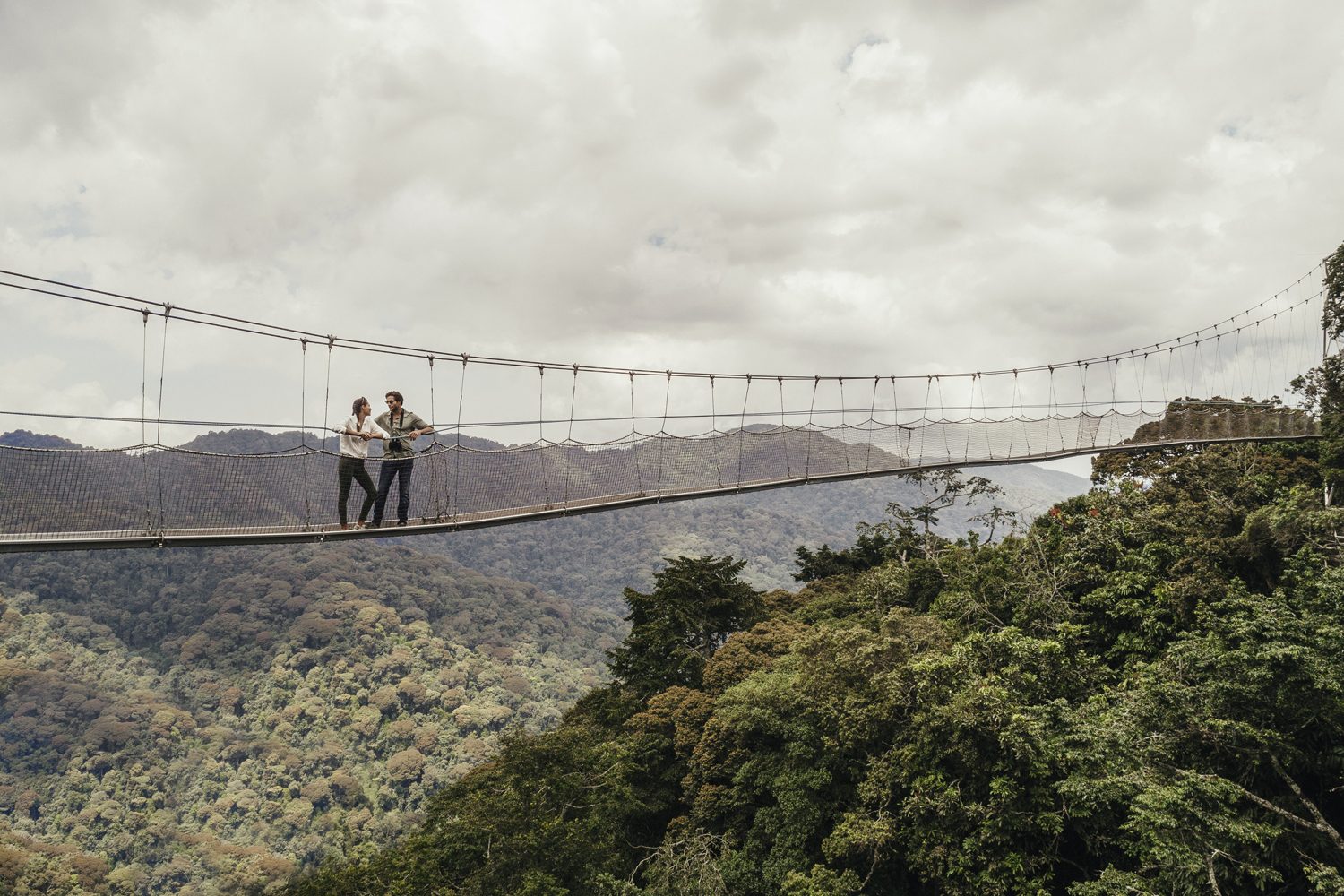
Nyungwe National Park’s canopy walkway was the first of its kind in East Africa. This suspended bridge of steel and rope stretches some 160 metres. It hangs high above the forest floor in the crown of the ancient trees. Walking it is both a thrill and a revelation. The rainforest canopy is a world of its own. Monkeys leap between branches there, and sunbirds flash through the light.
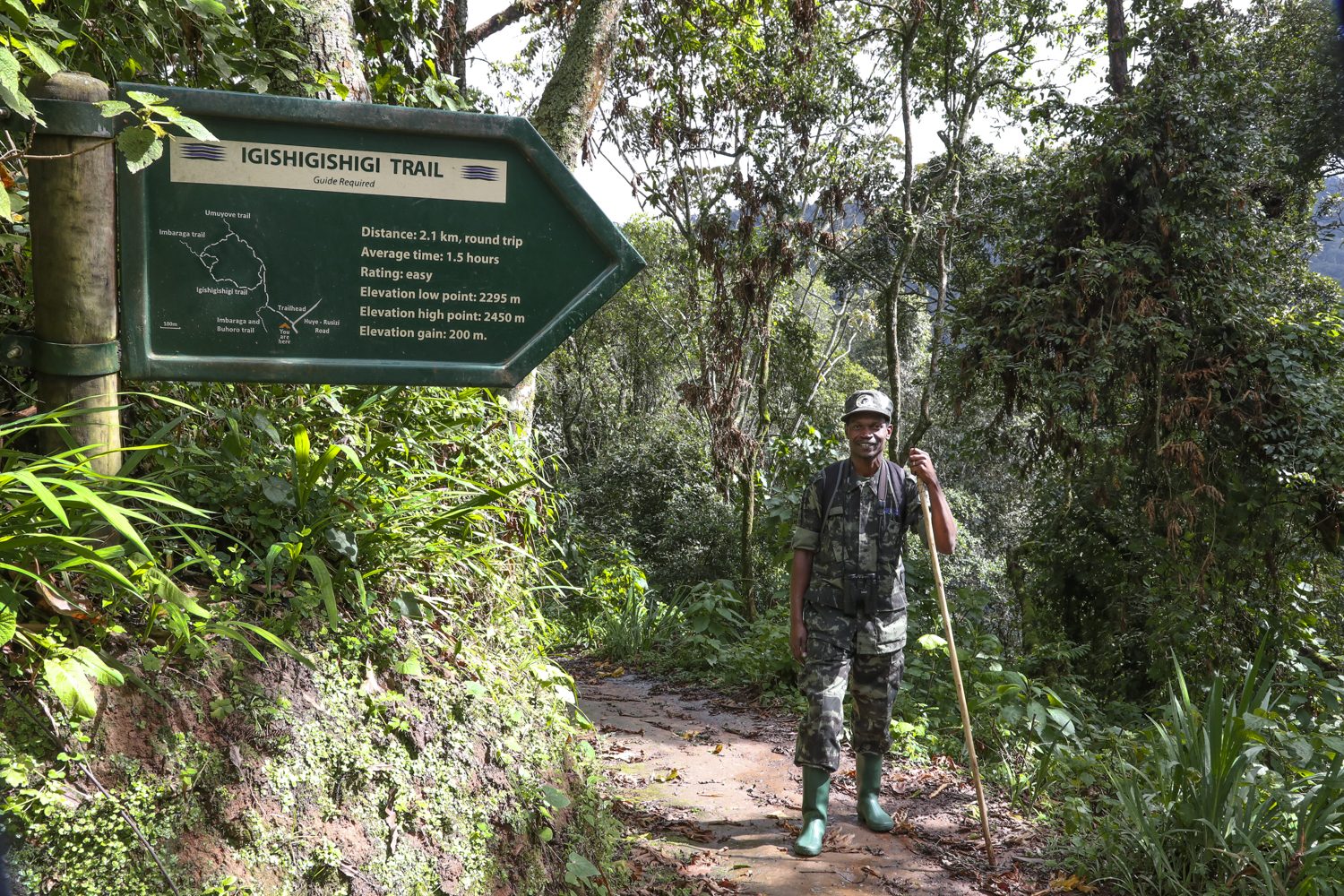
The walkway sits on the Igishigishigi Trail, a short walk from the main road. You can easily combine it with other forest trails. For many visitors it is the most memorable image of the whole forest. It looks like a slim line of steel hanging in a sea of green. Meanwhile, the mist of the Congo-Nile Divide drifts through the trees.
Nyungwe’s primate list is one of the richest in Africa. The Angola colobus is the most spectacular of all. These grey-and-white monkeys move through the canopy in groups of 300 to 400 individuals. That makes them among the largest troops of any monkey species on earth. Red colobus monkeys swing through the branches in striking red coats. Besides the colobus, L’Hoest’s monkeys, blue monkeys and golden monkeys live here too. The rare owl-faced monkey also calls the forest home.
Primates you can hope to see in Nyungwe:
Overall, Nyungwe is a world-class birding destination. Indeed, it holds around 300 bird species. More than two dozen are Albertine Rift endemics, birds found nowhere else on earth. In particular, the great blue turaco, with its electric blue and crimson plumage, is the forest’s poster bird. The red-collared babbler, the Ruwenzori turaco and the handsome francolin are among the specialities.
Serious birders spend days on the forest trails with a local guide. They often record well over a hundred species in a few days. In addition, the canopy walkway itself is a superb birding platform. At dawn, the forest edges are alive with weavers, sunbirds and barbets.
Additionally, well-maintained hiking trails thread through Nyungwe National Park. They range from short loops to multi-day routes. The Congo-Nile Divide Trail follows the ridge where Africa’s two great river systems part ways. Meanwhile, trails like the Isumo Waterfall Trail lead to dramatic cascades in the heart of the forest. Mountain biking is possible on some forest roads.
Rolling tea plantations ring the forest. They create a beautiful patchwork of green, and they are themselves worth a visit. Guided community walks offer a chance to meet tea farmers, coffee growers and local beekeepers. As a result, you will understand how the forest’s neighbours take part in its protection.
Generally, Nyungwe National Park welcomes visitors all year round, like all of Rwanda’s rainforests. The drier months, June to September and December to February, make trekking easier. While the rains bring dramatic scenery, they also bring fewer visitors. Pack for mud and cold. At these altitudes the forest is cool, and rain can arrive at any moment.
Accommodation ranges from simple forest lodges near the park gates to comfortable lakeside resorts. The park works well, for example, as a two-day stop on a longer itinerary. It also combines naturally with Lake Kivu, which lies an hour or two to the west.
On the whole, Nyungwe’s accommodation scene has grown up around the forest without crowding it. At the park’s edge you will find forest cabins and camps whose terraces look straight into the trees. Meanwhile, the evening entertainment is the chorus of birds and the occasional grunt of a colobus overhead. A night here is half the experience of visiting.
A little further out, the tea and coffee country around the forest offers comfortable guesthouses and plantation stays. On the western side of the park, the lakeshore of the Congo basin edges close. So a few lodges combine forest mornings with lake evenings. Gisakura, at the main park entrance, is the practical base for trekkers. It offers simple, friendly accommodation, and the park offices are minutes away.
Whichever you choose, book early in the dry seasons. Nyungwe is quieter than the gorilla parks. But the handful of quality lodges fill up fast. A first-row seat on the forest makes a huge difference. A long commute to the gate is worth planning around.
Nyungwe does not end at the forest fence. Additionally, its foothills are Rwanda’s great tea country. Rolling, impossibly green plantations look as though a landscape painter designed them. Visiting a plantation is one of the most relaxing half-days in the south of the country. You can walk among the tea pickers and learn how the workers pluck, wither and process the leaves.
Across the hills, small-scale coffee washing stations welcome visitors. Rwandan coffee runs from family farms to some of the world’s best cups, after all. The story unfolds best over a fresh brew on a plantation veranda. Both crops form the economic backbone of the region. Meanwhile, the money they earn keeps communities willing to coexist with the forest.
Community initiatives around the park are equally rewarding. For instance, guided village walks, beekeeping demonstrations and craft cooperatives all invite participation. In the cooperatives, women weave the famous Rwandan baskets. The people of the forest edge are its most important guardians. And spending time with them is both a pleasure and a quiet act of conservation support.
Nyungwe is a rainforest at altitude. This means one rule above all: expect rain, even in the dry season. A good waterproof jacket, quick-drying trousers and sturdy, grippy footwear form the foundation of any packing list. Likewise, gaiters or long socks will save your ankles from the leeches that appear after heavy rain.
What to pack for a day in the forest:
Layers matter more than bulk. The mornings are cold, the midday can be warm, and the rain can arrive in minutes. Leave heavy luggage at your lodge and carry only the essentials into the forest. Every kilogram counts on the long climbs.
In fact, Nyungwe is the largest of a chain of forest fragments that once covered the Congo-Nile Divide. Understanding that helps visitors appreciate both its glory and its fragility. In essence, what you see today is the surviving heart of a landscape that people cleared over centuries. The park’s boundaries are also its lifelines.
It is that rarity that makes a visit feel significant. In the space of a few days you can walk across the rooftop of Africa. You can stand on a walkway in the treetops and follow chimpanzees through the undergrowth. You also understand why the conservation of this one forest matters far beyond Rwanda. Few places on the continent pack so much meaning into such a small corner of the map.
No two days in Nyungwe National Park feel the same. But a single well-planned day can cover the essentials. The classic shape is a dawn start for chimpanzee tracking, the longest and most physical activity. Then come a relaxed lunch at your lodge and the afternoon canopy walkway. A short trail such as the one to Isumo Falls fits in too. That combination gives you the park’s three signature experiences without running yourself into the ground.
With a second day, however, the tempo changes completely. Take the longer Congo-Nile Divide Trail in the morning. Afterward, spend the afternoon on a community walk or tea plantation visit. Leave the forest with a sense of its people as well as its birds. Two days is the sweet spot: one day of highlights, one day of depth.
Walk the canopy walkway late in the morning. The light comes through the trees then, and the crowds from the road have thinned. The trails are quietest after two in the afternoon. That is a good time for birders to work the forest edges alone.
However you structure it, resist the urge to pack everything in. Nyungwe rewards slow walking, and altitude fatigue is real. The visitors who see the most walk slowly and sit often. Let the forest come to them.
In effect, Nyungwe National Park sits on one of the great hydrological divides of Africa. Rain falling on the western slopes of the park flows eventually into the Congo river and the Atlantic. Rain falling a few metres to the east joins the Kagera, the Nile and the Mediterranean. A single droplet can split a continent. You can stand astride that split on the park’s trails.
This makes Nyungwe a continental water tower. Consequently, its sponge-like forest stores rainfall and releases it slowly into the region’s great rivers. These sustain millions of people across the region. The rivers run from Rwanda itself to Uganda, South Sudan and Egypt. The health of the forest is, quite literally, the health of downstream nations.
Walking the Divide Trail brings this to life. Guides point out the slopes and name the rivers. They tell the story of the water cycle with the enthusiasm of people who know every stream. At the viewpoint on the ridge, you can turn slowly through 360 degrees. So you can trace the journey of two oceans from there.
It is a perspective that changes how you see the park. It is not just a beautiful forest, but an infrastructure of life. That is why Nyungwe’s protection matters far beyond tourism. Every visitor who cares for the place is part of the story.
Nyungwe is far from the gorilla parks in miles. But the reward is a trip across the whole width of Rwanda. You travel from the volcanoes of the north through the mountains of the west. The journey ends at the great forest of the south-west. The 6-day Rwanda gorilla trekking and Lake Kivu itinerary links the two primate experiences. Many travellers add the lakeside beaches as a place to rest between treks.
Whatever route you take, plan to give Nyungwe at least one full day. In short, allow two days to do justice to the forest, and book your chimpanzee permits early. The oldest rainforest in Africa has been waiting millions of years. It will be here when you arrive, and it will change the way you think about wild places. Contact our team to help you fit Nyungwe into your Rwandan itinerary.