Gorilla Permits Rwanda — 6 Years of Trusted Service
Africa keeps its secrets in its folds, and nowhere is Albertine Rift biodiversity richer than in the chain of mountains running through the western part of the continent, from the Virunga volcanoes of Rwanda and the mountains of Uganda down through the eastern Democratic Republic of Congo, Burundi, and Tanzania, this chain of mountains and valleys is one of the most remarkable places on the planet. It is the western branch of the great East African Rift, a geological scar where the continent is slowly pulling apart, and its mountains, forests, and lakes have produced a concentration of life found almost nowhere else.
Conservation scientists call the region a biodiversity hotspot because Albertine Rift biodiversity holds an exceptional number of species found nowhere else, while facing exceptional threats. The region is home to the mountain gorillas of the Virunga Massif, the chimpanzees of Nyungwe, the golden monkeys of the volcanoes, and hundreds of endemic birds, frogs, butterflies, and plants. For the traveller, this is the great prize of a Rwanda safari: in one small country, the Albertine Rift delivers more unique wildlife than most continents. This article explores what makes the Rift so special, what lives there, and why it is worth protecting.
The story of the Albertine Rift begins with geology. Tens of millions of years ago, the African continent began to split along the line of the East African Rift, a process that is still pulling the earth apart today. In the west, the rift formed a chain of highlands, volcanoes, and deep lakes, including Lake Kivu, Lake Edward, and the great Lake Tanganyika, one of the oldest and deepest lakes on Earth. The mountains rose, the rift valleys sank, and the landscape became a patchwork of steep slopes, cool forests, and isolated peaks.
That isolation is the key to the region’s richness. When a mountain range rises, it creates separate worlds: the animals and plants on one peak are cut off from those on the next, and over long periods they evolve along their own paths. The Albertine Rift’s many isolated highlands became, in effect, a chain of islands in the sky, each with its own evolving community of life. This is why the region holds hundreds of species that exist nowhere else: they evolved on these specific slopes, at these specific altitudes, in these specific pockets of forest.
Elevation adds a second layer of diversity. On a single Rift mountain, the habitat changes from lowland rainforest at the base to cloud forest in the middle, to bamboo, then heath, then alpine meadows at the summit. Each band of altitude has its own species, so a hike up a Rift mountain is a journey through several distinct ecosystems in a single day. The result is a stack of different worlds, and Rwanda’s volcanoes and Nyungwe Forest are two of the best places on Earth to see the whole vertical sequence.
When conservationists rank the world’s biodiversity hotspots, the Albertine Rift regularly appears at or near the top. Albertine Rift biodiversity contains more endemic vertebraterate species than any other region of mainland Africa, and its endemism is not limited to animals: hundreds of plants grow only in the Rift, from giant lobelias on the high peaks to forest trees found only in particular valleys. For biologists, the region is a living laboratory, and new species are still being described from its forests today.
The endemic animal list is a who’s who of African rarities. Among the mammals are the mountain gorilla, found only in the Virunga Massif and the adjacent Bwindi forest, and the golden monkey, a bright-coloured relative of the blue monkey that lives in the high bamboo forests of the volcanoes. Among the birds, the Albertine Rift is legendary among birders, with dozens of species confined to its forests, from the striking Rwenzori turaco to the secretive Albertine owlet, and the region is a target destination for birdwatchers from around the world.
Amphibians and butterflies complete the picture. The Rift’s moist forests and mountain streams harbour many frog species found nowhere else, and its butterfly populations are among the most diverse in Africa. For the visitor, the sheer volume of life is part of the wonder: a walk through Nyungwe or the volcano slopes passes plants, birds, insects, and sounds that exist nowhere else on the planet. This is not a generic African forest; it is a unique piece of the earth’s biological inheritance.
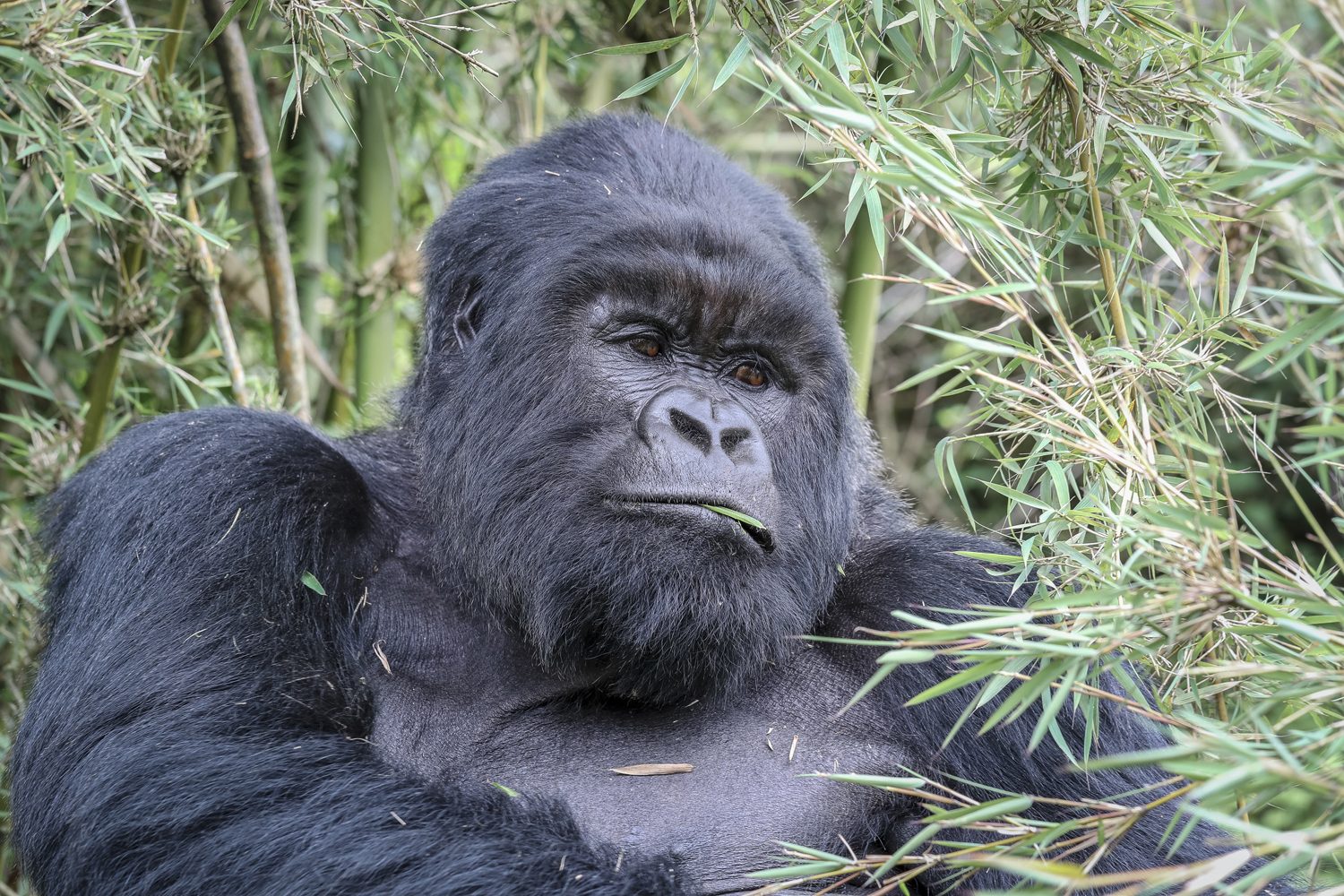
The most famous residents of the Albertine Rift are, of course, the mountain gorillas. The Virunga Massif, the chain of volcanoes that straddles Rwanda, Uganda, and the Democratic Republic of Congo, is one of only two places on Earth where the subspecies survives, and Rwanda is the heart of its conservation story. The population has grown from a low of around 254 animals in 1981 to more than one thousand today, one of the most celebrated recoveries in the history of conservation.
The gorillas are the Rift’s flagship species, the animals that put the region on the world’s conservation map. They live in the forest band between roughly 2,500 and 4,000 metres, feeding on bamboo, leaves, and fruits, and they are so deeply embedded in the Rift’s ecology that protecting them means protecting the whole ecosystem they depend on. The gorilla’s survival is therefore a proxy for the health of the Rift itself: when the forest is healthy enough for gorillas, it is healthy enough for everything else.
For the visitor, the gorillas are the experience of a lifetime. A trek in Volcanoes National Park is an encounter with the Rift at its most magnificent, and you can plan it on the park’s own websiteent, and the gorilla permit that funds the trek is the same money that keeps the Rift’s conservation machine running. The gorillas are not just a sight; they are the reason the world cares about this strip of mountains, and the reason the region’s other endemic species have a future at all.
Beyond the gorillas, the Rift is rich in other primates, and the most charismatic is the golden monkey. Named for the bright orange-gold patches on its back and limbs, the golden monkey lives in the high bamboo forests of the Virunga volcanoes, and a trek to see it is one of the most delightful experiences in Rwandan conservation. The monkeys move in lively troops, feeding on bamboo shoots and leaping between stems, and seeing them is a completely different encounter from the quiet majesty of the gorillas.
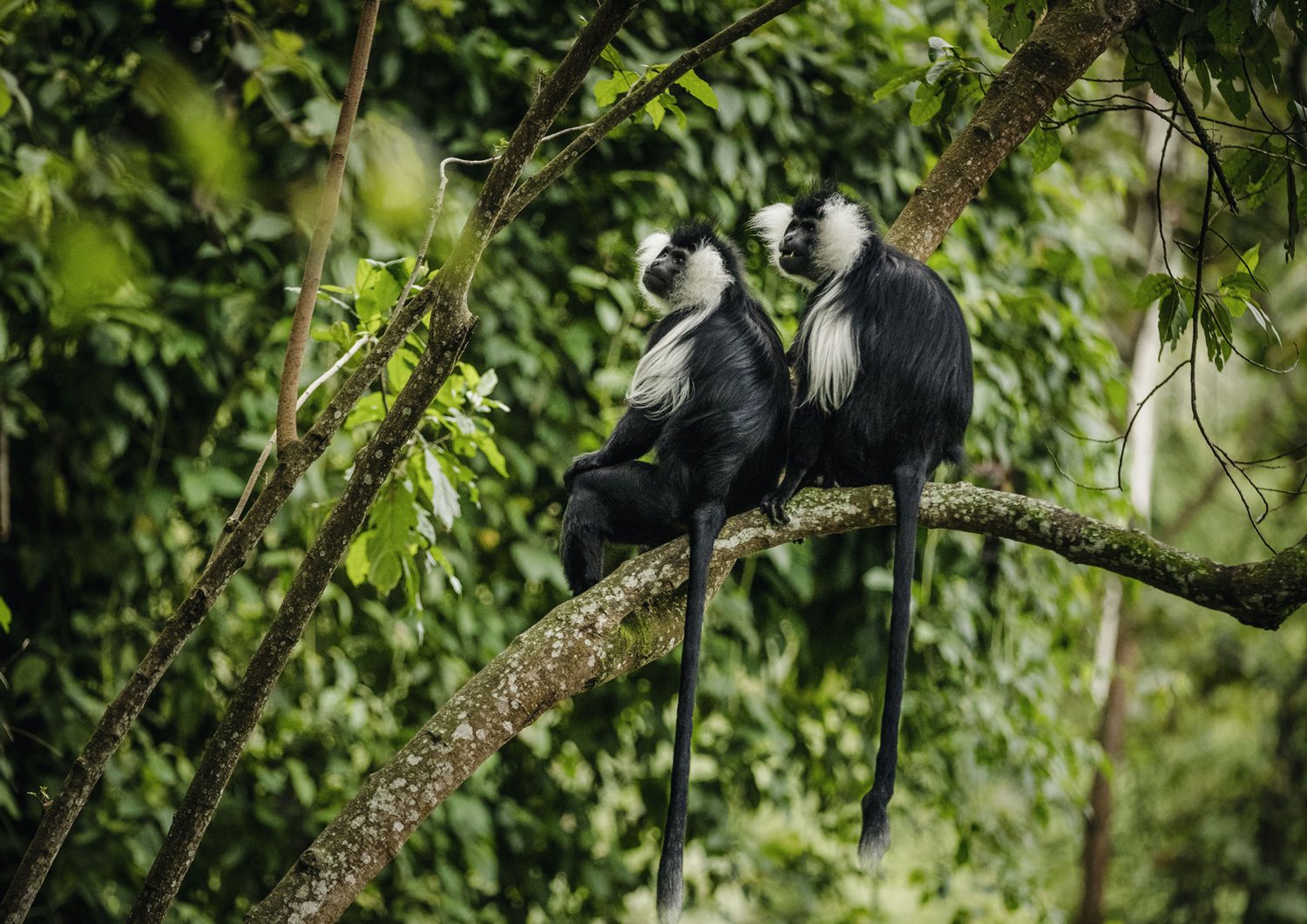
The Rift’s primate diversity extends much further. Nyungwe National Park, in the south-west of Rwanda, protects one of Africa’s largest montane rainforests, and its primate community is astonishing: thirteen primate species, including the eastern chimpanzee, the L’Hoest’s monkey, the owl-faced monkey, and troops of hundreds of Angola colobus monkeys that travel through the canopy like waves. For scientists, Nyungwe’s primate population is one of the richest in the world for a forest of its size, and for visitors it means a safari that is never short of wildlife.
The chimpanzees of Nyungwe are the second great ape of the Rift. The chimpanzee tracking experience in Nyungwe is one of Rwanda’s defining activities: following the calls of a community through the ancient forest, finding the animals in the branches, and watching a close cousin of humanity at home. That a single small country can offer both mountain gorillas and chimpanzees, the two most famous apes of Africa, is entirely down to the diversity of the Albertine Rift.
For birders, the Albertine Rift is a pilgrimage destination. The region is recognised as an Endemic Bird Area, one of the richest in Africa, and a skilled birding trip through Rwanda’s forests and mountains can deliver a list of endemic species that is the envy of the continent. The Rwenzori turaco, with its crimson wings and green crest, the handsome francolin, the Grauer’s warbler, and the shy Albertine owlet are among the prizes, and each is a species that exists only in this narrow strip of mountains.
Nyungwe is the crown jewel of Rift birding, with hundreds of species recorded in the forest and its borders, including many endemics. The forest’s canopy walk, one of the tallest in Africa, puts birders at eye level with the treetops, and a day on the forest’s network of trails can produce sightings that birders spend lifetimes chasing elsewhere. The eastern savannah and the lakes of the Rift add waterbirds and plains species, giving Rwanda a bird list that combines montane rarities and savannah classics in one compact country.
The birds matter beyond the aesthetic. Endemic birds are among the most sensitive indicators of forest health, and their presence in the Rift’s forests is a sign that the ecosystem is still functioning. Bird conservation in the Rift is therefore forest conservation, and the same protected areas that shelter the gorillas and chimpanzees shelter the birds. For the traveller, it means that every forest walk is also a birding walk, whether or not you came for the birds.
Albertine Rift biodiversity is not only about mountains and forests; it is also about water. The Rift’s highlands feed some of the most important lakes and rivers of central Africa, and its forests are the sponges that hold and release the water. Nyungwe, at the head of the Rift’s watershed in Rwanda, is the source of two of Africa’s great river systems: the Nile and the Congo, a fact that gives its protection continental significance. Rain that falls on Nyungwe’s canopy eventually reaches the Nile Valley or the Congo Basin, and the forest’s health is felt across half of Africa.
The lakes of the Rift add their own biodiversity. Lake Kivu, which borders the volcanoes and the Nyungwe highlands, is one of Africa’s great lakes, and its waters are home to species found nowhere else. Lake Tanganyika, further south, is a world-famous centre of aquatic evolution, with hundreds of unique fish species. The Rift’s valleys also support wetlands and rivers that host waterbirds, otters, and a web of life that connects the mountains to the lakes.
For the traveller, this means the Rift experience extends beyond the forest. The gorilla trekking and Lake Kivu journeys are among the most beautiful journeys in East Africa, joining the misty volcanoes to the terraced shores of the great lake. The Rift, in other words, is not a single ecosystem but a whole living landscape, and Rwanda is its most accessible showcase.
For all its richness, Albertine Rift biodiversity is under severe pressure. Its human population is among the densest in Africa, its forests have been cleared for agriculture over generations, and its mountains have been fragmented into islands of green in a sea of farmland. The endemic species of the Rift, evolved in isolation, are uniquely vulnerable: with nowhere else to go, a species that loses its forest loses its only home. The region’s status as a hotspot is as much a warning as a celebration.
The hope lies in the protected areas. Rwanda has created a network of national parks and forests that preserves the core of its Rift heritage: Volcanoes National Park for the gorillas and golden monkeys, Nyungwe for the chimpanzees and the watershed, Akagera for the eastern savannah, and the Gishwati-Mukura forests in the west. Each park is surrounded by the community programmes, revenue sharing, and tourism funding that give the local population a reason to keep the boundaries green.
Conservation in the Rift has also gone international. The region’s parks are managed with partners, its wildlife is monitored by scientists from many countries, and its funding draws on tourism from around the world. The money that trekking brings flows into the same system: permits, park fees, and responsible tourism are the economic engine that keeps the Rift’s species alive. The Rift is one of the few places on Earth where a holiday genuinely pays for the survival of a unique ecosystem.
The Albertine Rift is not an abstract scientific concept; it is the landscape you see from almost anywhere in Rwanda. The green mountains, the terraced hills, the mist that settles in the valleys, the volcanoes on the northern horizon, all of it is the Rift, and all of it is alive with the special richness of the region. A Rwanda safari is, in the deepest sense, an Albertine Rift safari, and every corner of the country adds a piece of the story.
Start with the mountains: the gorillas and golden monkeys of the volcanoes, and plan your route with Rwanda’s official tourism board, then the chimpanzees and colobus of Nyungwe, and add the savannah of Akagera for contrast. Between them, these parks cover the full range of Rift life, and our itineraries are designed to do exactly that. Whether you have time for one trek or a two-week expedition, contact our team and we will build a trip that shows you the Rift at its richest.
Albertine Rift biodiversity is Africa’s greatest because it is a landscape of islands in the sky, a chain of mountains where life evolved in isolation and multiplied in splendour. To walk its forests is to walk through millions of years of evolution, through the home of the gorillas and the source of great rivers, through one of the most precious pieces of the natural world. It is here, in these mountains, that the rarest species of Africa survive, and it is here, thanks to the visitors who care, that their future is being secured.