Gorilla Permits Rwanda — 6 Years of Trusted Service
Climbing Mount Karisimbi means taking on the highest point in Rwanda, a great extinct volcano whose summit rises 4,507 metres above the Virunga chain and, on clear days, looks down over the whole of northern Rwanda into Uganda and the Democratic Republic of Congo. Unlike its neighbour Bisoke, Karisimbi is not a day trip. The climb takes two days and one night, with a camp at 3,700 metres beneath the summit, and it is the most serious and the most rewarding hike in Volcanoes National Park.
Karimbi, as the mountain is known locally, is the second largest of the eight Virunga volcanoes, and its upper slopes carry a rare alpine ecosystem of giant lobelias, moorland and cold nights. The two-day format makes the climb tougher to fit into a short itinerary, but it also makes it safer and far more enjoyable: you gain altitude gradually, sleep in the mountain forest, and walk the final ridge in the first light of dawn, when the summit is often clear and the view stretches across three countries. This guide covers everything you need to know about climbing Mount Karisimbi: the route, the permits, the camp and the cost.
Bisoke gives you a crater lake in a day. Climbing Mount Karisimbi gives you Rwanda’s highest point, a night under the stars of the high Virunga, and a summit sunrise that hikers describe for the rest of their lives. Where the lower forest trails of the park are all about the gorillas, Karisimbi is about the mountain itself: the changing vegetation zones, the silence above the clouds, and the physical achievement of climbing more than 1,400 metres to the roof of the country.
The mountain is extinct, the remains of an old volcano that once stood far higher than today’s summit, and its name means “white shell” in Kinyarwanda, a reference to the cap of ice that historically covered the peak. The ice is long gone, but the summit still feels arctic in the early morning, and the upper slopes hold a landscape of giant groundsels, lobelia rosettes and mossy rock that is found nowhere else in Rwanda. On a clear day you can see the smoking cone of Nyiragongo, Mount Nyiragongo’s active crater in the Congo, and the whole sweep of the Albertine Rift.
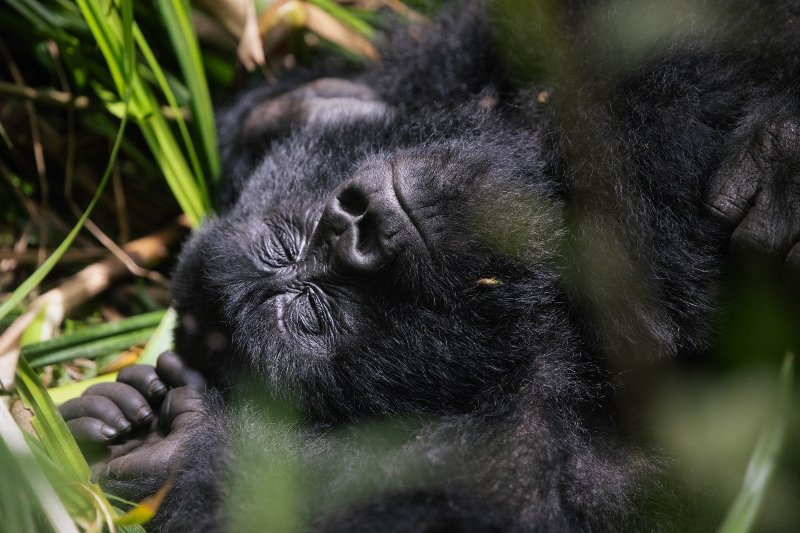
Climbing Mount Karisimbi also passes through the richest wildlife habitat in the park. The bamboo and Hagenia forest of the lower slopes is the territory of mountain gorillas, and while the trekking route stays on the trail, you are walking through the same forest the gorillas call home. Golden monkeys, blue monkeys and black-and-white colobus all live along the route, and the birdlife is exceptional, including the Rwenzori turaco and the handsome francolin.
Climbing Mount Karisimbi is organised by the Volcanoes National Park office and must be booked in advance, with a guide and ranger escort required throughout. Day one starts early at the Karisimbi gate, reached by four-wheel-drive from Kinigi over a rough track that becomes impassable in heavy rain. From the gate you walk up through farmland fringes and into the bamboo zone, which gives way around 2,700 metres to a dense, moss-draped Hagenia forest where the giant trees are the size of cathedrals.
The forest thins around 3,300 metres, and the trail climbs through open clearings of alpine flowers before reaching the Karisimbi campsite at 3,700 metres, a small clearing with basic shelters and a cooking area, perched on the shoulder of the mountain. The walk from the gate to the camp covers about 11 kilometres with 1,100 metres of ascent and takes most hikers five to seven hours. Porters, available at the gate, carry tents, food and personal gear, and are essential for a comfortable climb.
The night at 3,700 metres is the coldest night you will spend in Rwanda. Temperatures drop below freezing after sunset even in the dry season, and the camp sits above the cloud, with views over the dark cone of Bisoke and the lights of Musanze far below. This night of altitude is a deliberate part of the plan: it lets your body acclimatise before the final push to the summit.
Day two of climbing Mount Karisimbi begins early, usually around 3:30 a.m. The route from camp to the summit covers about 4 kilometres but climbs 800 metres, and in the dark it is a slow, steady grind over volcanic rock and moorland. The vegetation disappears entirely above 4,000 metres, leaving bare slopes of scree and lava rubble. Marked by a cairn and a small sign, the summit arrives in four to five hours, in time for the sunrise.
The summit of Karisimbi is a broad, flat crater rim rather than a pointed peak, with views that are among the most famous in East Africa. To the north, the jagged triple summit of Sabyinyo and the flat plateau of Gahinga mark the border with Uganda; to the west, the Congo basin stretches out flat and green to the horizon; and to the south, the lakes and terraces of Rwanda fall away towards the Virunga foothills. The sun rising over all of it, with the cold wind on your face, is the moment the two days of effort are about.
Hikers usually spend 30 to 45 minutes at the top, taking photos and resting, before the long descent. The way down retraces the route to camp, where a meal and a rest break are welcome, and continues the same day all the way to the gate. The full descent takes five to seven hours, and most hikers are back at Kinigi by late afternoon. The total distance over the two days is roughly 25 to 30 kilometres, with more than 2,000 metres of accumulated ascent and descent.
Climbing Mount Karisimbi requires a two-day hiking permit issued by the Rwanda Development Board, and unlike the single-day Bisoke permit it covers the overnight on the mountain. Prices vary by nationality and change from year to year, so confirm the current rate when you book; as a guide, foreign visitors should budget several hundred US dollars for the permit, plus guide fees, park fees and the services of porters, which are arranged at the gate in cash.
The climb must be booked through the park office or a licensed operator, and it cannot be attempted independently. Your booking includes the mandatory guide and ranger escort, and most operators bundle transport, the four-wheel-drive transfer to the gate, and the services of a cook. Because the camp is basic and carries no permanent staff beyond the guides, everything for the night is carried up on the first day, which is why porters are so valuable.
Permits for climbing Mount Karisimbi are limited to a handful of hikers per day and sell out well ahead during the dry seasons, so plan months in advance. The park also offers the longer and more technical Gahinga and Muhabura routes on the Ugandan side, but for Rwanda’s highest summit, Karisimbi is the classic. If you are combining the climb with gorilla trekking, book both through the same operator so the permits and the dates line up, and check the gorilla permits page for current guidance on the trek itself.
The window for climbing Mount Karisimbi comfortably is the same as for the rest of the park: the main dry season from June to September, and the shorter dry spell in December and January. In the rains, from March to May and again in November, the track to the gate becomes difficult or impossible for vehicles, the trail turns to deep mud, and the summit is often clouded in. Even in the dry season, be prepared for afternoon storms and near-freezing nights at the camp.
The early summit start matters because the mountain builds its own weather: mornings are usually clear, while cloud moves in over the upper slopes by mid-morning. Starting the final climb before dawn maximises your chance of a clear summit view and gets you down off the highest ground before the wind and storms pick up. A flexible itinerary with a spare day is worth having, so a weather delay does not wreck the whole plan.
Climbing Mount Karisimbi is a serious undertaking. The ascent from the gate to the camp is long and continuous, the second day adds 800 metres of altitude, and the total elevation gain is greater than any other route in the park. Hikers should be comfortable with full-day hill walking and should have done some training with elevation gain. Anyone who is out of shape will find the second day very hard.
Altitude sickness is the main risk. The camp at 3,700 metres is high enough to affect anyone, and the summit at 4,507 metres is well above the altitude at which symptoms become common. Headache, nausea, poor sleep and shortness of breath are all signs to take seriously, and the guides are trained to identify them. If symptoms are severe, the correct response is to descend, and the guides will make that call. Plan for a rest day at lower altitude after the climb, drink plenty of water, and never be ashamed to turn back; the mountain will still be there.
Porters carry the bulk of the camping gear, so your personal daypack should hold only the day’s essentials. Layer clothing for the second day: it will be below freezing at the summit start but warm by the time you reach the forest on the way down. The difference in temperature between the gate and the summit can be more than twenty degrees.
Climbing Mount Karisimbi is a physical investment, so it makes sense to build a sensible order into your itinerary. Most visitors climb the volcano either first, while legs are fresh, or last, after the gorilla trek and the other day hikes. The mountain hiking guide on this site compares all the routes in the park, including the one-day Bisoke climb and the short Muhabura walk, so you can match the difficulty to your schedule.
The classic northern-Rwanda itinerary pairs the Karisimbi climb with a gorilla trek and a day on the twin lakes of Bulera and Ruhondo, which offer canoe trips and village walks in the shadow of the volcanoes. For visitors with more time, the three-day Rwanda gorilla trekking safari can be extended into a full hiking week, and the mountain’s position close to the park headquarters makes it easy to add to any itinerary based in Musanze.
How fit do I need to be for climbing Mount Karisimbi? Fit enough for a full day of continuous climbing with altitude. Regular hill walking and stair climbing in the months before the trip are the best preparation.
How cold does it get at the camp? The camp at 3,700 metres regularly drops below freezing at night, and the summit can be colder with the wind. A proper sleeping bag is essential.
Is the climb safe? With guides, rangers and the acclimatisation night, the climb is managed safely for prepared hikers. Altitude is the main risk, and it affects everyone differently.
Can I see gorillas and climb Karisimbi on the same trip? Yes, and many visitors do. Book both permits through one operator so the dates line up, and give yourself a rest day after the climb.
Do I need my own tent and sleeping bag? Porters carry the group gear, and most operators supply tents. Your own warm sleeping bag is strongly recommended.
Climbing Mount Karisimbi is a genuine expedition, and it deserves proper planning: permits, a guide, porters, warm gear and an itinerary with a spare day. Get those right, and you will stand on the roof of Rwanda, watching the sun clear the Virunga chain, with the whole country below you.
We organise Karisimbi climbs with permits, guides, porters, transport and the mountain camp all arranged in advance, and we can combine the climb with gorilla trekking and the rest of the north. Contact our team to plan your dates, and we will take care of the logistics while you train for the summit. Karisimbi is patient with those who are prepared, and the reward, a sunrise over three countries from 4,507 metres, is worth every step of the climb.