Gorilla Permits Rwanda — 6 Years of Trusted Service
Chimpanzee tracking in Nyungwe National Park gives visitors an hour with our closest living relatives. Chimpanzee habituation in Nyungwe gives them something rarer: a full day inside the daily life of a wild community, in the company of the people whose patient work made the encounter possible in the first place.
Habituation is the long, careful process by which wild chimpanzees grow accustomed to human observers, and in Nyungwe it is both a conservation tool and a window into research. This guide explains what habituation means, what the experience involves on the ground, what you are likely to see, and how to book it.
If you have ever watched a wildlife documentary and wished you could be the person standing quietly at the edge of the clearing, notebook in hand, this is the closest a safari can take you.
There is a second way to think about chimpanzee habituation in Nyungwe: as an education. A standard trek answers the question of what a chimpanzee looks like; a habituation day answers the question of how a chimpanzee lives. For anyone planning a longer African journey, it also builds an understanding of the methods behind all great wildlife encounters, from mountain gorillas to wild dogs.
Every wild animal is afraid of humans, and with good reason. Habituation is the process of undoing that fear gradually, not by taming the animal but by teaching it, through months and years of neutral daily presence, that people are not a threat. Researchers follow a community every day, staying at a respectful distance, until the chimpanzees come to accept observers as part of the forest scenery.
Crucially, habituation changes behaviour without changing the animal. A habituated chimpanzee is still a fully wild creature that hunts, fights, mates and travels exactly as its unhabituated neighbours do. What has changed is tolerance, and that tolerance is conditional: it depends on visitors behaving predictably, quietly and at a safe distance, which is why the rules of the trek matter so much.
Habituation is also the foundation of modern primate tourism. Without it, no visitor could get near a wild chimpanzee, and without visitors, the forest would earn far less from its wildlife. In Nyungwe, as in Volcanoes National Park, chimpanzee habituation has turned conservation from a cost into a source of local income, and the chimpanzees into the forest’s most valuable residents.
It is worth understanding that habituation is never finished. Researchers observe communities continuously; new infants arrive unhabituated and must learn tolerance from their mothers, and any lapse in visitor discipline can set the process back. The habituation experience is not a spectator sport; it is a contribution to that ongoing work.
The ethical rules of the day are strict, and they exist for the animals’ sake. The guides will ask you to keep your voice to a whisper, to avoid sudden movements, to hold a defined distance, and never to hold eye contact for long, a signal chimpanzees read as a challenge. Far from spoiling the experience, these rules create its intimacy: the chimpanzees accept you precisely because you behave predictably.
Chimpanzee habituation in Nyungwe began with the studies of the late 1980s, when researchers started the long-term observation programmes that continue today. Following the same communities year after year, they learned the animals’ identities, families and territories, and the communities in turn learned to accept human presence. The habituation of the groups around Uwinka, Gisakura and Cyamudongo is the accumulated result of that trust.
The habituation experience lets visitors participate in that tradition. Rather than arriving at a known location for a fixed hour, you join a small team that sets out to find the chimpanzees in the manner of researchers: reading the forest, listening for calls, and following the trail of fresh feeding signs until the community is located.
Rwanda has become a global reference point for habituation. The same patient methodology that made the mountain gorillas of the Virungas accessible to travellers, documented in our gorilla habituation experience guide, has been applied to chimpanzees with equal success, and Nyungwe is the living proof that the model works.
The differences between the standard trek and the habituation experience are significant, and worth understanding before you book:
None of this makes chimpanzee habituation in Nyungwe better in an absolute sense; it is simply deeper. The standard trek is the perfect introduction to chimpanzee viewing, efficient and reliable, while habituation suits travellers who want to understand how the forest actually works and are prepared to give it a full day of their attention.
There is also an emotional difference. In a standard trek you are a guest; in a habituation session you are, for a few hours, part of the reason the chimpanzees are still here. Many participants describe the day as the most meaningful wildlife experience of their travels, precisely because it asked something of them.
If your itinerary only allows one morning in Nyungwe, the standard trek remains the right choice. If you have a full day to give, this is the day to give it.
What you wear matters more than you might expect. The habituation day takes you off the beaten trails, into damp undergrowth and up steep slopes, so boots with serious grip, quick-drying trousers and a rain shell are essential. Dress in muted colours, carry more water than you think you need, and leave the perfume at the lodge; your comfort, and the chimpanzees’ tolerance, both depend on it.
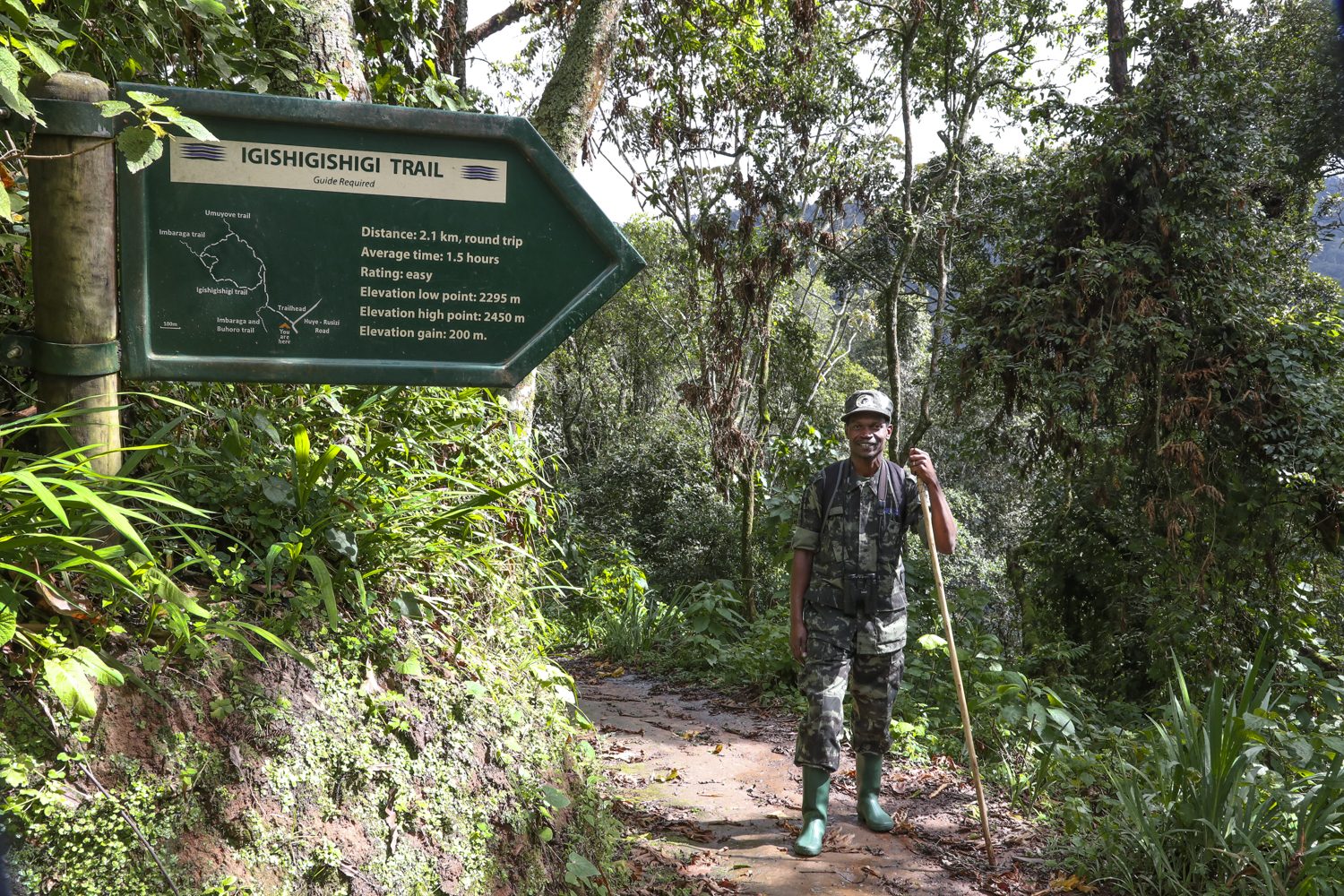
A chimpanzee habituation day in Nyungwe begins like every forest morning, in the dark. After an early breakfast you drive to the trailhead, meet your guides and the rest of the small party, and receive a briefing on the plan and the rules. Then you enter the forest while the canopy is still black against the sky.
The search is the heart of the day. Your team listens for the first calls of the community, checks the previous evening’s feeding trees, and follows the tracks and signs that chimpanzees leave everywhere: crushed leaves, half-eaten fruit, dung, and the distinctive sounds of movement. This is genuinely exciting work, and the guides involve you in it, explaining every clue as it appears.
Once the team finds the chimpanzees, the session begins in earnest. Unlike the strict one-hour format of the standard trek, habituation observation is open-ended, governed by the animals’ mood and your group’s conduct. You may follow the community as it travels, stop when it stops, and stay as long as the guides judge that the chimpanzees are comfortable. A picnic lunch taken in the forest is part of the deal.
The day ends with the walk back to the trailhead, usually in the afternoon, tired and full of stories. Because the schedule is long and the terrain demanding, a good level of fitness and a patient temperament are the two essential pieces of equipment.
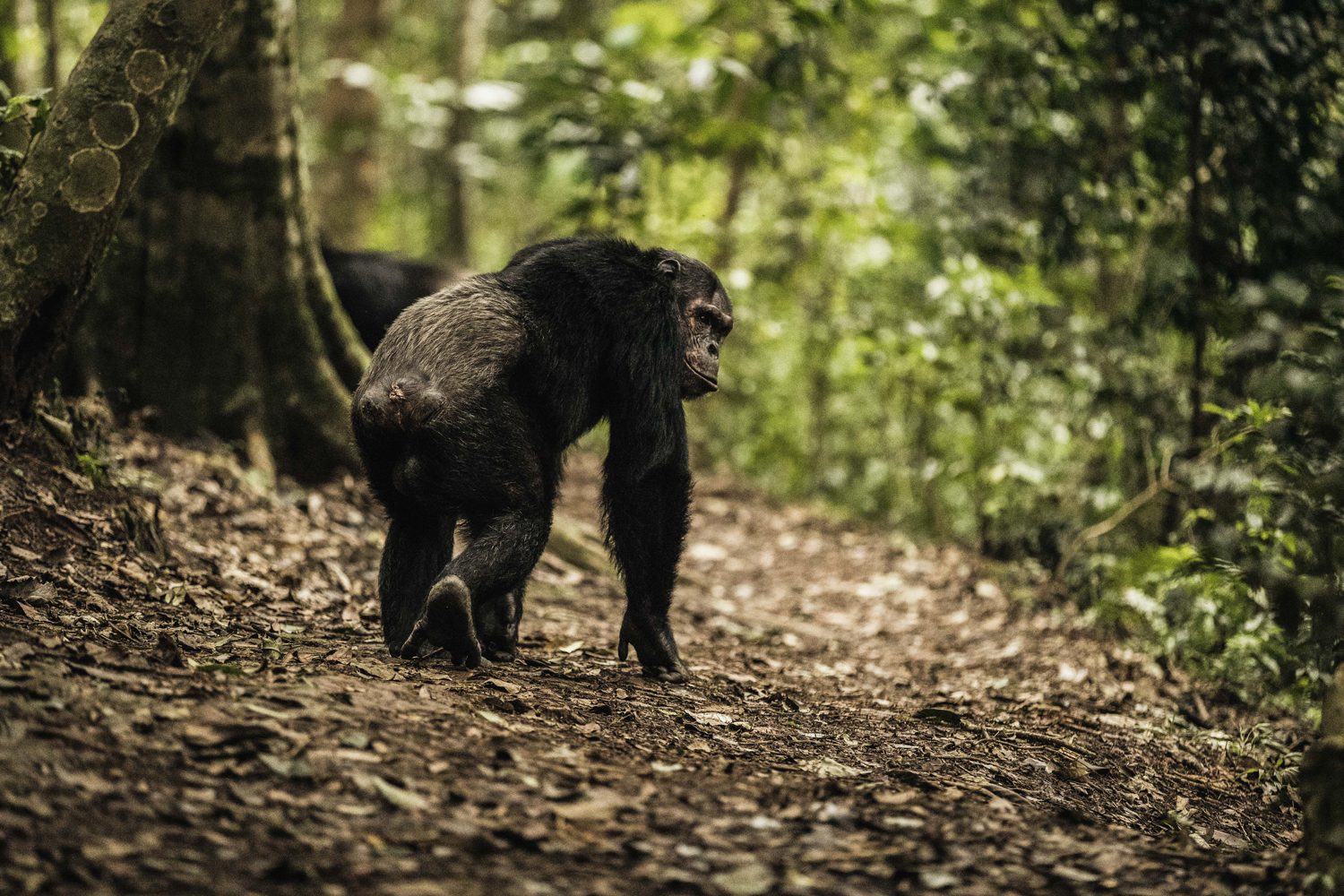
A full day in the company of chimpanzees reveals behaviours that the standard hour only hints at. Tool use is the most famous: watch a chimpanzee select a stem, trim it, and fish it into a termite mound with the concentration of a craftsman, or crush leaves to form a sponge for drinking water. Such moments are rare enough in research, let alone in tourism, and the habituation experience offers the best chance of seeing them.
Social life is the constant backdrop. Chimpanzee communities are full of alliance, argument and reconciliation: grooming sessions that go on for hours, pant-hooting greetings when parties reunite, dominance displays that make the forest shake, and the patient teaching of infants by their mothers. If you are very lucky, you may also witness hunting, when the community cooperates to pursue a small monkey through the canopy at astonishing speed.
None of this is guaranteed, and that is precisely the point. Chimpanzee habituation in Nyungwe does not sell sightings; it sells participation in the daily life of a wild community, with all the uncertainty that implies. The guides are candid about this, and the travellers who embrace the uncertainty come away with a deeper understanding than any guaranteed hour could provide.
There is also the sensory layer that no photograph captures: the smells of the forest, the texture of the air, the sheer volume of sound when a community erupts into hooting. Participants remember these details for decades, often more vividly than the sightings themselves.
One of the quiet joys of the habituation day is the picnic. Somewhere in the middle of the forest, with the community resting nearby, the guides unpack lunch and the conversation turns to the morning’s observations: which animals were seen, which alliances shifted, what the calls meant. It is the closest most travellers will ever come to a field researcher’s debrief, and it is unforgettable.
Chimpanzee habituation in Nyungwe suits a particular kind of traveller: patient, physically prepared and genuinely curious about animal behaviour. Birders, wildlife photographers, researchers and repeat visitors to Africa tend to love it, because it offers what they value most: time, depth and the sense of being let in behind the scenes.
It suits fewer travellers who are short on time, unused to long hikes, or expecting a guaranteed close encounter. The park authorities set minimum age and fitness requirements, and we will confirm the current rules when you book. If you are travelling with older children or less experienced walkers, the standard trek is a gentler introduction, and the habituation day can wait for another visit.
Solo travellers, by contrast, take to the habituation day immediately. Because the party is small and the schedule long, strangers become fast friends, sharing the tracking, the waiting and the eventual triumph of first contact. It is one of those rare travel experiences where the company is part of the product.
For anyone whose travel diary is dominated by wildlife documentaries and biology books, however, this is the experience you have been saving up for. It is the difference between watching an orchestra and sitting inside the rehearsal.
The park authorities price the chimpanzee habituation day in Nyungwe above a standard permit, reflecting the larger team, the longer day and the smaller group. Even so, it remains a fraction of the price of a gorilla permit, and it is widely regarded as one of the finest value wildlife experiences in East Africa. We will quote the current rate when you enquire.
What you get for the money is the full support structure of a Nyungwe day: park entry, expert guiding, the tracking team’s accumulated knowledge, and the logistical convenience of a properly organised outing. The easiest way to arrange it is as part of a package, such as our 2-day Nyungwe itinerary, which also covers your accommodation in the park.
One honest note on booking: habituation sessions are limited in number each day, so they sell out well in advance during the dry seasons. Fix your dates early, book through a licensed operator, and treat the permit as the fixed point around which the rest of your itinerary rotates. Park entry rules are published on Rwanda’s official tourism board website. You will find up-to-date pricing for chimpanzee and gorilla permits alike on our permit page.
Finally, pack for a full day rather than a morning: more water, more food, more patience. The guides will carry the group’s essentials, but your own comfort is your own responsibility, and a well-prepared traveller makes a better observer.
Weather is rarely the deciding factor in Nyungwe, but if you want the driest possible conditions for a long day on the trails, the June-to-September window is your friend, with December to February a close second. In the green seasons the day is wetter and the undergrowth thicker, but the forest is at its most dramatic, and the habituation teams know the trails in every condition.
A chimpanzee habituation day in Nyungwe sits naturally inside a larger primate safari. Many of our guests pair a Nyungwe habituation day with a gorilla habituation session in Volcanoes National Park, comparing how the two species were habituated and how their behaviours differ. Our gorilla habituation experience guide explains the gorilla version in detail.
Alternatively, combine the chimpanzee habituation day with a classic gorilla trekking morning, and you get the best of both worlds: the depth of a research day and the theatre of the silverbacks. Our 5-day gorilla and chimpanzee safari is designed to fit both into one seamless week.
Whichever combination you choose, the advice is the same: keep your schedule flexible, protect your fitness, and bring curiosity rather than expectations. The chimpanzees of Nyungwe have been waiting for observant humans for millennia; the least you can do is arrive with an open mind. When you are ready to plan the day, contact our team.