Gorilla Permits Rwanda — 6 Years of Trusted Service
Nyungwe National Park answers a question that very few forests on Earth can: how many kinds of primates can live in a single stretch of rainforest? The answer, in this case, is roughly thirteen species, a richness that makes Nyungwe one of the finest primate destinations in Africa and, indeed, the entire world.
Most visitors arrive for the chimpanzees and stay for everything else: troops of black-and-white colobus that fill the canopy with movement, shy L’Hoest’s monkeys that peek out from the roadside, and grey-cheeked mangabeys whose calls echo across the valleys. Welcome to Rwanda’s monkey capital. This guide introduces the full cast, and explains how to meet as many of them as possible.
Primates have shaped the way we understand Nyungwe. The researchers who came here decades ago to study the chimpanzees stayed to catalogue the monkeys, and their long-term studies have made this one of the best-documented primate forests in Africa, which Rwanda’s official tourism board features among the country’s top parks. The result, for the visitor, is a park where guides genuinely know their animals: not just species names, but families, territories and daily habits.
The primates of Nyungwe are the reason most travellers come, and they are also the reason many stay an extra day. This guide introduces the full cast of primates in Nyungwe and explains how to meet as many of them as possible. The good news is that seeing the primates of Nyungwe does not require luck: it requires a good guide and a little patience.
Nyungwe’s wealth of primates is no accident, and, above all, the park’s altitude range is the key to why so many primates live in Nyungwe. The park protects one of the oldest and largest blocks of montane rainforest in East and Central Africa, a thousand square kilometres of forest stretching across altitudes from about 1,600 metres to nearly 3,000 metres. That altitude range creates a ladder of habitats, from dense valley forest through montane woodland to bamboo and open swamp, and each habitat supports its own set of species.
Because the forest is ancient and never froze or dried out during past ice ages, its wildlife has had millions of years to diversify. Fruits, leaves and insects are available through the seasons, which is what allows so many primate species to coexist in one place, each one specialising in a different part of the forest.
Altitude is the key to it all, and it explains the primates of Nyungwe better than any map. The lowest valleys are warm and dense, home to the species that need heat and heavy fruit; the upper slopes are cooler, wetter and more open, where leaf-eaters and bamboo specialists hold sway. Between them lies a gradient of life that a single day of walking can cross, which is why Nyungwe feels less like one forest than a whole series of forests stacked on top of one another.
This layered richness is why scientists describe Nyungwe as one of the most important protected areas in the Albertine Rift, a region already famous as Africa’s evolutionary hotspot, and the Rwanda Development Board manages the park’s tourism. Its size, its altitude range and its sheer age combine to make it a natural laboratory, and every trail you walk is a quiet lesson in how a forest organises itself.
The primates of Nyungwe span ground dwellers and canopy specialists, and the park’s roughly thirteen species include:
Not every species is easy to see: some primates in Nyungwe show themselves readily, and others take real patience, because each one occupies a different slice of the forest: some live at ground level, some in the understorey, and others almost exclusively in the high canopy. A good guide knows where to look, which species move together, and what time of day each is most active.
A word of encouragement for first-time visitors: however, you do not need to see every species to appreciate the park. Two or three good sightings, properly savoured, will stay with you longer than a rushed checklist, and the guides will steer you towards the species that are reliably visible rather than the ones that merely exist on paper. Some of the park’s most wonderful moments, in our experience, come from the common monkeys viewed slowly.
Sightings are governed by simple etiquette: keep your distance, never offer food, and take your photographs quietly. The primates of Nyungwe tolerate human presence because that presence is consistently respectful, and that trust, built up over decades, is easily lost and slowly rebuilt. Your conduct on the trail is therefore more than a matter of enjoyment; it is a contribution to the park’s long-term reputation.
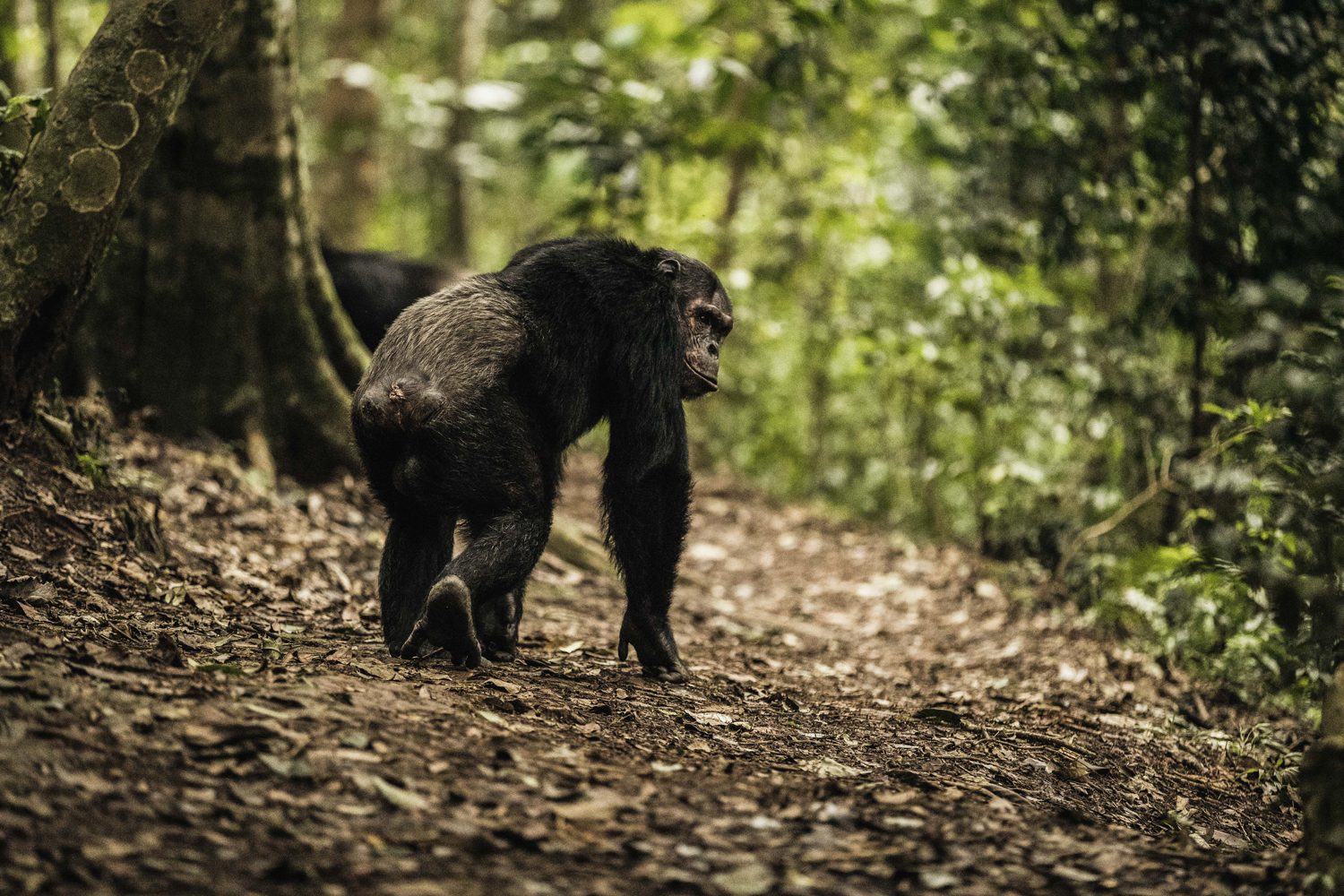
The chimpanzee, of course, is the star of the show, the most famous primate in Nyungwe, and the species most visitors have crossed the world to see. Nyungwe’s chimpanzees live in fission-fusion communities, splitting into small parties that reunite, split again and travel widely in search of fruiting trees. They are also tool users: stems are stripped and poked into termite mounds, and leaves are chewed into sponges for drinking water.
Meanwhile, tracking the chimpanzees of Nyungwe is a morning expedition led by expert guides, and the one-hour encounter is governed by strict rules that protect both the animals and the experience. The habituated communities around Uwinka, Gisakura and Cyamudongo are your window into their world, and our 2-day Nyungwe package is the easiest way to fit the trek into a short itinerary.
The chimpanzees also teach visitors something humbling about the forest. A party may travel several kilometres in a single morning, and the guides’ ability to anticipate its route, based on the previous evening’s calls and the condition of the fruit trees, is a skill honed over years of daily tracking. Even on the rare day when the chimps lead you on a long chase, you are moving through scenery so beautiful that the pursuit is its own reward.
If the chimpanzee is the park’s intelligence, the Ruwenzori colobus is its spectacle, and for many visitors it is the most unforgettable sight among the primates of Nyungwe. These striking monkeys are jet black with flowing white mantles and long tails, and they are leaf-eaters, spending most of their lives in the canopy where their complicated stomachs digest foliage that other monkeys cannot touch.
What makes Nyungwe exceptional, however, is the size of its colobus troops. Troops of up to four hundred individuals have been recorded here, among the largest groups of colobus monkeys ever documented anywhere in Africa. When a troop that size begins to move, leaping from tree to tree with their white mantles flashing, the forest itself seems to come alive. You can read more about this extraordinary experience in our guide to the colobus monkey trek.
Colobus troops are noisy neighbours. They produce a rolling, resonant call that sounds almost like thunder running through the trees, and a large troop on the move snaps branches, showers leaves and draws every eye upward. Seeing the white mantles of a hundred monkeys streaming across a single canopy is the kind of sight that makes first-time visitors laugh out loud with pure delight.

L’Hoest’s monkeys are the quiet souls among the primates of Nyungwe. They are large, dark-furred guenons with a neat white bib, and unlike most forest monkeys they spend much of their time near the ground, moving through the understorey in small troops of a dozen or so individuals. They are shy and wary, which makes every sighting feel like a small triumph.
Your best chances are along the forest trails near Gisakura and the tea estate edges, usually in the early morning or late afternoon. When you do see them, watch for the adults’ deliberate, cautious progress and the way juveniles are kept close; it is the closest Nyungwe gets to a glimpse of monkey family life.
There is a particular pleasure to watching L’Hoest’s monkeys at the forest’s edge. Because they live so close to the ground, they are the monkeys you are most likely to meet by accident, and encounters with them feel less like tourism and more like sharing a morning with the woods. Watch one scratch itself, yawn or scold a juvenile, and you will recognise gestures that would be entirely at home in your own garden.
Even when you do not see them, the signs of their presence are nonetheless everywhere: freshly stripped leaves at forest level, a glimpse of movement in the ferns, and that particular stillness that means a troop has just melted away into the undergrowth. Finding L’Hoest’s monkeys is an exercise in listening, and the park’s guides, who have spent years in these valleys, are masters of it.
High above the L’Hoest’s monkeys, the canopy primates of Nyungwe include the blue monkeys and grey-cheeked mangabeys. Blue monkeys are grey-blue in colour despite their name, and they are often the first primates a visitor sees, moving purposefully through the trees with their long tails arched. They regularly associate with other species, sharing fruiting trees in loose mixed-species alliances.
The grey-cheeked mangabey, in turn, is the forest’s loudest resident: its deep, resonant whoop-gobble calls carry across whole valleys, and hearing one at dawn is one of the great sound experiences of Nyungwe. Watch a mixed party of blue monkeys and mangabeys feeding together and you are watching one of the most sophisticated animal networks in Africa.
Mixed-species associations are one of the most fascinating habits in Nyungwe’s forests. Blue monkeys, mangabeys and red-tailed monkeys will travel and feed together for days at a time, each species watching for dangers that the others might miss. For the visitor this is a gift: find one species, and you will often find several, moving through the trees like a single many-headed creature.
For patient visitors, the rarer primates of Nyungwe are a badge of honour, and the park also reveals its shy species. The owl-faced monkey, with its pale face framed by dark fur, is a specialist of the deep forest and a species few travellers ever see. Red-tailed monkeys add flashes of colour to the lower canopy, while vervet monkeys patrol the forest edges and the gardens around the tea estates.
Ultimately, seeing the shy species is a matter of time, silence and the right guide. Dawn is the best hour, when the forest is waking and the monkeys are moving to their first feeding trees, and a full morning on the trails will almost always outperform a quick visit.
The owl-faced monkey deserves special mention because it is so rarely photographed. Named for the pale, owl-like pattern of its face, it is a forest interior specialist, and your guide will know the quiet corners where it is sometimes found. Spotting one is a badge of honour among Nyungwe regulars, and it is proof that patience in this forest is always rewarded.
Vervet monkeys, by contrast, occupy a different niche entirely: grey, cheeky and utterly at ease with people, they patrol the tea estates and picnic clearings, and their antics are a constant source of amusement. Seeing the sociable vervets at the forest’s edge and the deeply wild species of the interior on the same day is a reminder of how broad Nyungwe’s habitats really are.
Even the most devoted primate fan will be distracted by what else Nyungwe offers. The park holds more than three hundred bird species, including the great blue turaco, whose electric-blue and crimson plumage is one of the finest sights in African ornithology, and the Rwenzori turaco, along with a long list of Albertine Rift endemics found nowhere else on Earth.
Add more than a hundred species of orchids, dazzling butterflies, and the famous canopy walkway suspended high above the valley floor, and you have a destination that rewards far more than a single morning. It is possible to spend days here and never repeat a trail.
In addition, the canopy walkway deserves more than a passing mention. Suspended high above the forest floor, it puts you at the level of the tree crowns, where the light is different, the birds are closer, and the monkeys sometimes seem as surprised to see you as you are to see them. It is the perfect complement to a ground-level trek and a favourite of photographers, and it is included in most of our Nyungwe itineraries.

The best way to experience the primates of Nyungwe is with a guide who knows them intimately, and the practical way to do that is with a structured itinerary. and the practical way to do that is with a structured itinerary. Our 2-day Nyungwe package pairs chimpanzee tracking with a colobus and canopy walkway morning, giving you four of the park’s headline species in two days. For travellers who want the complete picture, our 10-day Rwanda primate itinerary combines Nyungwe with the mountain gorillas of Volcanoes National Park and the golden monkeys of the Virungas, covered in our golden monkey guide.
Whichever option you choose, travel with a light footprint: stay quiet, follow your guide’s instructions and let the monkeys set the pace. Nyungwe rewards patience with sightings no photograph can prepare you for. Contact our team to plan your primate safari, and discover why this corner of Rwanda is the monkey capital of Africa.
Most visitors who try the park for a day end up staying two. The first morning brings the chimpanzees, the second dawns on the colobus, and somewhere along the way the canopy walkway, the birding and the sheer stillness of the forest take hold. Nyungwe is a place that resists hurry, and the travellers who surrender to its pace are the ones who come home with the best stories.
A final thought on visiting responsibly. Nyungwe’s primates are wild animals, and the rules that govern your trek, the distance, the quiet, the ban on feeding, exist to keep them that way. Follow your guide’s instructions, keep noise to a minimum, and the forest will welcome you back again and again. Visit with respect, and Rwanda’s monkey capital will remain a wonder for generations to come.