Gorilla Permits Rwanda — 6 Years of Trusted Service
Nyungwe National Park rises out of the far south-western corner of Rwanda like a vast green cathedral. Its layered canopy wrapped in mist for much of the year. This is one of Africa’s oldest rainforests. A surviving remnant of the forests that once covered the Albertine Rift. It shelters the best chimpanzee tracking Nyungwe has to offer. A population of wild chimpanzees. For travellers who have dreamed of meeting our closest living relatives in the wild. A chimpanzee trek in Nyungwe is one of the most profound wildlife experiences the continent has to offer.
Yet for all its wonder, chimpanzee tracking in Rwanda remains a quieter. More intimate affair than the country’s famous gorilla treks. Permits cost a fraction of the price. Visitor numbers are strictly limited. The forest sees a fraction of the crowds. In this complete chimpanzee tracking Nyungwe guide, we walk you through everything you need to know: the park itself, the habituated chimpanzee groups, what a tracking morning actually feels like, how permits work, when to visit and how to book with total confidence.
Chimpanzee tracking is the sort of experience that sits on the calendar for months and lives in the memory for decades. It is also an experience that rewards preparation, meaning a reasonable level of fitness, the right clothing and boots, and a willingness to let the forest set the pace. With the right planning, the trek is not the hardest part of a Rwanda holiday. The hardest part is leaving the forest behind.
Nyungwe National Park protects one of the largest and best-preserved blocks of montane rainforest in East and Central Africa. Covering roughly a thousand square kilometres of highland forest on the Albertine Rift. Scientists describe it as a refugium. A place where ancient forests survived the great climatic shifts that swept the continent. The trees and the creatures that depend on them have been evolving together here for millions of years. Walk into the forest and you are walking through deep time.
That evolutionary depth shows in the numbers. The park is home to around thirteen species of primates. More than three hundred species of birds. Some of the highest concentrations of endemic orchids and butterflies in Africa. Many of Nyungwe’s birds, such as the Albertine owlet and the Rwenzori turaco, are found nowhere else on Earth. The forest’s health matters far beyond its borders. The rain that falls here feeds both the Congo and the Nile river systems.
For many visitors, chimpanzee tracking in Nyungwe is the quieter half of a Rwanda primate safari. It is also. Crucially. A working forest. The famous canopy walkway. Suspended high above the valley floor. Draws visitors who never expected to care about monkeys and leaves them converted. The chimpanzees give the park its greatest tourism magnet. Understanding Nyungwe means understanding why protecting an old rainforest matters.
The story of Nyungwe is also a story of protection. The forest has been formally guarded for more than a century, first as a colonial forest reserve and later as a national park. That long protection has allowed the trees and their wildlife to survive in a region where the surrounding hillsides have long been converted to farmland and tea plantations. Walk the boundary trails and you will see the tea estates creeping to the forest’s edge. A reminder of how precious this unfarmed wilderness has become.
Meeting them is the whole point of chimpanzee tracking in Nyungwe. Chimpanzees share more than ninety-eight per cent of their DNA with humans. Watching them for even a few minutes makes that kinship impossible to ignore. They plan, they play, they grieve, they argue and they reconcile. Nyungwe’s chimpanzees live in fluid fission-fusion societies. Splitting into small parties during the day and gathering in larger numbers at night. Is one reason every trek feels different from the last.
Roughly several hundred chimpanzees are thought to live in Nyungwe. Making the park one of the most important strongholds for the eastern chimpanzee in the Albertine Rift. These are wild animals in every sense. Feeding on fruit. Leaves and insects. Using stems to fish for termites. Occasionally hunting small monkeys in coordinated group raids that take place at astonishing speed.
Chimpanzees spend more than half of their waking hours feeding. Most of the rest grooming. Resting and moving between feeding sites. Watching a community go about its day is like watching a drama unfold in slow motion. Alliances form and break. Juveniles test boundaries. Mothers discipline their offspring. The hooting of one party echoes across the valley as another answers. It is no wonder researchers have devoted entire lifetimes to following these families.
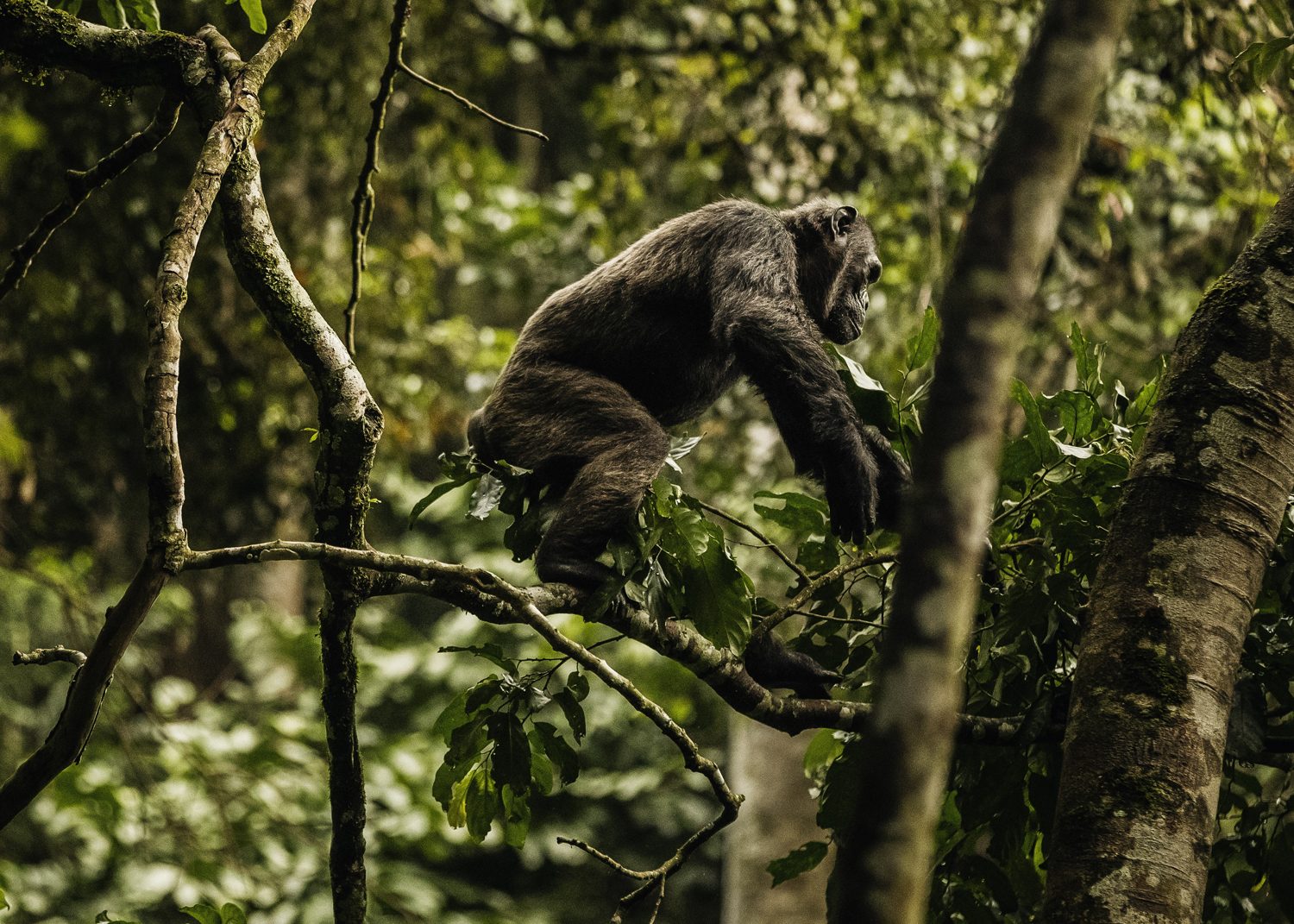
The answer to where to go chimpanzee tracking in Nyungwe has two parts. The first is the forest around Uwinka and Gisakura. The traditional heart of the park. Researchers have followed the chimpanzees for decades and where the terrain offers classic Nyungwe scenery. Dripping canopies. Mossy ridges and valleys full of hooting chimpanzees.
The second is Cyamudongo, a remnant forest patch lying about an hour’s drive from Gisakura. Close to the border with Burundi. This small. Isolated block supports its own habituated community of chimpanzees. Its remoteness means you may have the encounter almost entirely to yourself. Because the habituated groups are small, generally numbering a few dozen individuals each, the time you spend with them feels personal in a way that few wildlife experiences can match.
Habituation in Nyungwe has been a patient, decades-long process. Researchers and trackers have spent years following the same communities day after day. Letting the chimpanzees grow accustomed to human presence until a small. Respectful group of visitors can share the forest with them. The result is a controlled intimacy. The chimpanzees accept your presence. They remain utterly wild. Is exactly as it should be.
Expect an early start on any chimpanzee tracking morning in Nyungwe. Chimpanzees are most active in the first hours of daylight. Most treks begin with a pre-dawn wake-up. A quick breakfast. A drive to the trailhead while the sky is still dark. There you meet your guides. Park rangers and fellow trekkers. Attend a short briefing on the rules and the plan. Then step into the forest.
Tracking is part science, part art. Your guides follow the previous evening’s calls and feeding signs. Listen for the sound of breaking branches. Sometimes receive updates from trackers already in the field. The walking can be steep. Muddy and wonderfully quiet. First contact often arrives with heart-stopping suddenness. A loud hoot. A shower of leaves. Then dark shapes moving through the canopy above you.
Every part of the morning is choreographed for the welfare of the animals. The briefing covers the essential rules. Keep quiet. Stay together. Never chase a chimpanzee. Maintain a respectful distance at all times. Your guides also know the trail network in detail. Including the ridge lines and shortcuts that make it possible to follow a fast-moving party without exhausting anyone. They carry the radios that keep them in touch with trackers elsewhere in the forest.
When you reach the chimpanzees, the magic begins. That hour is the reason most people book chimpanzee tracking in Nyungwe at all. The rules are simple and strictly enforced. Keep your voice low. Follow your guide’s signals. Never surround the animals and never use flash photography. You will spend approximately one hour in their company. This limit keeps the encounter calm and protects the chimpanzees from stress.
That hour passes quickly. You might watch a mother groom her infant, or juveniles wrestle noisily, or a big male feeding in the canopy, occasionally glancing at you with unsettling intelligence. Every visit is different, and that is precisely the appeal. The chimpanzees decide what you will witness; your job is simply to be present for it.
After the hour ends, the group withdraws slowly and quietly. Leaving the chimpanzees to their day. The walk back to the trailhead is usually more relaxed. Full of excited conversation and the first excited sorting of photographs. It often produces sightings of other forest life. L’Hoest’s monkeys in the undergrowth. A great blue turaco crashing across a clearing. Or the far-off shriek of a grey-cheeked mangabey high above.
Permits for chimpanzee tracking in Nyungwe are among the best-value wildlife experiences in Africa. A chimpanzee permit for Nyungwe typically costs between US$90 and US$150 per person. A tiny fraction of the price of a gorilla permit and one of the best-value wildlife experiences in Africa. Permits must be arranged in advance through the official system run by the Rwanda Development Board, and they are issued for small trekking groups of no more than a handful of visitors. Availability is limited even when the park is otherwise quiet.
The simplest way to handle everything is to book through a tour operator. We take care of permits, transport, park entry, guides and accommodation. Your only job is to enjoy the forest. Our 2-day Nyungwe package covers the classic version of this experience end to end. You can compare costs with a Volcanoes National Park gorilla trek on our gorilla permit page before you decide.
You will also want to budget for the park entry fee and. If you are not travelling on a package. For transport. Guiding and a porter. Booked as part of a safari. These details are included and managed for you. Is why so many travellers prefer a structured package. The only decision you will face on the day is how many photographs to take.
Nyungwe is one of the wettest parts of Rwanda. Rain can fall in any month. The forest conditions each season are summarised by Rwanda’s official tourism board. The two drier windows, roughly June to September and December to February. Offer the most comfortable conditions and the best chances of clear trails. The wetter months bring quieter forests. Lush green light and lower prices. Chimpanzee tracking in Nyungwe runs year-round. The guides know the forest well enough to find the chimps in any weather.
For most travellers the long dry season is the easiest choice. Those who can travel in the green seasons are rewarded with fewer visitors and some of the most dramatic. Misty rainforest scenery in Africa. Whatever month you choose. Waterproof layers and grippy boots should be non-negotiable items in your bag.
Temperatures in Nyungwe are mild throughout the year. Thanks to the altitude. Daytime highs rarely rising far beyond the low twenties and nights that can feel distinctly cold. The forest floor is often damp even on dry-season mornings. The light filtering through the canopy is soft and beautiful. Particularly in the first hours after sunrise when the chimpanzees are at their most active.
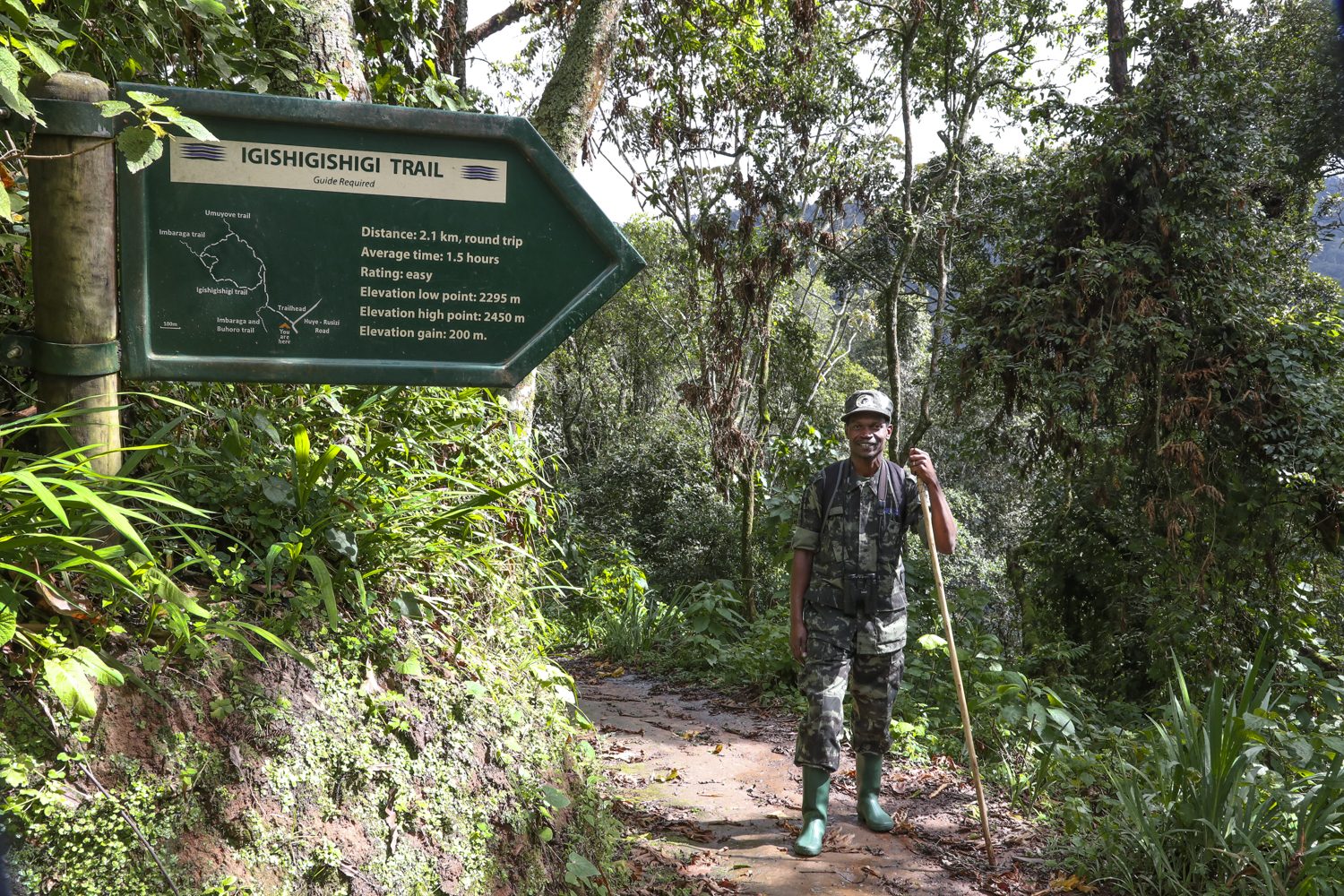
Pack for chimpanzee tracking in Nyungwe as you would for any rainforest trek. Packing well makes the difference between a memorable trek and a soggy one. Your checklist should include:
Trekking poles, binoculars and a dry bag for electronics are all worth considering. Leave the perfume and bright colours at the lodge. Dress in muted tones. Remember that a porter hired at the trailhead is a direct boost to a local family’s income.
Finally, remember that Nyungwe sits at altitude, so the sun is fierce even on cool days and dehydration is a real risk on a long trek. Carry more water than you think you need. Eat a proper breakfast. Pace yourself on the hills. The guides have walked these trails for years. Tell them honestly how you feel. They will match the pace to you rather than the other way around.
The great gift of Nyungwe is that it sits within a country small enough for you to do both of Africa’s signature primate encounters in a single trip. Many travellers start with a gorilla trek in the Virunga volcanoes and finish with the chimpanzees of Nyungwe. Or run the trip in reverse. Our 5-day gorilla and chimpanzee safari and our 10-day Rwanda primate itinerary do exactly this, and both are proven crowd favourites.
Whichever order you choose, the contrast is unforgettable. The hulking presence of a silverback one week. The lightning intelligence of a chimpanzee the next. If you are ready to begin planning, contact our team and we will build the itinerary around your dates, fitness and budget. The chimpanzees of Nyungwe are waiting.
Your first chimpanzee trek in Nyungwe will not be your last. Every visitor we have guided into this forest has come out changed. Carrying new respect for the intelligence that shares our planet. Whether you come for a day or for a week. The forest will give you exactly what you give it. Attention. Patience and time. In return it will hand you a morning you will talk about for the rest of your life.