Chimpanzees or Gorillas? Choosing Your Primate Trek in Rwanda

Chimpanzees vs gorillas: Rwanda offers travellers a decision that very few places on Earth can make – whether to spend your wildlife days on mountain gorillas, on chimpanzees, or on both. The gorillas of Volcanoes National Park have long been the country’s headline act, and deservedly so, but the chimpanzees of Nyungwe National Park have become a serious rival in recent years, and more and more visitors want to see both.

The chimpanzees vs gorillas comparison starts here: the two treks share a magical quality, yet they differ in almost every practical detail: cost, terrain, length, difficulty and the character of the encounter itself. This guide sets out the differences honestly, so you can choose the trek, or the combination, that fits your budget, fitness and travel style.

A note on phrasing before we begin: when we say gorillas in this guide, we mean the mountain gorillas of Volcanoes National Park, the only place in Rwanda you can see them. When we say chimpanzees, we mean the eastern chimpanzees of Nyungwe National Park, an entirely different corner of the country with a completely different forest. The two treks are about as different as two wildlife experiences can be, which is exactly why comparing them is worth your time.

Chimpanzees vs Gorillas: The Two Treks at a Glance

Before we dive into detail, here is the quick comparison every traveller asks for:

  • Species and setting: mountain gorillas in the volcanic Virunga massif; chimpanzees in the ancient rainforests of Nyungwe
  • Permit price: around US$1,500 per person for gorillas; roughly US$90 to US$150 for chimpanzees
  • Time with the animals: one hour with a gorilla family; about an hour with a chimpanzee party
  • Group size: up to eight visitors per gorilla family; similarly small groups for chimpanzees
  • Terrain: farmed foothills rising into steep volcanic slopes; dense, muddy rainforest trails
  • Best for: the once-in-a-lifetime spectacle; the intimate and energetic wildlife encounter

Neither experience is better in any absolute sense. They are simply different, and the trick is to match the trek to your priorities.

If you are weighing chimpanzees vs gorillas, keep two numbers in mind. The first is one thousand five hundred, roughly the dollar price of a gorilla permit. The second is one hundred and fifty, roughly the dollar price of a chimpanzee permit at the top of its range. Everything else, from difficulty to scenery to the character of the animals, flows from that single difference in cost.

The Gorilla Side of Chimpanzees vs Gorillas

A gorilla trek begins in the Virunga highlands of northern Rwanda, where Volcanoes National Park protects a population of mountain gorillas split among habituated family groups. Each family, typically ten to thirty individuals and presided over by a dominant silverback, is followed daily by trackers, and your group of eight will be assigned one family for the morning.

The hike takes you up through a mosaic of farmland, bamboo forest and dense cloud forest. Altitudes climb well beyond two and a half thousand metres, so the air is thin and the paths are steep, but porters are plentiful and the climb usually takes a few hours at most. Then the trackers step aside, the foliage parts, and you meet the gorillas.
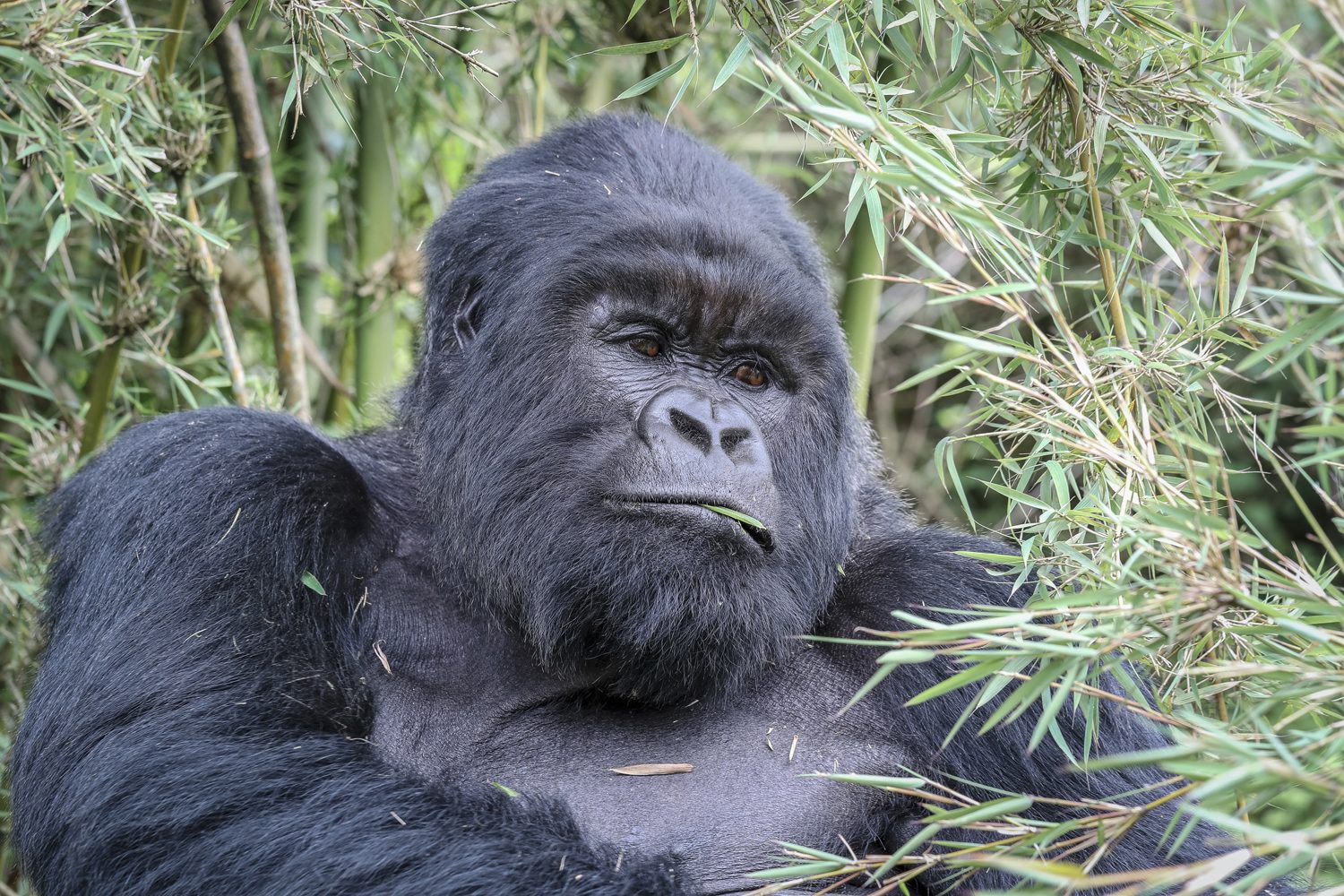
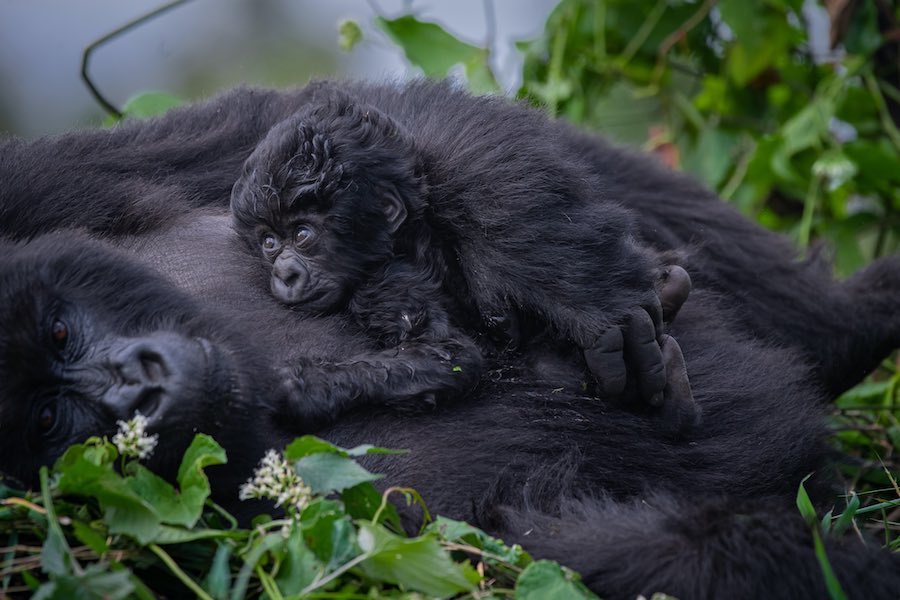
Silverback mountain gorilla resting in the bamboo forest, half of the chimpanzees vs gorillas comparison

What follows is the closest thing wildlife tourism has to theatre: silverbacks that weigh more than ten times your average traveller, infants tumbling through the undergrowth, and females grooming each other within arm’s reach. The gorillas largely ignore you, which is precisely the point. You spend one hour among them, and for most visitors it is the single greatest hour of their African journey.

Part of what makes the gorilla encounter so moving is knowing how close it came to never happening. Mountain gorillas were nearly extinct half a century ago, hunted and displaced as farming advanced up the volcano slopes, and their recovery is one of the great conservation stories of the modern era. Every permit you buy funds rangers, veterinary work and community programmes, which means your hour with a silverback is also a direct investment in the species’ future.

It is also a question of atmosphere. Visitors who complete the gorilla trek often describe a quiet kind of awe, the wonder that comes from standing beside something ancient, powerful and irreplaceable. The silverback does not perform for you; he simply sits, feeding and watching, and your visit becomes a form of respect. For many travellers, that hour in the bamboo forest is the truest moment of their entire African journey.

The Chimpanzee Trekking Experience

Chimpanzee tracking in Nyungwe is a different animal altogether. The day begins before dawn, with a drive to the trailhead and a briefing by torchlight, and the trek itself is a true pursuit: your guides follow calls, tracks and feeding signs through one of Africa’s oldest rainforests until the chimpanzees are found. Once located, you spend about an hour with the party, watching a far more fast-moving, vocal and unpredictable set of behaviours than any gorilla family will show you.

Where gorilla viewing is contemplative, chimpanzee viewing is electric. Chimps travel, feed, groom and squabble constantly; they make tools, fish for termites, and react to each other and to you with transparent emotion. Because the habituated parties in Nyungwe are small, the encounter has an intimacy that the gorillas, for all their drama, rarely deliver.

The setting deserves its own paragraph. Nyungwe is one of the oldest rainforests in Africa, a vast green basin of ancient trees, orchids and more than three hundred bird species, crossed by a famous canopy walkway suspended above the forest floor. Where the gorilla trek is an encounter with a single great animal, the chimpanzee trek is an encounter with an entire ecosystem, and the forest itself steals scenes throughout the morning.
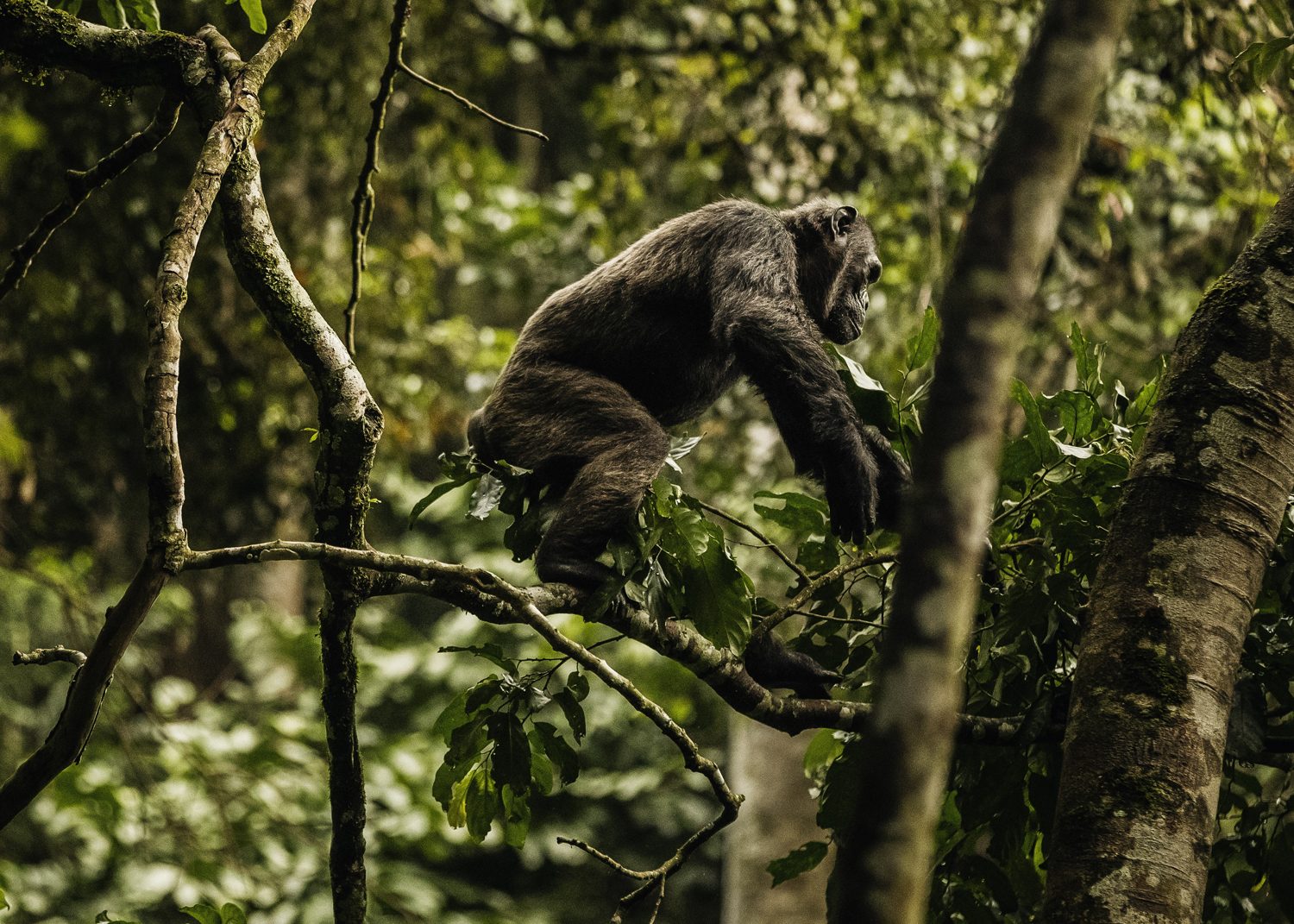
Chimpanzee watching visitors from the rainforest canopy in Nyungwe

Cost and Permit Realities: Chimpanzees vs Gorillas

The financial gap is enormous and, for many travellers, decisive. A gorilla permit from the Rwanda Development Board costs around US$1,500 per person, making it one of the most expensive single wildlife experiences in Africa, while a Nyungwe chimpanzee permit typically runs from US$90 to US$150. For the price of one gorilla permit, you could fund a week of chimpanzee tracking, park entry and lodge nights.

Demand differs too. Gorilla permits for the busiest months sell out months in advance and are allocated to a fixed daily quota, whereas chimpanzee permits are easier to secure at shorter notice. Whichever you choose, book through a trusted operator; the current permit rates for both species are published on our gorilla permit page, and we handle the paperwork for you.

If your budget decides the chimpanzees vs gorillas question, a sensible compromise is to take the gorilla trek and spend the savings on a fuller Nyungwe stay, where the chimpanzees, colobus monkeys and canopy walkway will keep you busy for days.

There is also a softer economic argument for the chimpanzee trek. Because a gorilla permit absorbs so much of a safari budget, many travellers end their trip the day after the gorillas and miss the rest of the country. A cheaper chimp permit frees up money for Nyungwe’s canopy walkway, a boat trip on Lake Kivu or a dedicated birding morning, which is how many of our guests end up seeing more of Rwanda than they ever planned.

Physical Demands: Chimpanzees vs Gorillas Compared

There is no simple answer, because the difficulty is of different kinds. A gorilla trek is a short, steep climb into high altitude, where the thin air and volcanic slopes test your lungs; a chimpanzee trek is longer and more relentless, with several hours of muddy, slippery forest walking at lower but still meaningful altitude.

Both treks are achievable for anyone with a reasonable level of fitness, and both can be eased with the help of porters. Tell your operator honestly about your mobility and stamina, and we will match you with the right trek and pace. Nobody should skip these experiences for fear of the climb.

One further difference is worth naming: the gorilla trek has a definite shape. You reach your assigned family, spend your hour, and descend, so the day is predictable from the briefing onward. The chimpanzee trek does not offer that certainty, because the chimpanzees keep moving, and your guides may lead you for hours over steep terrain before contact is made. If you are the kind of traveller who enjoys a pursuit, that unpredictability is a feature rather than a flaw.

Landscapes: Volcanoes Versus Nyungwe

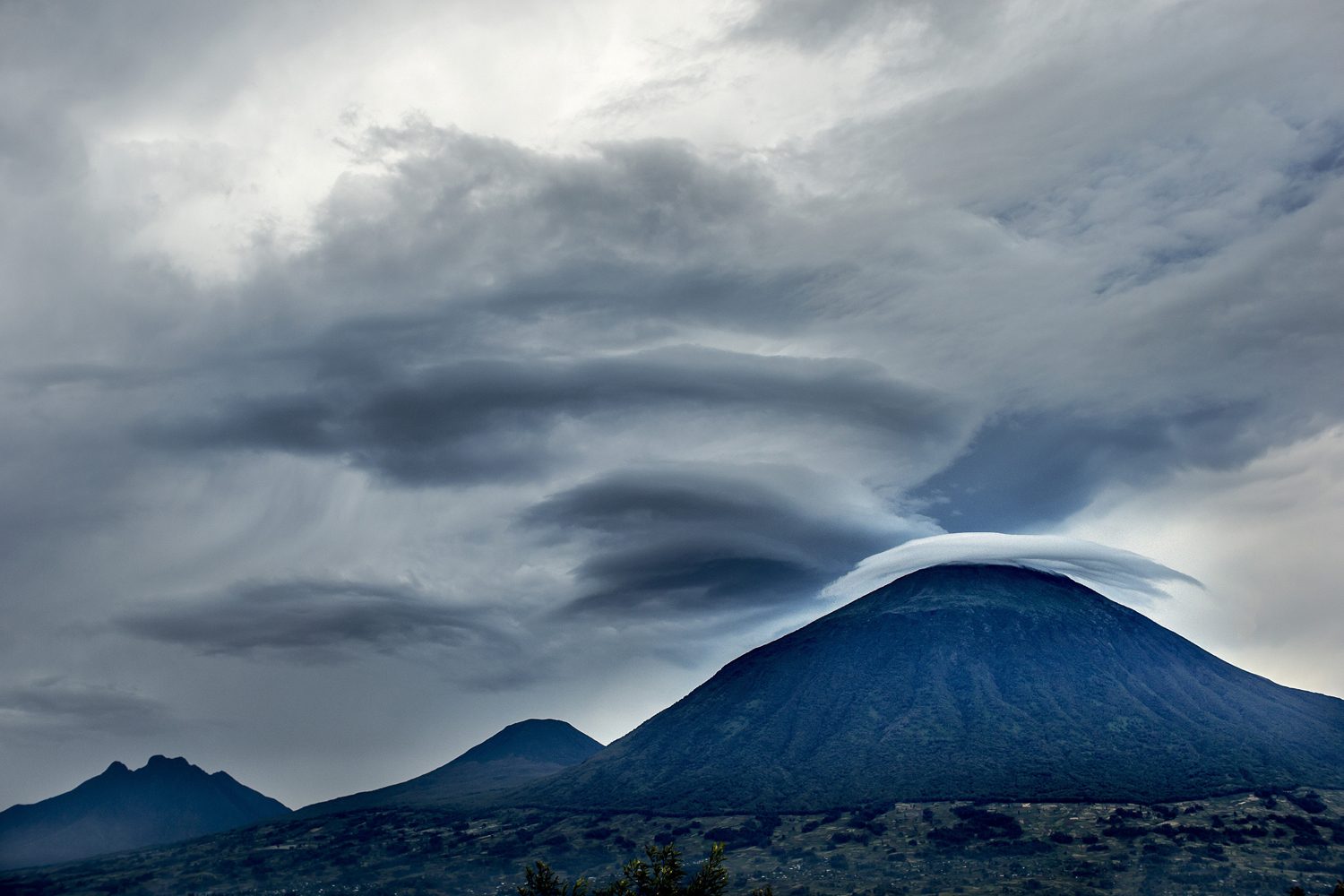
The settings are as different as the animals. Volcanoes National Park is dramatic, open and mountainous, with bamboo stands, giant lobelias and the jagged silhouettes of the Virunga chain visible for much of the trek. The views are some of the finest in East Africa, and on clear days you can look across the border into the Democratic Republic of Congo.

Nyungwe is enclosed, ancient and dripping: one of the oldest rainforests in Africa, full of ferns, orchids and birdsong, crowned by the famous canopy walkway suspended high above the forest floor. Where the volcanoes reward you with panorama, Nyungwe rewards you with immersion.

Both parks offer more than their headline animal. In Volcanoes you can add the golden monkeys of the Virungas, a separate permit and a walk through sprawling bamboo forest that many visitors rate nearly as highly as the gorillas themselves, and our golden monkey guide covers that trek in detail. In Nyungwe the extras are the colobus monkeys, the birding and the canopy walkway, which means a single Nyungwe visit can feel like three different excursions.

Crowds, Booking and Time

The gorilla trek is the most sought-after wildlife experience in Rwanda, and it shows. In peak months every permit is taken, visitor groups must keep strict distance from the families, and your hour is fixed by regulation. Chimpanzee tracking runs in smaller groups to quieter corners of a much larger park, so the overall experience feels more exclusive and more spontaneous.

Time is another factor. A gorilla trek fits neatly into a 3-day Rwanda gorilla trekking safari from Kigali, while a Nyungwe chimpanzee trek is best paired with an overnight in the park, as our 2-day Nyungwe package demonstrates. If you are short on days, the gorillas are the quicker win; if you have time to spare, the forest rewards the slower traveller.

Booking advice applies equally to both treks: use a licensed operator, confirm the exact permit date before you pay, and leave room in your itinerary for the small delays that mountain roads and rainforest weather can introduce. A professional operator holds your permits, coordinates the briefings and handles the paperwork, so that your only task on the day is to arrive at the trailhead with your boots laced.

Chimpanzees vs Gorillas: Which Should You Choose?

If this is your first visit to Africa and you want the continent’s most iconic moment, choose the gorillas. Nothing photographs, or lingers, quite like a silverback. If you are a wildlife enthusiast on a budget, choose the chimpanzees: you will see more behaviour, more movement and more of the forest for a fraction of the price.

Families should note that both treks carry minimum age rules, usually fifteen years, so check current regulations when you book. And if you cannot decide, you do not have to: the majority of our guests now choose to see both animals on one itinerary, and most describe the pairing as the defining experience of their Rwanda holiday.

Photographers face a genuine dilemma, because the two animals demand opposite techniques. Gorillas sit still, which rewards slow, careful composition; chimpanzees never stop moving, which rewards fast autofocus, a long lens and the courage to shoot through branches. Bring the longest telephoto you can carry, protect it from the rain, and you will come home with two very different portfolios.

There is no wrong answer in the chimpanzees vs gorillas choice, and no shame in letting your wallet decide for you. A traveller who sees chimpanzees in Nyungwe and returns a year later for the gorillas will enjoy two completely different holidays, while a traveller who sees both in a single week enjoys the greatest wildlife double-header Rwanda has to offer. Choose the animal that makes your heart beat faster, and let your operator handle everything else.

Do Both: The Ultimate Primate Safari

Rwanda is small, and its two great primate experiences sit at opposite ends of a drive that takes about a day. A combined itinerary lets you compare a silverback’s stillness with a chimpanzee’s cunning, and you will leave with two completely different stories to tell. Our 5-day gorilla and chimpanzee safari and our 10-day Rwanda primate itinerary are designed for exactly this purpose.

The permits, the park logistics and the transport all become our problem, not yours. If you would like help deciding, or simply to lock in your dates, contact our team and we will put together the perfect primate adventure for you.

Whichever you choose, remember that both treks are privileges that millions of travellers will never experience. Whether you spend your hour with a silverback or your morning chasing chimpanzees through an ancient forest, you will return with stories that make every other holiday feel like a warm-up. The only wrong answer is never going at all.
Rwanda vs Uganda Gorilla Trekking: Which Is Better in 2026?

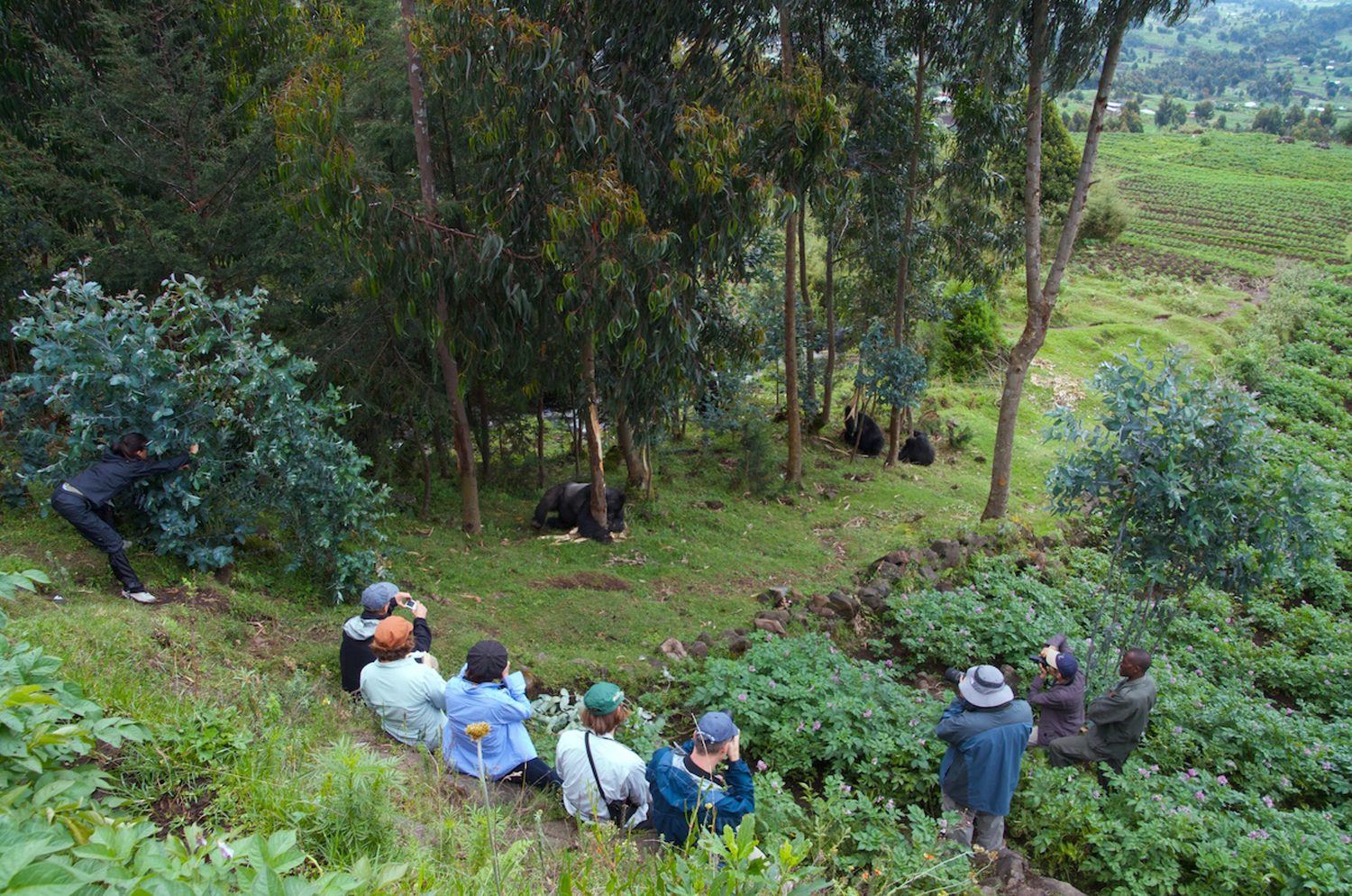
Rwanda vs Uganda gorilla trekking sparks more debate than almost any other question in African travel. Both countries deliver the same extraordinary core experience: tracking wild mountain gorillas through misty forests. You spend a life-changing hour in their presence. They differ meaningfully in cost, travel logistics, terrain, accommodation, and the shape of the surrounding trip.

Rwanda vs Uganda gorilla trekking: trekkers meeting a mountain gorilla family in Volcanoes National Park

In 2026, Rwanda’s permit costs US$1,500 and Uganda’s roughly US$800. The price gap is bigger than ever. Yet Rwanda remains the top choice for many travellers, including repeat visitors. This guide breaks down every difference honestly, so you can choose the country that genuinely fits your budget, your fitness, and your travel style.

Both destinations rest on the same conservation miracle: tourism money brought the gorillas back from the edge of extinction. Whichever you choose, your permit money funds rangers, anti-poaching patrols, and community programmes. You cannot make a wrong choice morally, only a wrong choice for your own itinerary. With that reassurance, let’s get into the details that matter.

Gorilla Permit Costs: Rwanda vs Uganda

The permit is the single biggest cost and the biggest difference. The Rwanda Development Board sets the official gorilla permit at US$1,500 per person, year-round, for Volcanoes National Park. The Uganda Wildlife Authority charges US$800 for Bwindi Impenetrable National Park, and the same rate applies to Mgahinga Gorilla National Park. For a family of four, that is a US$2,800 difference before you have booked a single hotel room.

However, the headline gap narrows once you add everything else in. Uganda’s main gorilla parks sit 8-10 hours by road from Entebbe international airport, which means extra nights of accommodation, a larger safari vehicle, and more travel time. Rwanda’s Volcanoes National Park is just 2-3 hours from Kigali’s international airport – frequently the difference of US$500-1,000 in ground costs, not to mention two full days of holiday time. When the full package is tallied, Rwanda’s premium shrinks substantially. For current pricing on the Rwandan side, check our gorilla permit costs page.

What the permit includes is nearly identical in both countries: a briefing, a guided trek with armed rangers, and exactly one hour in the presence of a habituated gorilla family. Uganda adds value in one respect. With a cheaper permit and a longer trek, the cost per minute of rainforest adventure is significantly lower for hikers. Rwanda counters with certainty: its permits are allocated with surgical precision, and the shorter trek window means your hour is almost never compromised by a trail that ate the day.

In the Rwanda vs Uganda gorilla debate, the permit is only the opening move. The full Rwanda vs Uganda gorilla comparison must add flights, lodges, and transfers. For a short trip, the numbers usually favour Rwanda. For a long overland tour, Uganda often comes out ahead.

Getting There: Rwanda vs Uganda Travel Time and Logistics

This is where the two countries differ most dramatically. Flying into Kigali, you can be in your Musanze lodge within three hours of landing. The volcanoes sit on the horizon as you arrive, and a trek is often possible the next morning. Uganda requires either an internal flight from Entebbe to Kihihi or Kisoro, or a long road transfer. Expect 8-10 hours on winding mountain roads to Bwindi, frequently a full day of driving.

Rwanda’s roads are famously well-maintained, and the drive to the park itself is a scenic highlight through terraced hillsides and banana groves. In practical terms, Rwanda fits a gorilla trek into a long weekend or a short mid-week holiday; Uganda realistically needs five or more days, and that extra time costs money. For time-poor travellers, this difference alone usually decides the question.

It is also worth weighing the entry experience. Kigali’s airport is modern, efficient, and visa-friendly. Rwanda’s credit-card and mobile-money infrastructure is among the best in Africa, so your whole trip can run paperless. Uganda’s international entry at Entebbe is straightforward too, but connecting onward adds a layer of complexity. Your safari vehicle needs to be in the right place, and any flight delay ripples through an 8-10 hour transfer. Travellers doing a three-night gorilla stopover overwhelmingly choose Rwanda. Travellers on a three-week East African overland circuit naturally end up in Uganda anyway.

Gorilla Trekking Experience: Rwanda vs Uganda Terrain and Difficulty

Both countries share the same habituated mountain gorilla population and the same one-hour viewing rule, but the trekking is noticeably different. In Rwanda’s Volcanoes National Park, the terrain is generally more open. Bamboo and Hagenia forest cover volcanic slopes, and the trails are steep but mostly passable. You also get a better chance of a short, easy trek. The park runs a smooth, well-organised daily operation with a briefing, porters, and strict group allocation.

Uganda’s Bwindi, by contrast, is a dense, ancient rainforest of enormous trees and thick undergrowth. Brutally steep ridges make the trek genuinely wilder and more challenging. It can easily take the better part of a day. Many travellers prefer Bwindi precisely for this: the sense of exploration is greater, the forest is more dramatic, and the moment of arrival feels harder won. If you have mobility concerns, are an older traveller, or simply prefer comfort, Rwanda is the gentler choice.

Group sizes and the viewing experience are nearly identical: eight trekkers per family in both countries, one hour of viewing, strict distance rules. The daily routines differ slightly – Rwanda briefs its trekkers at the park headquarters with excellent facilities, while Bwindi’s briefings happen at forest-edge trailheads that feel more like an expedition departure. Porters are available and encouraged in both, and the tipping culture is the same; your porter’s income in either country is a genuine lifeline for the village economies around the parks.

Scenery and Setting: Rwanda vs Uganda

Rwanda’s gorillas live on the flanks of the Virunga Volcanoes. These extinct cones rise to over 4,500 metres. They are often dusted with mist at dawn and visible from your lodge balcony. The setting is cinematic and compact: golden bamboo forests, alpine meadows, and the blue mass of the range. Combined with the Twin Lakes and the town of Musanze, it feels like a highland resort rather than a frontier.

Bwindi’s setting is entirely different – a vast, ancient rainforest draped over steep hills, mysterious and primeval, with rivers and gorges hidden under the canopy. Views are less sweeping (the forest swallows you), but the immersion is total. Travellers who love lush, dramatic wilderness often fall for Bwindi instantly; travellers who want postcard volcano panoramas should pick Rwanda.

Weather and Climate: Rwanda vs Uganda

Rwanda’s Volcanoes National Park sits high on the Virunga Massif. Its climate is crisp and alpine: cool mornings near 10°C and pleasant afternoons around 20-22°C. Rain arrives in short, sharp bursts. The two dry seasons, June to September and December to February, are reliable trekking windows. The park is compact, so forecasts are easy to read and the operation runs on schedule almost every day of the year.

Bwindi is wetter and more temperamental. Its name means impenetrable, and it rains somewhere in the forest on most days, in every season. The upside is that Bwindi’s gorillas tolerate drizzle and trekking runs year-round. The downside is muddier conditions and a higher chance of a long, soggy climb. Travellers who hate wet boots should factor this in. For everyone else, the forest’s lushness is precisely what makes Bwindi magical. In both countries, the dry months are the best months, and the wet months reward you with emptier trails and better prices.

Accommodation: Rwanda vs Uganda Lodging Options

Rwanda has leaned hard into high-end tourism. The lodge scene around Volcanoes National Park is among the finest in Africa. Bisate Lodge, Singita Kwitonda, and One&Only Gorilla’s Nest offer architectural wow factor, world-class dining, and volcano views, at luxury prices. Excellent mid-range options also ring Musanze, so Rwanda wins for travellers who want a premium, polished base.

Uganda offers a wider price spread. At Bwindi you will find luxury lodges too, but also a healthy selection of solid mid-range hotels and genuine budget options, including community camps and backpacker-friendly guesthouses – something Rwanda’s park gateway largely lacks. Budget-conscious trekkers who accept simpler lodgings can stretch their money much further in Uganda, and the gorilla experience itself is identical once the hiking begins.

There is a broader point about the shape of each trip. Rwanda’s model is lodge-and-trek: a short transfer, a comfortable base, the trek, and a smooth return. It suits travellers who want the gorillas as the centrepiece of a polished holiday. Uganda’s model is expedition-and-circuit: rougher roads, longer days, wilder nights, and a trip that feels like an adventure even before the gorillas appear. Neither is better. They are different experiences, and the right one depends on the holiday you have in mind.

Combining Gorillas with the Rest of Your Trip

The surrounding itinerary matters as much as the trek itself. Rwanda is compact. A classic one-to-two-week loop can cover Volcanoes National Park, an Akagera safari, Nyungwe’s rainforest, and Lake Kivu’s beaches, all with short drives between them. Uganda, in contrast, pairs its gorillas with tree-climbing lions in Queen Elizabeth National Park. It also offers chimpanzee tracking in Kibale Forest and the great Murchison Falls. The result is a bigger, wilder circuit that rewards travellers with more time.

Both countries also offer gorilla habituation experiences, where you spend up to four hours with a family during their habituation process – but Rwanda’s is pricier and more exclusive. If you want gorillas plus a classic East African safari circuit with more wildlife variety, Uganda’s parks (often combined with Kenya or Tanzania) are a natural fit. If you want maximum experiences in minimum kilometres, Rwanda wins outright. Our complete Rwanda gorilla trekking guide covers the full Rwandan picture.

Practicalities: Visas, Safety, and Getting Around

Rwanda is arguably the easiest country in Africa to travel in. Citizens of most countries receive a visa on arrival or an e-visa in advance. The roads are excellent, and the police are professional. Violent crime against tourists is virtually unheard of, and the country consistently ranks among the safest destinations in Africa. English and French are both widely spoken, US dollars are accepted nearly everywhere, and the currency is easy to manage. There is no land border to cross for a Volcanoes trek, no internal flight to catch, and no malaria medication debate beyond the standard prescription.

Uganda is safe and welcoming too, but it requires more care and planning. Expect an internal flight or a long road transfer to Bwindi, cash for park fees, and a slightly less predictable road network in the wet season. Both countries require a yellow fever certificate on arrival. Both are best visited with a licensed operator who handles permits, transport, and logistics. The marginal difference is that in Rwanda those logistics are simpler, which is why the country suits first-time Africa travellers so well.

Which Should You Choose in 2026?

After weighing everything – cost, time, terrain, accommodation, and itinerary – here is the honest bottom line.

The Rwanda vs Uganda gorilla decision rewards honesty about your travel style. A first safari, a honeymoon, or a long weekend points to Rwanda. A big East African circuit, a tight budget, or a taste for wilderness points to Uganda. Both answers are right when they fit your plan.

  • Choose Rwanda if: you have a higher budget, limited time, prefer easier treks and smooth logistics, or want luxury lodges – the two-to-three-hour transfer from Kigali is transformative for short trips.
  • Choose Uganda if: you are budget-conscious (the US$700 permit saving is real), want a wilder, more challenging trek in dense rainforest, or plan to combine with Queen Elizabeth, Kibale, or a wider East African circuit.
  • Choose Rwanda for: families with older children, first-time Africa travellers, honeymooners, and anyone with mobility or fitness concerns.
  • Choose Uganda for: seasoned adventurers, backpackers, and travellers who value wilderness immersion over comfort.

The best year to visit either country is the year you can actually go. Both deliver the same unforgettable hour with the gorillas, and neither will disappoint. For most people, the Rwanda vs Uganda gorilla choice comes down to volcanoes versus rainforest, and both are spectacular. If the decision still feels tight, check the best time to visit Rwanda and let the season, not the spreadsheet, tip the balance.

Final Thoughts and Next Steps

Whichever country you choose, the planning rules are the same: book the permit first, then build the trip around it. Permits for peak seasons move fast in both countries, and licensed operators can confirm availability instantly. Our 3-day Rwanda gorilla safari is the definitive short trip, with the trek, transfers, and lodging handled end to end. Longer versions add the golden monkeys of the bamboo forest and the lakes of the west.

Our recommendation in 2026: if the budget stretch is comfortable, Rwanda delivers a more refined, easier, and time-efficient experience that justifies its premium for most first-time visitors. If savings matter or you crave a wilder trek, Uganda’s Bwindi will reward you deeply. For official visitor information, start with the Visit Rwanda tourism board. Either way, contact our team with your dates and we will secure your permits and arrange the details – then start training for the hills.

Gorilla Trekking in Rwanda: Complete Guide, Costs, and Essential Tips

Gorilla trekking in Rwanda is widely regarded as one of the greatest wildlife experiences on Earth, and for most travellers it costs more than any other safari activity they will ever book – a chance to sit, breathless, within metres of a family of wild mountain gorillas in the misty rainforest of the Virunga Volcanoes. Fewer than 1,100 mountain gorillas remain on the planet, all of them living in just two small regions, and meeting them face to face is an encounter most travellers describe as genuinely life-changing.

What This Guide Covers

If you are weighing the budget, the short version is that gorilla trekking in Rwanda costs less than most travellers fear once the permit is paid: flights, lodges and transfers are negotiable, and there are real ways to trim the total. This guide sets out what gorilla trekking in Rwanda costs from start to finish, where the money goes, and how to plan a trip that fits your budget without cutting corners that matter. You can cross-check the permit price and park rules at any time on Rwanda’s official tourism board.

This complete guide covers everything you need to know before you go: the true cost, what your permit actually covers, how to book, where to stay, how to reach the park, what to pack, the fitness required, the rules of engagement, and what a typical three-day itinerary looks like. Read it once, and you will arrive in Rwanda fully prepared for the adventure of a lifetime.

Forty years ago, the mountain gorilla was on a path to extinction, its population crushed by poaching, deforestation, and conflict. Today there are just over 1,000 individuals in the wild – which makes this one of the rarest primate encounters on Earth. Every permit sold in Rwanda is part of the machinery that reversed that slide, and knowing that context makes the experience immeasurably richer when a silverback finally steps out of the undergrowth a few metres from where you stand.

Gorilla Trekking in Rwanda: Quick Facts and Costs

Before diving into the details, here are the headline facts every first-time trekker needs.

  • Permit cost: US$1,500 per person – the official Rwanda Development Board price.
  • Time with the gorillas: exactly one hour with a family of 8-12 gorillas.
  • Where: Volcanoes National Park, northwest Rwanda, about 2-3 hours from Kigali.
  • When to book: at least 3-6 months ahead; dry-season permits can sell out a year in advance.
  • Group size: maximum 8 trekkers per gorilla family; 80 permits issued per day.
  • Difficulty: easy to challenging, depending on the family’s location and the season.

The permit is the single biggest line item on a Rwanda trip, but it is also the entire point: it funds conservation, anti-poaching patrols, veterinary care, and community programmes – the full picture is explained in our guide to how gorilla trekking supports conservation.

Gorilla Trekking in Rwanda: Are You Guaranteed to See Them?

Essentially, yes – the industry standard is 99.9%. Every day at dawn, dedicated trackers climb into the forest to locate each habituated gorilla family, following overnight nesting sites and fresh trails. By the time your group assembles at the park headquarters, the trackers know exactly where your family is, and your guide leads you straight to them.

gorilla trekking Rwanda costs and tips

Whatever the outcome on the day, gorilla trekking in Rwanda costs the same whether your family is half an hour from the trailhead or several hours up the slope: the allocation is drawn daily, and the permit price never changes. The caveat is that straight is a relative term in a steep rainforest: the family might be resting 30 minutes from the trailhead or several hours up a slippery volcano slope. But the gorillas themselves – in all but the rarest of circumstances – will be found, and the hour you spend with them is yours the moment you step out of the forest edge at their clearing.

Where Do Mountain Gorillas Live?

Mountain gorillas survive in only two regions on Earth. The first is the Virunga Massif, a chain of dormant volcanoes shared between Rwanda, Uganda, and the Democratic Republic of Congo, where Volcanoes National Park is the Rwandan side of the range. The second is Uganda’s Bwindi Impenetrable National Park, a separate forest block to the north. Every single mountain gorilla on the planet lives in one of these two mist-covered forests, between 2,500 and 4,000 metres in elevation.

Any realistic estimate of gorilla trekking in Rwanda costs starts with those twelve families, because the daily permit cap of eighty is what keeps the price high and the experience intact. Rwanda’s Volcanoes National Park hosts around a dozen habituated families available for trekking each day. Because the park sits higher and the terrain is a little less extreme than Bwindi, treks here are generally considered more accessible – one of the reasons travellers compare the two countries’ options so carefully in our Rwanda vs Uganda gorilla trekking comparison.

How Hard Is the Trek?

Trek difficulty in Volcanoes National Park varies enormously – and it is largely luck of the draw. Groups are assigned to families by a daily allocation at the park headquarters, and each family ranges over a different part of the mountain. On a good day you will meet your family after an easy 30-60 minute walk over relatively level trails; on a hard day you will spend four to six hours climbing steep, muddy slopes through dense bamboo and stinging nettles.

Regardless of difficulty, everyone over 15 (the minimum trekking age) can generally attempt it. The keys are a reasonable baseline of fitness, correct footwear, and the services of a porter, who will carry your pack and haul you up the worst slopes for about US$15. If you can walk steadily uphill for a few hours at home, you can trek in Rwanda – take it slowly, hydrate, and let the guides set the pace.

If you want to train beforehand, three to four weeks of regular hill walking, stair climbing, or incline treadmill sessions make a measurable difference. On the day itself, a light breakfast before the briefing, a steady supply of water on the climb, and a small energy snack for the way down will carry you through. And remember: the guides walk at your pace, not theirs, and the porters have pulled everyone from nervous first-timers to Olympic athletes up these slopes – there is no shame in grabbing a steadying hand.

What to Wear for Gorilla Trekking in Rwanda

Dressing correctly is half the battle. Wear long hiking trousers and a long-sleeved shirt or sun hoodie – this is not about fashion, it is about stinging nettles, blackberry brambles, and forest insects. A waterproof rain jacket is non-negotiable (the Virungas make their own weather), and sturdy waterproof hiking boots with good grip are your single most important item. A hat and sunglasses complete the kit.

Carry a small daypack with at least 1.5 litres of water, energy snacks, and a spare dry layer – but know that you will leave it with the porters at the trackers’ rendezvous point shortly before meeting the gorillas. For the full rundown, work through our essential packing list for gorilla trekking when you pack your bags.

Photography Tips

You will be astonishingly close to the gorillas – often within a few metres – so leave the long telephoto at home. A mid-zoom (24-105mm or 50-150mm) is perfect, and even a modern smartphone will deliver frame-filling shots of silverbacks and babies. Set your camera before the trek: a shutter speed of around 1/320 to 1/500 freezes the action in the dim forest light, and modern sensors handle high ISO without complaint.

Two rules matter more than gear. First: no flash, ever – it distresses the gorillas and is strictly forbidden. Second: enjoy the moment between shots. Trekking guides universally say the travellers who put the camera down for part of their hour remember the encounter most vividly. Keep the phone on silent and move slowly when the gorillas approach. If you are relying on a phone, set it to burst mode before the trek: in the low forest light, bursts capture sharp frames among the movement, and the screen is easy to aim at chest height without startling anyone.

Booking Gorilla Trekking in Rwanda: Permits, Transport and Stay

The permit is the backbone of your trip, so book it before anything else, and remember that gorilla trekking in Rwanda costs exactly US$1,500 per person for the permit: the price is fixed, published, and identical for every visitor. Permits are issued by the Rwanda Development Board and cost a flat US$1,500 per person; only 80 are available per day for Volcanoes National Park, and they move fast. For peak dates (June to September and the festive period) book six months to a year ahead; for shoulder seasons, three to six months is usually safe. A licensed operator handles the booking, payment, and paperwork for you – see current gorilla permit costs and availability here.

Getting There: From Kigali to the Park

Getting to the park is easy. Kigali International Airport is 2-3 hours by road from Musanze, the gateway town at the park’s edge, along a good paved highway with beautiful hillside views. Most travellers arrange a private transfer or join a package such as our 3-day Rwanda gorilla safari, which pairs the trek with airport transfers, lodging, and a guided hike. If you are already in the region, a single-day trip from Kigali is a practical option for tight schedules, though an overnight stay is strongly recommended so you trek fresh and early.

Accommodation around the park spans the full spectrum. At the luxury end, properties like Bisate Lodge and Singita Kwitonda offer architectural showpieces with sweeping volcano views, spa treatments, and gourmet dining – genuinely world-class. Mid-range lodges around Musanze, such as Five Volcanoes Boutique Hotel, deliver comfort, atmosphere, and warm service at a fraction of the price, and there are clean, friendly budget guesthouses in Musanze town for those watching costs. Whichever you choose, book early for peak season, and consider where you will spend your non-trekking hours: many lodges arrange golden monkey tracking, village walks, and coffee tours, turning rest days into experiences in their own right.

Gorilla Trekking Costs in Rwanda: Full Breakdown

Here is the honest economics of a Rwanda gorilla safari, based on the price list published by the Rwanda Development Board.

If you want the short version of gorilla trekking in Rwanda costs, the arithmetic is simple: US$1,500 for the permit, roughly US$1,200-2,000 for flights, US$80-150 a night mid-range, and US$100-200 for transfers, porters and tips. Add everything together and gorilla trekking in Rwanda costs somewhere between US$3,000 and US$5,000 per person for a three-night trip, depending on your choices. Most of that total is the permit, and the permit is also the part doing the most good.

  • Gorilla permit: US$1,500 – the fixed national price, unchanged year-round.
  • Flights to Kigali: roughly US$1,200-2,000 round-trip from Europe or the US.
  • Lodging: US$80-150 per night mid-range; US$500-1,500 per night at top lodges.
  • Transport: US$60-120 per vehicle for the Kigali-Musanze transfer.
  • Porters, tips, and extras: budget US$50-100 in cash.

A complete trip from overseas typically lands around US$6,000-8,000 per person including everything. The permit is the single biggest cost – and it does serious work: a substantial share is channelled into conservation and the community revenue-sharing programme, so your money quite literally protects gorillas and transforms lives. It is the closest thing travel offers to a donation that gives you an hour with a silverback in return. Families and couples should note that the permit price is identical for every visitor, so the economics favour those who travel with purpose: a once-only splurge that funds a decade of protection.

Tipping, Etiquette, and Safety

Any full picture of gorilla trekking in Rwanda costs should include a few days of cash for tips and extras, because etiquette on the mountain matters as much as the budget. Tipping is an expected and important part of gorilla trekking economics. A good range is US$5-10 per person for your guide, and the same per porter – for porters especially, tips are a substantial part of their income, often the difference that sends their children to school. Trackers receive a share through the system; if you feel moved after an exceptional trek, a little more never goes amiss. Cash in US dollars or Rwandan francs works everywhere.

Etiquette around the gorillas is simple and strictly enforced: keep at least seven metres of distance, do not eat or drink in their presence, no flash photography, no pointing or sudden movement, and if a gorilla approaches you, stand still and let it pass. Anyone with a cold or flu must not trek – the rule protects the gorillas, who share 98% of our DNA and can catch human diseases with devastating effect.

On safety: Rwanda is one of the safest countries in Africa for travellers, carrying a travel advisory comparable to that of France, Germany, or Italy. The people are famously welcoming and honest. Standard precautions apply – keep valuables in your hotel, use registered taxis – but the bigger risks on your trip are a wet boot on a muddy slope, which is exactly what the porters are there to prevent.

A Typical 3-Day Gorilla Trekking in Rwanda Itinerary

Here is how a classic three-day Rwanda gorilla trekking trip unfolds.

  • Day 1: arrive in Kigali; transfer 2-3 hours to Musanze; afternoon at leisure or a golden monkey trek if energy allows.
  • Day 2: the main event – early briefing at park headquarters, trek to your assigned gorilla family, one unforgettable hour with them, then a relaxed return to your lodge.
  • Day 3: optional morning activity (village walk, coffee tour, or the Ellen DeGeneres Campus), then transfer back to Kigali for your flight.

A classic three-day shape is the most efficient way to experience gorilla trekking in Rwanda: costs stay contained because the trek is the only big-ticket item, and the rest days can be as simple or as luxurious as you choose. This is the shape of most standard packages, and it can be stretched into longer adventures that add Akagera, Nyungwe, or Lake Kivu – the choice depends entirely on how many days you can spare.

The Verdict: Is It Worth It?

Is it worth it? Absolutely – and not just because it is once-in-a-lifetime. Forty years ago the mountain gorilla was on the brink of extinction; today, thanks to conservation funded by travellers’ permits, more than 1,000 individuals roam the Virungas, and the population continues to grow. Meeting a silverback who regards you with calm curiosity, watching a baby somersault past your knees, hearing the soft grumbles of a family at rest – it is the closest thing wildlife tourism has to a religious experience.

The price is steep, the effort is real, and the reward is out of all proportion to both. Every dollar of your permit goes back into keeping these animals alive and giving Rwandan communities a reason to protect them – a rare case where the best experience on Earth is also one of the most ethical. Book your dates, contact our team, and start training for the hills – the gorillas are waiting.

Gorilla Trekking Fitness: How to Prepare for the Climb

Gorilla trekking fitness matters more than any other factor in how much you enjoy the climb through Volcanoes National Park, and it starts with your permit from the Rwanda Development Board. This guide covers the honest training that works, the altitude factor, and the day-of strategy.

Gorilla Trekking Fitness: How to Prepare for the Climb

There is a conversation that happens quietly in every safari lodge the night before a trek, when the reality of gorilla trekking fitness suddenly feels very immediate. Guests look at each other across the dinner table, and someone eventually asks the question nobody wants to ask: how fit do I actually need to be for this? The honest answer is that gorilla trekking is a genuine mountain hike, and your enjoyment of it depends directly on your preparation. The good news is that the preparation is simple, achievable, and within reach of almost everyone.

The physical reality of gorilla trekking fitness is straightforward. You will walk for anywhere from thirty minutes to three hours each way, on narrow trails that climb and fall through a rainforest at altitudes between 2,400 and 3,200 metres. The trails are muddy, root-crossed, and sometimes steep enough to require hands-on-bamboo climbing. You will be carrying a daypack, though your porter can carry it for you, and you will be walking at a pace set by your group.

This guide tells you honestly what fitness the trek requires, gives you a training plan that works for real life, and explains how to manage the specific challenges of altitude, mud, and the long day. It is the same briefing we give our guests, written down so you can start preparing months before you fly.

What Gorilla Trekking Fitness Actually Requires

Let’s be precise about what gorilla trekking fitness really demands. The key fitness components are cardiovascular endurance, leg strength, and balance. Cardiovascular endurance matters because the trek is sustained effort: hours of walking at altitude, where every step costs more oxygen than it would at sea level. Leg strength matters for the climbs, where you will lift your body weight up steep sections hundreds of times. Balance matters because the trails are uneven, and good balance keeps you upright and injury-free.

You do not need to be an athlete. The park’s guides are expert at pacing, and treks are designed so that a reasonably active person can complete them with effort but without heroics. What you do need is a baseline of fitness and, crucially, honesty with yourself about your limits. The trekkers who struggle are rarely the unfit ones who prepared honestly; they are the ones who assumed the trek would be a gentle forest stroll and arrived without training.

Age is less of a factor than fitness level. Fit travellers in their seventies trek successfully every year, and unfit travellers in their thirties struggle. The park sets a minimum trekking age of fifteen, but there is no effective maximum, and the limiting factor is always cardiovascular capacity and leg strength, not the number on your birth certificate.

A Gorilla Trekking Fitness Training Plan That Works

The best training for a mountain hike is walking on varied terrain, and the good news is that you can build real gorilla trekking fitness without a gym. Start eight to twelve weeks before your departure, and train three to four times per week. The core of the programme is long walks: build up from sixty minutes to three hours over the course of your preparation, walking on hilly ground where you can find it, and carrying a weighted daypack to mimic the real conditions.

Add stair climbing or incline walking twice a week. Stairs are the single best training tool for gorilla trekking fitness, because they build exactly the leg strength the climb demands. If you have access to a stairwell, a hill, or a treadmill with incline, use it: twenty minutes of sustained stair climbing builds the quadriceps, hamstrings, and glutes that carry you up the volcano.

Add strength work twice a week if you can manage it. Squats, lunges, step-ups, and calf raises build the legs; planks and deadlifts build the core that protects your back on the uneven ground; and carrying a loaded pack builds the shoulders and back that hold your kit steady. Two thirty-minute sessions a week of simple bodyweight exercises are enough to make a visible difference.

Altitude Training for Gorilla Trekking Fitness

Altitude is the wild card of gorilla trekking, and it deserves specific preparation. The trekking zone sits between 2,400 and 3,200 metres, altitudes where the air is thinner and every effort costs more. The body’s response to altitude is individual, and even fit people can feel breathless and headachey on the mountain, while less fit people sometimes breeze through. What you can do is prepare your cardiovascular system to work efficiently and, on the day, pace yourself.

Interval training is the closest you can get to altitude preparation at sea level. High-intensity intervals, short bursts of effort followed by recovery, improve your body’s oxygen efficiency and its ability to recover between efforts. If you can train at altitude, either by visiting a high city or using an altitude training mask, so much the better, but for most travellers, solid aerobic conditioning plus disciplined pacing on the day is the realistic and effective strategy.

On the trek itself, the altitude rules are simple: start slowly, take the breathers your guide offers, drink water regularly, and do not chase the front of the group. Your guide knows the trail and will set a sustainable pace. The trekkers who suffer altitude symptoms are almost always the ones who charged up the first section and spent the rest of the day recovering.

The Role of Porters and the Trekking Day

Your porter is a fitness tool as well as an economic one. For around US$20, a porter carries your daypack up and down the mountain, freeing you to focus on walking and photography, and providing a steadying hand on the steepest sections. There is no shame in hiring a porter, and there is no shame in taking their arm on a difficult descent: the porters are mountain professionals, and they have carried hundreds of guests through this exact terrain.

The structure of the trekking day also matters for your preparation. You will wake early, eat a proper breakfast, and be at the park headquarters by seven. The walk to the trailhead, the climb, the hour with the gorillas, and the walk back will take most of the day, and you will be on your feet for four to six hours in total. Train for long days as well as steep ones: a four-hour Sunday walk is closer to the real experience than a thirty-minute gym session.

And plan your rest. The day before the trek should be a travel and settle day, not a sightseeing marathon. Arrive at your lodge early, eat well, hydrate, and sleep. The difference between a well-rested trekker and an exhausted one is the difference between a great memory and a painful one, regardless of fitness.

Health Considerations and Medical Preparation

Before booking a gorilla trek, consult your doctor about your travel plans, particularly if you have heart conditions, respiratory conditions, or mobility issues. The park operates a strict illness policy: visitors with coughs, colds, or fevers are refused trekking, because gorillas are vulnerable to human respiratory diseases. If you are at all unwell on the morning of the trek, tell your operator, and do not trek: the permit may be lost, but a gorilla family’s health is worth more.

Pregnancy requires a specific conversation with your doctor and with your operator. The trek involves altitude, rough terrain, and sustained exertion, and many operators and physicians recommend against it, but the decision is personal and medical. Similarly, if you have had recent surgery, joint problems, or balance issues, talk it through in advance, because the forest floor is unforgiving.

Carry any personal medication in your daypack, not your checked luggage, and bring a small first-aid kit with blister supplies. The guides carry medical kits and radios, and the park has evacuation procedures, but your preparation prevents the problems in the first place.

Mental Preparation and Pacing for Gorilla Trekking Fitness

Fitness is as much mental as physical. The trek can feel long, especially if your family group is deep in the forest, and the ability to keep your head steady on a steep, muddy hour is a skill in itself. The mental toolkit is simple: break the trek into sections rather than thinking about the whole, focus on the next twenty steps rather than the next hour, and remember that the trackers know where the gorillas are and the walk has an end.

Pacing is the physical expression of mental control. Start deliberately slowly, keep a conversational pace, and take every water break your guide offers. If you feel breathless, stop: there is no shame in being last to the gorillas, and the encounter waits for the group. The rangers will not leave you behind, and your group mates will be grateful for a pace that works for everyone.

Finally, remember why you are walking. The trail leads to one of the rarest and most profound wildlife encounters on Earth, and every steep section is a down payment on that hour. When the mud deepens and the altitude bites, remind yourself that the silverback at the end of the trail has been waiting for you all morning, and keep walking.

Putting the Plan Together

If you have eight weeks before your trek, the plan is straightforward: walk three times a week, climb stairs twice a week, strengthen your legs and core twice a week, and take one long walk each weekend that builds from one hour to three. If you have less time, compress it: two long walks and two stair sessions a week will still build real capacity. If you have more time, add distance and weight, and consider a practice hike with a loaded pack.

Whatever your starting point, start now. The single biggest predictor of a great trek is preparation, and preparation is a decision you make today, not on the mountain. When the briefing ends at Kinigi and the group heads for the trailhead, you will know, in the deep confidence of trained legs, that you are ready.

And when the trek is behind you, keep the habit: the fitness that carried you up the volcano will carry you through the rest of your Rwanda safari, from the canopy walkway at Nyungwe to the game drives of Akagera. For the full itinerary around your trek, plan it with our team.

What Happens If You Are Not as Fit as You Would Like

If you are reading this three weeks before your trek, or three weeks after a long sedentary stretch, the honest message is that there is still time to make a difference, and there is also a way to enjoy the trek regardless of your starting point. The park’s guides structure every trek around the slowest member of the group, not the fastest, and their entire professional ethos is about getting everyone safely to the gorillas and back. You will not be left behind, and you will not be hurried.

If your fitness is genuinely limited, your strategy is to lean on the day’s structures: arrive extra rested, start at the back of the group, hire a porter and hand over your entire pack, take every rest stop offered, and use a walking stick on the descents. Many of the treks offered by responsible operators now include a support system that can adapt pace and route to the group’s condition, and the rangers will cut a shorter route if the family is reachable that way, which they often are, because hhetically the gorillas settle close to the trail heads of their own favourite feeding areas.

There are also honest alternatives for those who want the encounter without the full physical challenge. The gorilla habituation experience and the classic trek both require a walk, but the trek is graded and the difficulty varies enormously by family and day. Discuss your capabilities with your operator in advance, choose your dates and groups with guidance, and reserve a rest day before the trek. With the right structure, visitors across a wide fitness range enjoy this experience every single week, and you can be one of them.

The mountains are patient, and so is the experience they hold.

Best Time to Visit Rwanda for Gorilla Trekking: A Complete Seasonal Guide

The best time to visit Rwanda for gorilla trekking, in the bamboo of Volcanoes National Park

Rwanda’s weather is one of the great under-appreciated factors in safari planning. The country sits just south of the equator, but its altitude tempers the tropical climate into a pattern of two dry seasons and two wet seasons that shape everything about the travel experience: the trails, the visibility, the crowds, the prices, and even the behaviour of the wildlife. Choosing the right time to visit Rwanda is one of the most consequential decisions you will make for your gorilla trekking holiday.

The good news is that gorilla trekking is possible year-round, and there is no month in which Volcanoes National Park closes or the gorillas become unseeable. The mountain gorillas live in the forest whatever the weather, and the treks run every single day. What changes with the seasons is the quality of the experience: how hard the walking is, how clear the viewing is, how busy the park is, and what you pay for your accommodation.

This guide breaks down Rwanda’s climate by season, explains what each period genuinely feels like on the mountain, and helps you choose the dates that match your priorities, whether that is the driest possible trails, the quietest park, or the best value for money.

When to Visit Rwanda: Climate at a Glance

Rwanda has two dry seasons and two wet seasons, though in practice the transition months blur the edges. The long dry season runs from mid-June to mid-September and offers the most consistently dry weather of the year. The short dry season runs from mid-December to mid-February and is generally drier and sunnier than the surrounding months, though more variable than the long dry season.

The long wet season runs from mid-March to mid-May, and the short wet season from October to mid-December. These are the green seasons, and the names are literal: the country turns vivid green, the waterfalls run full, and the volcanic slopes are at their most beautiful. They are also the quietest, cheapest, and most intimate months to visit.

Altitude plays a huge role in the microclimate of the trekking itself. The Virunga massif, with its peaks rising above 4,500 metres, generates its own weather, and even in the dry season the forest can receive rain showers, particularly in the afternoons. A dry-season trek is not a rain-free guarantee: it is a statistical improvement. Plan for rain any day of the year, and celebrate when it does not come.

The Long Dry Season: The Classic Window to Visit Rwanda

The long dry season is the classic safari window, and for good reason. From mid-June to mid-September, the trails through Volcanoes National Park are at their firmest and most walkable, the visibility in the forest is at its best, and the gorillas are easier to locate because the trackers’ routes are more predictable. For most first-time visitors, this is the most comfortable time to visit Rwanda for gorilla trekking.

The weather at the park during this window is genuinely pleasant: cool mornings around ten to fifteen degrees, warm midday sun, and a real but manageable chance of an afternoon shower. The photography is excellent, with clear light and the greenest possible backdrop against the dry-season sky. The golden monkeys are active, the canopy walkway at Nyungwe is at its driest, and every other activity in the country operates at full capacity.

The price you pay is crowds. This is school-holiday season in Europe and North America, and the demand for gorilla permits peaks in July and August. Permits sell out weeks ahead, lodges fill, and the park’s car park at Kinigi is at its busiest. You will still have a superb experience, because the park manages the traffic beautifully, but you will share it with more people, and you will pay peak prices for accommodation.

The Short Dry Season: Visiting Rwanda in December to February

The short dry season runs from roughly mid-December to mid-February and offers the second-best weather of the year. January is particularly reliable, with settled conditions, warm days, and cool mountain nights. This is a favourite window for travellers from North America and Australia, and a good month to visit Rwanda for trekking; the park operates at near-peak capacity through the festive period and into the new year.

The December holidays are the busiest single period of the entire year, with Christmas and New Year bringing heavy demand for permits and lodges. From mid-January onwards, the pressure eases slightly, and the combination of good weather and thinner crowds makes late January and early February an excellent compromise month.

One advantage of the December to February window is the Kwita Izina festivities and the cultural calendar around the park, which give a longer stay extra texture. The weather is warm enough for comfortable trekking, the evenings are crisp, and the forest is in excellent condition after the preceding rains.

The Green Seasons: Visiting Rwanda When the Rain Brings Riches

The wet seasons run from October to mid-December and from mid-March to mid-May, and travellers who visit Rwanda in these months are rewarded with the forest at its most dramatic. Yes, it rains more, and yes, the trails are muddier, but the green seasons deliver a version of Rwanda that the dry-season crowds never see: forests at their most lush, waterfalls in full flow, mountain air washed clean, and a national park that feels like it belongs to you alone.

Rainfall in the green seasons typically arrives in short, sharp afternoon downpours, with mornings often clear and trekking perfectly viable. The rain cools the forest, clears the dust, and produces the saturated colours that make photographs from the green season leap off the page. The gorillas, of course, could not care less: they are mountain-forest animals, and a bit of rain is their home weather.

The practical advantages are substantial. Permit availability is far better, so you can book closer to travel and choose your dates with freedom. Accommodation prices drop, sometimes sharply. The park is quieter, the treks feel more intimate, and the porters and guides have more time for conversation. For repeat visitors, the green season is often the preferred choice precisely because of the solitude it offers.

Month-by-Month Breakdown

January: reliable dry weather, moderate crowds, excellent all-round conditions. February: dry and warm, good value before the spring rains. March: transition to rain, greener forest, fewer visitors, lower prices. April and May: the heart of the long wet season, quietest months of the year, lush landscapes, cheap lodges. June: wet start, rapid drying from mid-month, the season’s first rush of visitors. July and August: peak dry season, peak prices, peak demand, guaranteed sunshine more often than not. September: still excellent weather with easing crowds, a photographer’s favourite. October: transition to rain, green and quiet, superb value. November: wet season proper, quiet, intimate, and green. December: rains ease from mid-month, festive crowds build, prices rise toward peak.

Every month rewards a different kind of visit to Rwanda, and every one can produce a magical trek, and the choice is a trade-off between comfort, solitude, and budget. Our long-form seasonal guide goes even deeper into the monthly detail if you want the full picture.

How the Season Affects the Trekking Itself

The trekking experience changes with the weather in three practical ways. First, trail conditions: dry-season trails are firm underfoot and easy to navigate, while green-season trails are muddy and slippery, requiring more care, more grip, and a higher fitness bar. Second, visibility: dry-season forest is more open and the gorillas are easier to spot at a distance, while the wet-season undergrowth is denser and viewing can feel closer and more enclosed. Third, distance: in the dry season the trackers can predict family locations more accurately, while in the wet season the gorillas move further in search of dry feeding grounds, and treks can be longer.

None of these differences are deal-breakers, and the park’s guides handle them all with routine professionalism. If you are an experienced hiker, the green-season mud is simply part of the adventure. If you are trekking with young children or older travellers, the dry season’s firmer trails are a genuine comfort advantage. If photography is your priority, both seasons have their virtues, with dry-season clarity and green-season colour.

The golden monkeys are a useful bellwether: in the dry season they are predictable and active, while in the green season they feed lower and are occasionally harder to locate. Either way, the rangers find them, and the hour in the bamboo is the same delight year-round.

Weather Beyond the Park: Planning the Whole Trip

Rwanda’s weather is regional, and your itinerary will cross several climate zones, so check Rwanda’s official tourism board before you finalise the dates of your visit to Rwanda. Kigali sits at a temperate altitude with mild temperatures year-round. Akagera National Park, in the east, is hotter and drier, with savannah conditions that peak in the dry season. Nyungwe, in the southwest, is the wettest corner of the country, and its rainforest climate makes rain a constant companion whatever the month. Lake Kivu enjoys a pleasant lakeside climate, warm and humid, with its best swimming weather in the dry seasons.

Planning a full circuit means balancing these zones. A dry-season visit gives you the best of everything: firm trails in the volcanoes, game-viewing clarity in Akagera, and walkable paths in Nyungwe. A green-season visit concentrates your wet weather in Nyungwe and the volcanoes while Akagera often stays perfectly usable, which makes the Akagera safaris an excellent green-season choice.

Whatever the season, pack layers and rain protection as standard, and let your operator adjust the itinerary to the weather on the ground. The best Rwandan itineraries are built with flexibility, because the country’s weather, like its gorillas, follows its own rhythms.

Choosing Your Dates: When to Visit Rwanda

If you want the driest possible trails and don’t mind crowds and prices, target July, August, or January. If you want good weather with fewer people, aim for late January, February, or September. If you want solitude, intimacy, and value, and you can handle mud, choose April, May, or November. If you want the green season’s beauty with the best odds of dry mornings, try late September, early October, or early December.

For families and less mobile travellers, the dry seasons are the safer bet, because the best time to visit Rwanda for them is when the trails are firm. For photographers chasing colour and atmosphere, the green seasons are the hidden treasure. For budget-conscious travellers, the green seasons can cut your accommodation costs by a third or more, which frees budget for extra activities.

And remember: permits are the real calendar. Once you have chosen your season, lock your permit dates early, and build the itinerary around them. If you need help matching your dates to the best of what Rwanda offers, our team can help you plan, or browse the ready-made Rwanda safari packages that already have the seasonal logic built in.

Festivals and Events Across the Calendar

Beyond the weather, Rwanda’s calendar is rich with events that can shape your travel experience. The most famous is Kwita Izina, the gorilla naming ceremony held each year in September at the foothills of the Virunga volcanoes; if you visit Rwanda during the ceremony, book permits and rooms months ahead. Modelled on the traditional Rwandan baby-naming ceremony, Kwita Izina publicly names each newborn gorilla of the year, with celebrities, conservationists, and community members acting as namers. Attending Kwita Izina is a moving celebration of Rwanda’s conservation success, and it fills the lodges around the park for a week, so permits and rooms need serious lead time.

The rest of the year offers a steady rhythm of cultural events. Umuganda, the national community work day, happens on the last Saturday of every month and offers visitors a chance to see civic life in action across Kigali and the countryside. The national coffee festival celebrates Rwanda’s finest export with cupping sessions, farm tours, and barista competitions, usually in the mid-year months. Genocide memorial events in April are a period of national mourning, and while tourism continues, visitors should be respectful of the sombre atmosphere and the memorials’ visiting protocols.

For photographers, the country’s big cycling and sports events, including the annual cycling tour of Rwanda, add energy to the streets, and the growing arts scene in Kigali brings exhibitions, concerts, and festivals throughout the year. None of these events should drive your trekking dates by themselves, but if your travel window coincides with Kwita Izina or another festival, it can turn an already memorable trip into something extraordinary, provided you book early enough to secure permits and rooms.

Keep a close eye on the extended forecast in the week before travel, and trust your operator’s advice on the ground.

Gorilla Habituation Experience in Rwanda: Four Hours in the Wild

Gorilla Habituation Experience in Rwanda: Four Hours in the Wild

For most visitors, one hour with a habituated gorilla family is the summit of a Rwanda safari. For a smaller, more determined minority, it is just the appetiser. The gorilla habituation experience, or GHE, offers something the standard trek cannot: up to four hours in the forest with a family of gorillas that is still being habituated, watched over by the very researchers and trackers who are building the trust that makes gorilla tourism possible.

A gorilla habituation experience begins with the process by which wild gorillas learn, gradually and entirely on their own terms, to tolerate the presence of human observers. It takes months or years of daily visits by the same team, moving closer as the gorillas’ comfort grows, until the family can safely host tourist groups. Rwanda’s habituation programme is one of the most sophisticated conservation operations in Africa, and the GHE lets you sit inside that process rather than simply enjoying its results.

The experience is physically demanding, emotionally intense, and fundamentally different from a standard trek. This guide explains what the GHE actually involves, what it costs, how to book it, and how to decide whether it is right for you.

What Is the Gorilla Habituation Experience?

The GHE is a special permit that allows a small group of visitors to spend up to four hours with a gorilla family that is in the process of being habituated. Unlike the classic trek, where the family is already comfortable with visitors, the habituating family is still getting used to human presence, and the visit is conducted under strict protocols designed to protect both the gorillas and the process.

Because the gorillas are not yet fully habituated, the encounter rules are even stricter than on a standard trek. Groups never exceed six visitors, the researchers and trackers remain in control at all times, and visitors must be patient, silent, and utterly passive observers. The gorillas may stay at a distance, they may come close, and they may simply ignore you: the encounter follows their lead, and the reward is watching authentic wild behaviour without the subtle adjustments that full habituation brings.

The most famous habituating groups in recent years have been the families in the eastern sector of the park, and the gorilla habituation experience has become increasingly popular with wildlife professionals, researchers-in-training, photographers, and travellers who want the deepest possible gorilla encounter. If the classic hour feels like a window into the gorillas’ world, the GHE is a seat inside the laboratory where that window is being built.

How a Gorilla Habituation Experience Day Unfolds

The gorilla habituation experience day begins even earlier than the standard trek. You gather at the park headquarters in Kinigi around six in the morning, register, and meet your research team: rangers, trackers, and the habituation experts who know the family intimately. After the briefing, the group drives to the trailhead and sets out in the first light, following the trackers’ radio updates on the family’s overnight location.

The approach trek can be long and demanding. Habituating families often live deeper in the forest than the fully habituated groups, because they have not yet been drawn toward the familiar trail systems. Expect two to three hours of steep, muddy, vegetation-choked walking at altitude, and prepare accordingly. The trackers carry machetes to clear the route, and porters are absolutely essential: this is the hardest trekking in the park.

When the team makes contact, it settles into observation. The group spends the four hours following the family as it feeds, travels, rests, and interacts, with the researchers recording behaviour and the visitors watching in near silence. You take lunch on the move, away from the gorillas, and the day does not end until the researchers call the session, usually early to mid-afternoon, followed by the long walk back out.

Gorilla Habituation Experience Costs and the Permit

The GHE permit costs US$1,500 per person, the same as a standard gorilla permit, which is remarkable value when you consider that you are getting four times the time, a smaller group, and access to the research process. The permit is issued by the Rwanda Development Board and is subject to the same booking dynamics: it must be secured in advance, it is date-specific, and it is non-refundable.

Supply is extremely limited. Only a small number of GHE permits are available per day, split between the habituating families. Demand comes from photographers, conservation students, and repeat visitors, and peak-season GHE permits can sell out months ahead. If the GHE is on your wish list, book it early and be flexible with dates.

The price covers the park experience and the researcher team, but not transport, accommodation, or porters. As with the standard trek, we strongly recommend hiring a porter, and tips for the trackers and researchers are customary at the end of the experience. When you book through us, all of these logistics are arranged as part of your safari package, so the only decisions left are personal ones.

Fitness for the Gorilla Habituation Experience

This is the most physically demanding gorilla habituation experience in Volcanoes National Park, and fitness is the difference between a memorable day and a punishing one. The combination of altitude, steep terrain, dense vegetation, and a full day on your feet requires genuine preparation. Start a walking and stair-climbing routine at least eight weeks before your trek, build up to sustained efforts of three to four hours, and practise on uneven ground where possible.

Gear matters more here than anywhere else. Knee-high gaiters, heavy-duty waterproof boots, thick gloves, long sleeves, and a high-quality rain shell are non-negotiable. Carry electrolyte tablets, high-energy snacks, and more water than you think you need, and let your porter carry the load. The research team will carry your lunch, but your daypack is your lifeline.

If you are building the GHE into a longer itinerary, place it carefully. Do not trek the GHE the day after a hard climb, and do not follow it with a long drive if you can avoid it. A rest day after the GHE is a luxury worth planning for, and our 8-day Rwanda adventure safari is structured to let you do exactly that.

Is the GHE Worth It?

For the majority of travellers, the answer is no, and that is not a criticism of the gorilla habituation experience: it is a question of fit. The standard gorilla trek delivers the world’s most famous wildlife encounter with a fraction of the physical toll, and for most visitors one hour with a silverback family is precisely the right dose. The GHE is for travellers who want more, who are comfortable with silence and uncertainty, and who understand that the gorillas may keep their distance.

For those travellers, the GHE is transformative. Four hours of following a gorilla family through its daily life, without the pressure of a timed encounter, reveals behaviour you simply never see in the standard hour: the full range of feeding, travel, social grooming, infant play, and dominance displays. Photographers return with portfolios that no other encounter can replicate anywhere on Earth.

There is also an ethical dimension worth weighing. The GHE supports the habituation programme directly, and habituation is how Rwanda expands its tourist-accessible gorilla population while keeping the rest of the forest untouched. Every GHE permit is an investment in the long-term expansion of gorilla tourism and conservation, and travellers who care about that story find the experience deeply meaningful.

GHE vs Standard Trek: Key Differences

The table of differences is simple. Standard trek: up to eight visitors, one hour with a fully habituated family, moderate fitness, wide availability, US$1,500. GHE: up to six visitors, up to four hours with a habituating family, high fitness, scarce availability, US$1,500. Same price, same park, entirely different encounter.

There is one more difference that matters: unpredictability. In the standard trek, you are virtually guaranteed a close, satisfying encounter because the family is used to people. In the GHE, the gorillas are still learning, and on some days they simply move deeper into the forest and the group must follow, or the encounter stays at a greater distance. The researchers manage the risk with skill, but the experience genuinely depends on the gorillas’ mood.

If that sounds like an adventure rather than a risk, the GHE is for you. If you prefer certainty, stick with the classic trek and add the golden monkeys for a second primate hour. Both routes are superb, and both are included in our Rwanda safari collection.

Photography in the GHE

For photographers, the gorilla habituation experience is the holy grail of gorilla encounters, and it rewards preparation. The longer observation window means more chances for natural behaviour, better light through the day, and the rare opportunity to capture moments that tourist-facing groups rarely show: yawning silverbacks, infant nursing, chest-beating displays, and the quiet dignity of a resting family.

Pack for the conditions: a weather-sealed body, a versatile zoom covering 70-200mm, a fast prime for low light, and batteries to spare, because four hours is a long time to shoot. Keep your kit protected from rain and dust, and keep your movements slow and minimal. The researchers will guide you to the best angles, and their patience is a masterclass in fieldcraft.

Above all, resist the urge to shoot constantly. The GHE is a rare opportunity to be present with wild gorillas for hours, and some of the best memories are the ones with no camera between you and them. Balance the photographs with the moments, and you will return with both a portfolio and a story.

Planning Your GHE Safari

Build a gorilla habituation experience into a longer itinerary, because the permit, the fitness, and the day itself deserve context. A common shape is a 4-day package with the GHE on day two, golden monkeys on day three, and buffer time around both. Add Nyungwe or Akagera afterwards, and you have a complete Rwandan wildlife story.

Book the GHE as early as you can, and let your operator match your dates to availability. Bring a willingness to walk, an open mind about what the gorillas will offer, and the patience to let the day unfold. The habituating families are the future of gorilla conservation, and spending four hours with them is the closest you will ever come to witnessing conservation being built in real time.

If the GHE is calling to you, talk to us about dates, and we will handle the permit, the logistics, and the rest of the itinerary around it.

A Typical Day in Detail

To understand the gorilla habituation experience fully, it helps to walk through the day in detail. The morning starts at the park headquarters in Kinigi, where the habituation team introduces itself: the lead researcher, the rangers, the trackers, and the porters. The briefing covers the protocol for the day, the family’s recent behaviour, and the ground rules for the encounter, which are stricter than the standard trek because the gorillas are still learning. The briefing tells you to keep voices at a whisper, to stay behind the researcher at all times, and to be ready for the family to behave unpredictably.

The Approach Trek

The drive to the trailhead is usually shorter than for the standard trek, because the habituating families live in their own sector of the park, but the walk that follows is typically the longest and toughest of your safari. The trackers locate the family from the night’s nesting site, and the group climbs through farmland edges, bamboo, and tangled forest to reach the point where the family is feeding. Along the way, the researcher talks about the habituation process, the family’s history, and the individual gorillas you are about to meet, which makes the long approach feel like a field lecture with a wilderness soundtrack.

With the Family

Once with the family, the four hours begin in earnest. The researcher calls out behaviour notes in a low voice, the trackers keep the family in view, and the visitors observe, photograph, and simply exist in the gorillas’ world. The group takes breaks away from the family, usually in a small clearing, while the porters serve a packed lunch. By mid-afternoon, the researcher calls the session to a close and the group walks out of the forest, tired, quiet, and carrying one of the most unusual days in African travel. The walk out is a time for reflection, and most guests arrive back at their lodge with the feeling of having witnessed something genuinely rare.

Whatever your reasons for choosing the habituation experience, plan a buffer day afterwards: the physical toll is real, and a slow morning at your lodge is part of the experience.

Golden Monkey Trekking in Rwanda: The Complete Guide

Golden monkey trekking in Rwanda: a troop moving through the bamboo forest of Volcanoes National Park

Ask any visitor who has done both, and you will hear the same thing. Golden monkey trekking in Rwanda is the surprise highlight of a safari. The mountain gorillas are the headline act, and rightly so, but the golden monkeys, with their striking orange-and-gold coats and their restless, acrobatic energy, deliver a primate encounter that is completely different in character. It is utterly delightful in practice.

Golden monkeys are a subspecies of the blue monkey. They are endemic to the Albertine Rift region that straddles Rwanda, Uganda, and the Democratic Republic of Congo. In Rwanda, their stronghold is the bamboo forests of the Virunga massif. The park protects roughly one hundred and twenty golden monkeys in the families open to tourism. They live in large, fluid troops that can number thirty to eighty individuals, and they are among the most mobile of Africa’s primates, moving through the bamboo in waves of chattering, leaping colour.

For travellers already visiting the gorillas, adding a golden monkey trek is the easiest extension of the trip. You get the same park, the same morning routine, and the same magnificent mountain setting. The cost is a fraction of a second gorilla permit. This guide covers golden monkey trekking in Rwanda from start to finish: the trek itself, the permit, the cost, the best season, and how to combine the monkeys with the rest of your Rwanda safari.

What Makes Golden Monkey Trekking Special

Golden monkeys look like a hybrid of a macaque and a small colobus. Their colouring is their calling card: a mantle of golden-orange fur across the back and limbs, with a cream belly, a dark face, and expressive pale-blue eyelids. The colour is most vivid in the adults and fades slightly in the young. In the low morning light of the bamboo forest, a troop of golden monkeys moving through the stalks looks like liquid sunshine.

Behaviourally, they are endlessly entertaining. Golden monkeys are diurnal, feeding heavily in the morning and evening. Bamboo dominates their diet, and they add fruit, flowers and the occasional insect. Watching a troop feed is a masterclass in chaos. Individuals leap from stalk to stalk, juveniles wrestle and chase, and sentinel adults scan the treetops. The whole troop keeps up a constant commentary of soft grunts and alarm calls.

Unlike the gorillas, who largely ignore you, golden monkeys are curious and reactive. They will watch you with open fascination. On a good day a troop will swing directly overhead, close enough that you could count the individual hairs on a juvenile’s tail. The encounter is less solemn and far more playful than the gorilla hour, which is why so many visitors describe it as the most fun hour of their holiday.

Where the Golden Monkeys Live in Rwanda

The golden monkeys you will trek are habituated families within Volcanoes National Park. The park supports several habituated groups. They are generally found in the bamboo zone of the forest, at altitudes between 2,400 and 2,900 metres, on the slopes below the volcanoes’ upper vegetation zones. The two most commonly visited groups in recent seasons are known by the trackers as the local families. The park rotates access to manage the pressure on any one group.

The trekking experience begins exactly like the gorilla trekking: an early morning registration and briefing at the park headquarters in Kinigi, followed by a drive to the trailhead and a guided hike to the troop’s last known location. Because golden monkeys are so mobile, the trackers work harder to keep tabs on them. The trekking distance can vary more widely than for gorillas, from under an hour to two hours or more in either direction.

The bamboo zone is a world of its own. The bamboo grows so densely that light barely reaches the forest floor. The trail is a tunnel of green. The soundscape is extraordinary: the creak of bamboo stalks under the monkeys’ weight, the rustle of wind in the leaves, and the constant chatter of the troop itself. It is a different forest from the gorillas’ domain, wilder and more enclosed, and it rewards visitors who enjoy the journey as much as the destination.

The Golden Monkey Trek Experience in Rwanda

The trek follows the same daily rhythm as gorilla tracking. You gather at Kinigi, typically between seven and eight in the morning, and receive a briefing. Guides assign you to a group of up to eight visitors with a ranger guide and trackers. The drive to the trailhead takes roughly twenty to forty minutes. The walk from there to the troop can be anything from forty minutes to two and a half hours, depending on where the monkeys are feeding.

When the troop is located, you spend one hour in their company, observing them from a respectful distance. The same encounter rules apply as for gorillas: no flash photography, no eating or drinking in front of the animals, and no loud noise. Keep a minimum distance of about seven metres, though the monkeys frequently close that gap themselves. The rangers will position the group to give you the best viewing angles as the troop moves through the bamboo.

Golden monkey trekking in Rwanda starts at the park headquarters like a gorilla trek. The golden monkey trekking experience lasts about an hour with the troop. Most golden monkey trekking in Rwanda takes place in the bamboo zone. It is a gentle, joyful morning in the forest.

Bring your camera with a decent zoom lens if you have one. The monkeys move fast, and the bamboo is busy. A fast shutter speed and a modest telephoto will give you frames that most photographers would kill for. The golden monkeys are also one of the few wildlife subjects where burst mode is genuinely useful: a troop explosion of leaping monkeys is a sight you will want thirty frames of.

Golden Monkey Permits: Cost and Booking

A golden monkey permit in Rwanda costs US$100 per person per trek, a fraction of the gorilla permit price. That makes it one of the best-value wildlife encounters in Africa. The Rwanda Development Board issues the permit through the same channels as gorilla permits. Your tour operator books it as part of your itinerary, or you book directly through the official portal if you are travelling independently.

Availability is significantly easier than gorilla permits. Because the golden monkey permit is so much cheaper and the daily allocation is generous, last-minute bookings are usually possible. Even in peak season you can normally secure a permit with a few days of notice. That said, if you are booking a combined gorilla and golden monkey package, everything is handled in one booking, and your dates are locked in well ahead of travel.

The permit does not include the park entry fees for your vehicle or the standard trekking costs, which are bundled into your safari price when you travel with an operator. As with the gorilla permit, your one hour is strictly timed, and the same physical preparation applies: the trek involves altitude, steep terrain, and, in the bamboo zone, a lot of ducking and pushing through vegetation.

Best Time for Golden Monkey Trekking in Rwanda

Golden monkeys can be trekked year-round, and there is no bad season. The two dry seasons deliver the most comfortable experience. From June to September, and again from December to February, the trails are firmer and the bamboo is drier. The monkeys are more active in the open. The wet seasons, March to May and October to November, bring mud and drizzle. They also bring quieter trails, greener forest, and lower prices on accommodation.

There is one quirk worth knowing: the golden monkeys feed heavily on bamboo shoots, and their movements track the bamboo’s growing cycle. The trackers know the local rhythms, and the rangers will adjust the route accordingly. On any given day the troop is where it is, and the trekking distance is simply part of the experience.

Morning is universally recommended over afternoon. The monkeys are most active in the first hours after dawn, the light is better for photography, and the forest is cooler. All golden monkey treks in Rwanda operate in the morning. The afternoon is best spent on the other activities around Musanze, whether that is the cultural village, the caves, or simply resting before your next adventure.

Combining Golden Monkeys with the Gorillas

The golden monkey trek slots perfectly into any gorilla safari, and the most popular combination is two trekking mornings back to back: gorillas on day one, golden monkeys on day two. Golden monkey trekking in Rwanda pairs perfectly with a gorilla safari, and most travellers do both. This is the exact shape of our 3-day gorilla and golden monkey safari in Rwanda, which gives you both encounters, transfers from Kigali, accommodation at the park, and all permits in a neat, well-priced package.

Why do both? Because they are complementary experiences in the same ecosystem. The gorilla hour is slow, solemn, and profound. The golden monkey hour is fast, playful, and endlessly entertaining. Photographers get two completely different sets of images. Families get a gentle primate experience alongside the more demanding gorilla trek. Travellers also get the satisfaction of having seen two of the rarest primates in Africa within forty-eight hours.

If you have a spare morning after your gorilla trek, the golden monkeys are the best possible use of it. The permit is cheap, the trek is manageable, and the memory is disproportionate to the cost. For a full itinerary that also takes in Nyungwe, Akagera, and the lakes, our 6-day Rwanda safari shows how the pieces fit together.

Practical Tips for the Golden Monkey Trek

Dress for the bamboo zone exactly as you would for the gorillas. Long trousers, long sleeves, sturdy boots, gloves, and a rain shell are the basics. The bamboo holds water long after rain, and you will brush against it constantly. Waterproof clothing is more valuable here than on any other trek in Rwanda. Before you go, remember that golden monkey trekking in Rwanda runs daily, rain or shine. Insect repellent is a good idea, and sun protection matters for the exposed sections of the drive and trail.

Pack light and hire a porter. The bamboo is dense, and you will want your hands free for balance and for pushing stalks aside. A porter costs around US$20, carries your daypack, and supports the local community, so it is a triple win. Carry water in a bottle you can stow securely, because a swinging bottle on a narrow trail is a hazard in the bamboo.

Finally, manage your expectations on distance. The monkeys are mobile, and a trek that takes forty minutes one day can take two hours the next. The guides will not hurry you, and the rangers will find the troop regardless of how far it has moved. Go in prepared for a proper hike, and the hour with the golden monkeys will take care of the rest.

Why Golden Monkeys Matter for Conservation

The golden monkey permit is not just a ticket: it is a conservation payment. The revenue from golden monkey trekking funds the protection of the bamboo zone, pays the rangers and trackers, and feeds into the community revenue-sharing programme that supports schools, clinics, and water projects in the villages around the park. The communities’ stake in the monkeys’ survival is the single most important safeguard the species has.

Golden monkeys are not endangered at the global level, but the Albertine Rift population is fragmented, and the bamboo forests of the Virunga are under constant pressure from agriculture and encroachment. Every visitor who pays for a permit makes the argument that living golden monkeys are worth more than a cleared hillside. Tourism has already proved this equation for the gorillas, and the golden monkeys are the same logic in miniature.

So when you book that second morning at the park, know that you are doing more than adding an hour of fun to your holiday: you are financing the protection of one of Africa’s most beautiful primates and the ecosystem it calls home. And if you want the whole experience organised, from permits to porters, our team is a message away.

What to Wear and Bring for Golden Monkey Trekking

Golden monkey trekking shares most of its equipment list with gorilla trekking, but the bamboo zone adds a few specific requirements. Start with long trousers and a long-sleeved shirt, ideally in quick-drying fabric, because the bamboo holds moisture and the undergrowth is full of stinging nettles. Waterproof boots with good ankle support are essential: the bamboo floor is littered with old stalks that hide ruts and holes, and a twisted ankle in the middle of a monkey trek is a long way from the car park. Wear the boots with thick socks, and consider gaiters to keep mud and debris out of your footwear.

Golden Monkey Trekking Gear: The Essentials

Gloves are the item most visitors forget and most porters insist on. The bamboo grows in dense thickets, and you will spend a good part of the trek pushing stalks aside and hauling yourself up slopes hand over hand. A pair of lightweight gardening or trekking gloves protects your hands from thorns, nettles, and the razor-edged leaf sheaths of the bamboo. A rain shell is non-negotiable, because the forest generates its own weather and a shower can arrive within minutes. A warm mid-layer will earn its place on cooler mornings.

For your camera, take a telephoto or a good zoom if you have one, plus spare batteries and memory cards. The monkeys move quickly and the bamboo is busy. Consider a strap you can trust and a lens hood to keep water off the glass. Leave the tripod at home: there is no stable ground in the bamboo, and you will be moving too often. Finally, carry your own water and a high-energy snack. Keep everything in a daypack that a porter can carry for you if you wish. The trek is manageable for most reasonably fit travellers. Arriving equipped turns a good experience into a great one, and you can then concentrate on the monkeys rather than on your discomfort. For official park information, see the Visit Rwanda tourism board.

Gorilla Trekking Rules: The Complete Guide to Staying Safe and Ethical

Gorilla Trekking Rules: The Complete Guide to Staying Safe and Ethical

Every visitor who steps into Volcanoes National Park to see the mountain gorillas must follow the same gorilla trekking rules, and those rules exist for a single responsibility: to spend one hour in the company of one of the most endangered species on Earth without causing a single problem. The rules of gorilla trekking are not arbitrary restrictions dreamt up by bureaucracy. Every one of them was written in response to a real event, a real risk, or a real lesson learned the hard way.

Understanding the rules before you trek transforms your experience. Instead of feeling policed by your ranger, you understand why the distance rule matters, why eating is forbidden, and why a visitor with a cold is genuinely dangerous to a family of gorillas. With that understanding comes confidence: you stop worrying about breaking a rule and start enjoying the encounter, because you know exactly what is expected of you and why.

This guide collects every rule of gorilla trekking in one place, explains the reasoning behind each one, and gives you the practical details you need to follow them comfortably. It is the same briefing you will receive at the park headquarters in Kinigi, expanded with the context that turns rules into knowledge.

The gorilla trekking rules to follow are grouped below by theme, and each section explains the rule, the reason behind it, and how it plays out on the mountain. If you follow these gorilla trekking rules to the letter, your guide will have nothing to correct and the family will stay calm throughout your hour. The rules are simple to follow once you understand them, and understanding them is exactly what this guide is for.

The Seven-Metre Gorilla Trekking Rule to Follow

The most fundamental rule of gorilla trekking is the distance rule: you must stay at least seven metres, roughly twenty-two feet, away from the gorillas at all times. The park guards enforce this distance diligently, and the park’s official website restates it at every briefing. The seven-metre rule is the first gorilla trekking rule to follow because it protects both sides of the encounter. Mountain gorillas are not aggressive animals, but they are wild, they are powerful, and they have their own boundaries. A gorilla that feels crowded or cornered may react, and a reaction from an animal of this size is something you do not want to trigger.

The seven-metre rule also protects the gorillas from us. Human presence, however benign, is stress, and habituated gorillas tolerate our presence precisely because the park keeps it predictable and controlled. A visitor who suddenly lunges forward to get a better photo, or who crowds around a mother and infant, breaks the predictability that makes the whole encounter possible. The distance is the contract that allows the hour to happen at all.

In practice, the seven metres are measured by the rangers, and the gorillas themselves frequently violate the rule. A curious juvenile or a confident silverback may wander right past you, occasionally within touching distance. When this happens, the instruction is simple: stand still, stay calm, and let the rangers manage the situation. Do not reach out, do not retreat suddenly, and do not photograph with flash. The rangers will reposition the group calmly, and the encounter continues.

Disease Protection: The Gorilla Trekking Rule That Saves Lives

Mountain gorillas share roughly 98 percent of their DNA with humans, which makes them vulnerable to almost every human disease, and particularly to respiratory infections. A common cold that costs you two days of sniffling can be fatal to a gorilla, and a single infected visitor can pass a virus through an entire family group. This is not a theoretical risk: respiratory disease outbreaks have been documented in wild gorilla populations, and conservationists have watched families suffer because of germs carried into the forest by well-meaning visitors, and the gorilla conservation charity continues to track the threat today. For anyone planning to follow the gorilla trekking rules in full, the health rules matter most of all.

The rules that follow from this are absolute. If you have a cough, a cold, a fever, or any respiratory symptoms, you must not trek, and the park will refuse you at the briefing if you are clearly unwell. If you feel symptoms developing on the morning of your trek, tell your operator or the park staff: you may be offered a later trek, a mask, or, in the worst case, a rescheduled permit. No permit is worth a gorilla’s life.

During the encounter, cover your mouth if you cough or sneeze, turn away from the gorillas when you do, and keep your distance scrupulously. Since the global health scares of recent years, the park has also required masks for trekkers showing any sign of illness, and this is a rule you should welcome rather than resent. Our guide to how gorilla trekking supports conservation explains how these measures fit into the broader conservation picture.

Eating and Drinking Rules

You may not eat or drink anything while you are with the gorillas. The reason is simple: food creates association, and the eating rule is one of the simplest gorilla trekking rules to follow because it only asks you to wait an hour. A gorilla that sees a human eating and connects the sight with a snack is a gorilla that has just been given a powerful reason to approach people, and that is a behaviour change with dangerous consequences for the whole species. A habituated gorilla that starts seeking food from visitors becomes a problem animal, and problem animals in national parks end badly.

The rule applies to everything: water bottles, snacks, even chewing gum. If you are thirsty during the encounter, wait until you have moved away from the family. The rangers will manage your water breaks on the walk out. Your porter can hold your water and snacks during the encounter itself, which keeps them safely out of the equation.

Relatedly, dispose of nothing in the forest. Empty wrappers, tissues, and bottles should go home with you. Park staff provide collection points at the trailheads, and the guides carry bags for waste. Leave the forest exactly as you found it, which is to say, with nothing added and nothing removed.

Gorilla Trekking Photography and Filming Rules to Follow

Photography is welcome, encouraged, and central to the experience, but it comes with strict limits, and like every gorilla trekking rule, the photography rules are easy to follow once you know them. Flash photography is absolutely forbidden. A camera flash is a sudden burst of light directed straight at a wild animal, and the result is stress, confusion, and potentially a startled reaction. Modern phone cameras and DSLRs handle low light well enough, and the gorillas are usually encountered in decent light, so there is no excuse for flash.

Filming is allowed, and the rangers will happily move your group for better angles, but keep the filming respectful and unobtrusive. Do not use drones, which are prohibited inside the national park entirely, and do not attempt to set up tripods in a way that crowds the gorillas. If you want professional-quality photography, many operators offer dedicated photography treks with guides who understand light, composition, and gorilla behaviour.

One more photography rule that visitors often miss: your guide and trackers are working professionals, and asking them to pose for photographs during the encounter distracts them from their job. Save the selfies with the team for the trailhead, where everyone can relax and celebrate properly.

Behaviour Around the Gorillas: Trekking Rules to Follow

Beyond the specific rules, the park expects a baseline of respectful behaviour that can be summarised in a single sentence: the encounter happens on the gorillas’ terms. This is the gorilla trekking rule to follow when your heart is racing: keep your voice low and let the gorillas come to you. Keep your voice low, move slowly, avoid sudden movements, and let the gorillas approach you rather than the other way around. The golden hour of gorilla viewing is a chance to observe wild behaviour, and wild behaviour happens when the gorillas feel unobserved, so the less you impose yourself, the more you see.

Never touch a gorilla. This should go without saying, but the temptation is real when a curious infant reaches toward you. The rule is absolute: no touching, under any circumstances, no matter how gentle the moment feels. A touch is a stress event for a wild animal, and the precedent it sets for future encounters is damaging.

If a silverback chest-beats, charges, or shows any display behaviour, do not panic. These displays are almost always communication, not aggression, and the rangers are experts at reading them. The standard response is to stand still, avoid eye contact, and follow the ranger’s instructions. In the vast majority of encounters, nothing more dramatic than a warning display ever happens.

Dress and Equipment Rules

The park does not police your clothing, but the forest does, and none of the gorilla trekking rules to follow demand special gear, though sturdy boots keep you comfortable. Long trousers and long sleeves are the unofficial uniform, protecting you from stinging nettles, thorny undergrowth, and the insects of the rainforest floor. Sturdy waterproof walking boots are essential, and lightweight gardening gloves protect your hands when you are gripping vines and bamboo on the steeper sections.

Your daypack should contain water, a light rain jacket, insect repellent, sun cream for the exposed sections, and your camera. Leave valuables at the lodge, and leave plastic bags at home: the park is increasingly strict about single-use plastics. If you hire a porter, they will carry your daypack, which frees you to focus on the walk and the photography.

There is no official dress code beyond practicality, but there is an unofficial one: dress for a mountain environment. Temperatures in the Virunga forest range from cool to cold, and the weather can change from sun to rain within minutes. Layering is the answer, and our complete gorilla trekking packing list goes through every item in detail.

Porter Etiquette and Community Rules

Hiring a porter is one of the most positive choices you can make on a gorilla trek, and porter etiquette is a gorilla trekking rule to follow even before you reach the forest, because it sets the tone for the day. The porter scheme is described in detail on Rwanda’s official tourism board. Porters are local people employed through the park system, and the porter scheme is a cornerstone of community-based conservation: it gives people who live alongside the gorillas a direct financial stake in their survival. The cost is modest, around US$20, and the service is invaluable on the steep, muddy trails.

Treat your porter with respect and gratitude. They are not luggage carriers; they are mountain guides who know these forests intimately, and many are excellent sources of information about the park and its wildlife. Carry a few small notes for tipping at the end of the trek, and always thank your ranger and trackers as well. Tipping is customary, expected, and absolutely earned: the standard guidance is US$20–US$40 per trekker for the ranger team, distributed according to your satisfaction.

The community rules extend beyond the porters. The villages around the park benefit from tourism revenue through the revenue-sharing scheme, which funds schools, clinics, and water projects. When you buy crafts at the cultural village, when you eat at community restaurants, and when you hire porters, you are feeding the conservation economy that keeps the gorillas safe.

Illness, Age, and Fitness Rules

The park places no official age limit on gorilla trekking, but the minimum age enforced in practice is fifteen years, and anyone who wants to follow every gorilla trekking rule should be honest about fitness, because the rules protect the whole group. The decision reflects the physical demands of the trek and the behavioural discipline required around the gorillas. If you are travelling with children, the park will assess the group’s fitness at the briefing, and families should be realistic about whether a three-hour climb at altitude is appropriate for younger members.

There is no maximum age, and plenty of fit travellers in their seventies and eighties trek successfully every year. What matters is cardiovascular fitness and honesty about your limits. The guides will slow the pace for the group, and porters can physically support you on the steepest sections. If you have medical conditions that could be affected by altitude or strenuous exercise, consult your doctor before booking, and inform your operator so they can plan accordingly.

Pregnant travellers should seek medical advice before booking, and the park reserves the right to refuse trekkers whose condition suggests risk. These rules exist for your safety and for the smooth running of the trek, and they are applied with discretion and common sense by the park staff.

What Happens if You Break the Gorilla Trekking Rules

The enforcement reality is simple: the rangers are in charge, and their word is final on the mountain, so the final gorilla trekking rule to follow is the simplest one: when the rangers speak, you follow. A minor infraction earns a quiet correction. A serious or repeated infraction, such as approaching a gorilla aggressively or using flash repeatedly, can result in the encounter being terminated early, and in extreme cases visitors have been fined and banned from the park. The rules are rarely enforced harshly because visitors rarely break them; the briefing is thorough, and the stakes are understood.

The deeper enforcement mechanism is personal. You are an ambassador for every future visitor, and the behaviour of tourists shapes the park’s willingness to keep offering these encounters. When you follow the rules, you are not just protecting yourself and the gorillas: you are protecting the right of everyone who comes after you to have this experience.

The rules of gorilla trekking can be summarised in one line: keep your distance, keep your germs, and keep your ego at home. Follow that line, and the gorillas will give you the best hour of your life. If you want to plan your trek around a family, a lodge, or a full itinerary that respects these rules from the ground up, browse our Rwanda safari packages or talk to our team.

What to Expect on Your First Gorilla Trekking Day

Your first gorilla trekking day in Volcanoes National Park starts before sunrise and is unlike any wildlife experience you have had before. This guide walks you through it hour by hour, so that nothing surprises you.

What to Expect on Your First Gorilla Trekking Day

You have booked your permit, packed your bags, and woken up in a lodge at the foot of the Virunga volcanoes. Now the reality of the day begins: a gorilla trek is not a zoo visit, and it is not a gentle nature walk. It is an expedition into the rainforest on the slopes of a volcano, following trackers who have been up since dawn, searching for a family of wild gorillas that has decided, entirely on its own terms, where it will spend the morning.

Everything about the day is designed around the gorillas, not around you. The early start, the small group sizes, the strict rules, and the careful pacing all exist for one reason: to give the gorillas a safe, stress-free encounter while giving you the privilege of watching them live their lives. Understanding this from the start transforms the experience from a checklist item into something genuinely profound.

This guide takes you through the entire first trekking day, hour by hour, so that nothing surprises you. From the 7am briefing at the park headquarters in Kinigi to the moment the rangers hand you your certificate at the end of the trail, here is exactly what happens, what you should do, and how to make the most of the best morning of your trip.

The Night Before Your First Gorilla Trekking: Arriving in Kinigi

Your first gorilla trekking starts the evening before, when you arrive in Musanze or at one of the lodges clustered around the village of Kinigi. The park headquarters are a few kilometres from Musanze town, and the lodges range from budget guesthouses to luxury safari camps with views directly over the volcanoes. Wherever you stay, aim to be in bed by nine o’clock: the next day starts early, and you will need your energy.

Spend the evening checking your packing one final time. Set out your long-sleeved shirt and trousers, your waterproof jacket, your sturdy boots, your gloves, and your small daypack ready for the morning. Charge camera batteries and empty memory cards the night before. Keep your passport and permit confirmation in your daypack; you will need both at the briefing. If you have hired a porter in advance, your accommodation or operator will confirm the arrangements the night before.

Joining a 2-day gorilla trekking package puts the logistics of the night before, including your transport from Kigali, in the hands of our team, your lodge booking, and your morning wake-up call. If you are self-driving, fill your tank in Musanze the evening before, because the morning queues at the fuel station are a real thing, and a flat tank is a fast way to miss your briefing.

The 7am Briefing at Kinigi

All trekkers gather at the park headquarters in Kinigi between 7:00 and 7:15am, the official start of your first gorilla trekking day in Volcanoes National Park. The car park fills quickly, and the atmosphere is a mix of excitement, nervous energy, and the quiet chill of the mountain morning. Park staff register you at the entrance, checking your passport against your permit. This is not a formality: the permit is personal, the name must match, and the park takes the process seriously.

Once everyone is registered, the briefing begins. A park ranger explains the rules of the encounter in detail, with simultaneous interpretation into English, French, and often Kinyarwanda. The rules are straightforward and sensible: keep at least seven metres away from the gorillas, do not eat or drink in front of them, do not use flash photography, keep your voice low, and follow the rangers’ instructions at all times. Feeling unwell with a cough, cold or fever? Rangers may ask you to stay behind or wear a mask, because gorillas are extremely vulnerable to human respiratory diseases.

After the briefing, the park allocates trekking groups. The park assigns your group to a specific gorilla family and tells you roughly how long the trek should take. The groups hold a maximum of eight people, which is small enough to be unobtrusive and large enough to be economically viable. If you have a preference for a particular family, such as the famous ones led by long-established silverbacks, the park will try to accommodate you if you requested it at booking time.

The Drive to the Trailhead on Your First Gorilla Trekking

From the park headquarters, you drive out to the trailhead for your assigned family, an easy start to your first gorilla trekking. Some families are relatively accessible, with trailheads close to the park roads, while others live deep in the forest, and the drive can take up to an hour over increasingly rough tracks. The drive itself is part of the experience: you climb through the farmlands that fringe the park, past potato fields and eucalyptus plantations, before the road narrows and the forest begins to close in around you.

At the trailhead, park staff make the final checks. Park staff confirm your group, your guide, and your porter allocation. This is also the moment to hand your porter any heavy gear: they carry your daypack, your water, and your camera bag, which is a blessing on the steeper sections of the climb. Porters are local community members who work for the park, and hiring one is both practical and ethical, since porter wages are a direct benefit to the communities that live alongside the gorillas.

The Trek Through the Forest

And then you walk. The trek from the trailhead to your gorilla family can take anywhere from thirty minutes to three hours or more, depending on where the family slept and fed overnight. The trackers left at dawn to locate the family, and they communicate with the guide by radio, so the route you take is live and current. You may walk through open farmland edges, dense bamboo, stands of giant lobelias, and the tangled vines of the rainforest understory, all of it on narrow, muddy, steep trails.

Pace yourself. The altitude here is significant, with trekking happening anywhere from 2,400 metres to over 3,000 metres above sea level, and the combination of altitude and steep terrain is harder than it looks. The guide sets a pace that the whole group can manage, and it is perfectly normal to stop for water and breathers along the way. Your porter can carry your pack, but they cannot carry you, so a basic level of fitness genuinely changes the quality of your day. Worried about the physical side? Our gorilla trekking fitness guide has a simple training plan that works.

The forest itself is spectacular. Birds call overhead, black-and-white colobus monkeys crash through the canopy, and if you are lucky, you will see elephants or buffalo from a safe distance. The air is cool and humid, and the light filtering through the canopy is unlike anything you will see elsewhere. Even the walk, on its own, is worth the journey.

The Moment of Contact

When the trackers are in radio contact and the family is located, the guide will pause the group for a final briefing. Voices drop to whispers. Cameras come out of bags. The guide leads you through the final section of vegetation, and then, somewhere in the green light ahead, there is movement, and the forest is suddenly full of gorillas.

There is no reliable way to describe the first sight of a mountain gorilla in the wild. A silverback may be feeding calmly, a mother may be grooming her infant, juveniles may be wrestling in the undergrowth. The rangers position you at a respectful distance, usually seven metres or more, and your hour begins. Gorillas habituated to human presence largely ignore you, and that is exactly what you want: the privilege of watching a wild family live its life without fear.

The hour passes differently for everyone. Some visitors spend the whole time photographing, others simply stand and watch, and many do both, caught between the desire to document and the need to simply be present. The rangers keep gentle track of the time and will guide you around the family to see different individuals. If a gorilla approaches you, stand still and let the ranger manage the situation; the encounter is calm, but it is a wild animal, and the rules exist to keep both of you safe.

The Rules of the Encounter

The rules you heard at the briefing come into their own during the encounter. Keep your distance, keep your voice down, and never, ever touch a gorilla. Do not eat or drink in front of them, because the association between humans and food is the last thing anyone wants these gorillas to learn. Do not use flash photography under any circumstances. If you need to sneeze or cough, turn away and cover your face. Feeling unwell means you should not be there at all, a rule we covered in detail in our gorilla trekking rules guide.

These rules are not bureaucratic fussiness. Mountain gorillas share about 98 percent of their DNA with humans, which means they can catch our diseases – which is why conservation charities such as the Gorilla Organization work to keep the encounter safe, and a single respiratory infection can sweep through an entire family. The seven-metre rule, the mask policy for unwell visitors, and the ban on food are the frontline of gorilla conservation, and every visitor who follows them is doing their small part to protect a species that numbers barely a thousand wild individuals.

After Your First Gorilla Trekking Hour: The Walk Back

When the hour is up, the rangers gently signal the end of the encounter, and the group walks back the way it came. The walk back is always easier than the walk in, both because the trail is familiar and because of the quiet euphoria that follows the encounter. Conversations that were whispers on the way in are full of laughter on the way out. Porters hand back your gear at the trailhead, and a vehicle returns you to the park headquarters.

Back at Kinigi, the park offers a modest café and, for those who booked it, a lunch. This is also where you receive your gorilla trekking certificate, the official memento that confirms you trekked on this date with this family. The certificate is a lovely souvenir, and it is worth taking the time to pose for the photograph at the famous park sign with your certificate in hand.

Making the Most of Your First Gorilla Trekking Day

A gorilla trek day does not have to end at lunchtime. Many visitors use the afternoon to visit the Iby’Iwacu cultural village, a community-run experience just outside the park that showcases Rwandan traditional life, dance, and crafts, and where the revenue supports the community groups that are the grassroots of gorilla conservation. Others head into Musanze town to visit the local markets or the Musanze caves.

On a longer itinerary, your trek day usually falls at the start or in the middle of your trip, with rest days around it. A common and extremely popular combination is gorillas on day one and golden monkeys on day two, which our 3-day gorilla and golden monkey safari packages neatly. Whichever way you structure it, make sure you leave room in the day for the experience to settle: the best part of a gorilla trek is often the hour afterwards, when the weight of what you just witnessed finally lands.

Your first gorilla trekking day will be exhausting, extraordinary, and far too short all at once. Go in prepared, follow the rules, stay present, and let the day do its work. You will come out of that forest changed, with a certificate in your hands and an hour in your memory that no photograph will ever fully capture.

Your First Gorilla Trekking Checklist

Before the morning briefing, run through the essentials once more: your passport and permit confirmation, sturdy boots and long clothing, a waterproof layer, water and a snack for the trail, gloves for the vines, and a fully charged camera. Hand the heavy items to your porter and keep the paperwork on you. And above all, arrive rested: this is a day of walking that rewards both preparation and presence.

If you are trekking with children or older travellers, tell the guide at the briefing so the group can pace accordingly, and remember that the porters are there to make the whole experience lighter.

How to Get a Gorilla Permit in Rwanda in 2026

How to Get a Gorilla Permit in Rwanda in 2026

If you are planning a Rwanda safari, the first thing to master is how to get a gorilla permit, because it is the single most important piece of your trip. Without it, no amount of planning, packing, or driving to Volcanoes National Park will get you within sight of a silverback. With it, you unlock the most profound wildlife encounter the African continent has to offer: one full hour in the company of a family of endangered mountain gorillas in their natural rainforest home.

For 2026, the demand for permits is higher than ever. Rwanda’s population of mountain gorillas continues to grow thanks to decades of conservation success, but the permit system deliberately keeps visitor numbers low and controlled. Each gorilla family can be visited by a maximum of eight tourists per day, and every permit is tracked, named, and dated. This scarcity is exactly what protects the gorillas, and it is exactly why planning ahead matters so much.

This guide walks you through everything you need to know about getting a gorilla permit in Rwanda in 2026: the official costs, how the booking system works, when to buy, what your permit includes, and the mistakes that travellers make every single year. Whether you are organising the trip yourself or booking a packaged 3-day Rwanda gorilla trekking safari, this is the reference you need before you part with a single dollar.

What Exactly Is a Gorilla Permit?

A gorilla permit is an official entry ticket issued by the Rwanda Development Board (RDB) that authorises you to visit one habituated gorilla family in Volcanoes National Park for exactly one hour. The permit is issued for a specific date and a specific family group, and it cannot be transferred, shared, or reused. When you arrive at the park headquarters in Kinigi, your permit is checked alongside your passport, and the park authorities assign you to your trekking group on the spot.

The permit is priced differently for different categories of visitor, but the route to get a gorilla permit in Rwanda is the same for everyone: a valid, dated booking before you trek. The standard price for international visitors has been US$1,500 per person for several years, and while there have been periodic announcements about possible increases, the 2026 rate for the classic trekking permit remains US$1,500 for non-residents. East African Community citizens pay a heavily discounted rate, and Rwandan nationals pay less again. The permit fee funds gorilla conservation, veterinary care, ranger salaries, community development projects, and the ongoing habituation of new families.

It is important to understand what the permit does not include. Your permit does not include transport from your lodge or from Kigali to the park. It does not include the services of a private guide, unless you arrange one. It does not include accommodation, meals, or porter hire, although porters are highly recommended and well worth the small fee. The permit covers park entry, the ranger team, the trackers who locate the family, and your one-hour encounter with the gorillas. Everything else on safari is separate.

How the Gorilla Permit System Works in 2026

Rwanda operates one of the most sophisticated wildlife permit systems in Africa, and understanding it is half the battle when you want to get a gorilla permit in Rwanda. The Rwanda Development Board controls the allocation of permits for Volcanoes National Park, and permits are released on a rolling basis. In practice, the board allocates a certain number of permits to official tour operators and travel agencies, while the remainder is sold directly through the official online booking portal. Tour operators like ours hold allocations that we can confirm quickly, which is why most first-time visitors find it much easier to book through an operator than to navigate the portal themselves.

Every day, a small number of permits goes to last-minute sales. If you arrive in Musanze with no permit and no booking, the park offices in Kinigi occasionally release unclaimed permits the evening before the trek, or even on the morning itself. This is rare during peak season and should never be relied upon, but it is worth knowing that a walk-in permit is not a complete impossibility. The trade-off is that you have no choice of family, and you risk several days of waiting.

The allocation per family is strict: eight people per family per day. With around twenty habituated gorilla families open to tourism in Volcanoes National Park, roughly 160 permits are available on a typical day, and every single one is usually sold during the peak months. During the long dry season from June to September, and again over Christmas and New Year, permits frequently sell out two to three months in advance. For the most popular trekking dates, four to six months of lead time is the recommended planning horizon.

How Much Does a Gorilla Permit Cost in 2026?

The headline number for 2026 is US$1,500 per person for international visitors, a figure that has held steady for several years and continues to include the full park experience. Below is the current breakdown of permit prices by category:

  • International visitors: US$1,500 per person per trek
  • East African Community residents: significantly discounted rate (typically around US$200, subject to valid resident documentation)
  • Rwandan citizens: heavily subsidised local rate
  • Gorilla habituation experience: US$1,500 per person for the extended four-hour encounter

All prices are set by the Rwanda Development Board and are identical whether you buy directly or through an operator. This is an important point: no legitimate tour company can sell you a standard gorilla permit at a discount, because the price is fixed by the government. If an operator offers you a permit below the official rate, you should be very suspicious, because you are almost certainly being offered a permit that does not exist. Our gorilla permits and cost guide keeps this information current so you always know exactly what you should be paying.

On top of the permit price, you should budget for the practical costs that surround the trek. Park entry in a private vehicle involves a small park access fee that is usually bundled into your safari price. Porters cost around US$20 per person and are one of the best-value additions to any trek. A gratuity for your ranger guide and trackers is customary, typically US$20–US$40 per trekker depending on your satisfaction. These extras are modest compared to the permit itself, but they are worth budgeting for in advance.

When Is the Best Time to Buy a Gorilla Permit?

The simple answer is: get your gorilla permit in Rwanda as soon as you have confirmed your travel dates. Permits are date-specific, so you need to know exactly which day you want to trek before you can buy. The long dry season, running roughly from mid-June to mid-September, offers the best combination of clear trails and high visibility, and these are the months when permits vanish fastest. The short dry season from December to February is the second busiest window, particularly over the festive period.

If you have flexibility, consider the shoulder months. Late September to November and March to May are the wetter seasons, when rain is more likely and trails can be muddy. The trade-off is that the forest is greener, the waterfalls are full, and, critically, there are far fewer tourists, which means more relaxed trekking and better odds of getting the exact dates you want. Many repeat visitors actually prefer the green seasons for photography, because the light after a rain shower in the Virunga rainforest is extraordinary.

For 2026 planning specifically, the advice is unchanged from previous years: if you are travelling in peak season, book your permit at least three months ahead, and ideally four to six. If you are travelling in shoulder or low season, two to three months is usually enough, and last-minute availability of one or two permits is not uncommon. Whatever your dates, the safest route is to book your permit together with your accommodation and transport through a single operator, so that your entire Rwanda safari package is coordinated around your trek day.

How to Book a Gorilla Permit Step by Step

Booking a permit yourself is entirely possible, and if you follow the steps below you can get a gorilla permit in Rwanda without an operator. First, go to the official Rwanda Development Board booking portal and create an account. Second, select your desired trek date and check availability, keeping in mind that the system shows live availability across the habituated families. Third, select your family if you have a preference, or accept whatever is allocated. Fourth, pay online by credit card or bank transfer. Fifth, print or download your confirmation, which you will present at the park on the day.

There are some practical wrinkles to be aware of. The portal occasionally experiences payment failures with international cards, particularly when bank security systems flag the cross-border transaction. If this happens, do not panic and do not rebook: contact the RDB support desk, who will confirm whether your permit was already allocated. Permits are non-refundable and non-transferable in almost all circumstances. If you cannot trek on your permit date for any reason, you lose the money. This is the single most common cause of traveller disappointment, and it is the strongest argument for booking through an operator who can help you re-plan around a missed flight.

The alternative, and the route used by the vast majority of visitors, is to let a tour operator handle everything. When you book a gorilla safari with us, your permit is confirmed before you fly, your name is registered with the park, and your trek day is locked into your itinerary. If your flight is delayed or a border crossing takes longer than expected, we adjust your arrangements rather than watching your US$1,500 evaporate. This is the practical difference between booking a ticket and booking a holiday.

Common Permit Mistakes and How to Avoid Them

The most expensive mistake you can make when you set out to get a gorilla permit in Rwanda is booking it for the wrong day. Your permit is valid only on the date printed on it, and the park will not swap it. Double-check your flight arrival times before committing to a date, and remember that Kigali is a three-hour drive from the park on winding but well-maintained roads. Flying into Kigali on the same day as your trek is a risky plan unless your flight lands very early in the morning.

The second most common mistake is assuming your permit covers more than it does. As covered above, your US$1,500 covers the trek and the hour with the gorillas, and nothing else. Travellers who arrive expecting breakfast, a guided drive, and a ranger-narrated experience are often surprised. The park briefing at Kinigi does explain the rules thoroughly, and the rangers do accompany you, but the hospitality layer is provided by your operator, not the permit.

Finally, travellers often underestimate how quickly peak-season permits disappear. A common scenario is the traveller who books flights in January for a July safari, then waits until May to sort out permits, only to find the entire week is sold out. If you are flexible, an operator can often still find dates a few days earlier or later, but inflexible travellers with locked hotel bookings have been known to postpone whole safaris. The golden rule of 2026: get your gorilla permit in Rwanda first, everything else second. If you need help with dates, availability, or a full itinerary built around your permit, contact our team and we will take care of it.

Gorilla Habituation Experience: The Extended Permit

Beyond the classic trekking permit, Rwanda offers the gorilla habituation experience (GHE), which costs the same US$1,500 but delivers something very different. Instead of one hour with a fully habituated family, you spend up to four hours with a family that is still being habituated, in the company of researchers and trackers. You witness the earliest stages of the process that has made gorilla tourism possible, watching how researchers communicate with wild gorillas that have not yet learned to tolerate close human presence.

The habituation experience is physically demanding. The groups being habituated are usually deep in the forest, and the trek can involve several hours of difficult terrain, dense vegetation, and steep slopes before you even make contact. You must be fit, patient, and prepared for a long day. In return, you get the most intimate and educational gorilla encounter Rwanda offers, and the knowledge that your fee directly funds the expansion of Rwanda’s habituated gorilla population, which in turn supports more conservation jobs and more protected habitat.

Only a limited number of GHE permits are issued each day, and they are extremely sought after by wildlife enthusiasts and photographers. If this sounds like your kind of experience, discuss it with us early in your planning, because securing these permits requires even more lead time than the standard trek.

Permits and Your Full Rwanda Itinerary

Your gorilla permit should be the anchor of your itinerary, and the rest of your trip should be built around your trek day. The most common mistake is arriving in Rwanda a day before the trek and leaving immediately afterwards, which leaves you exhausted and, frankly, missing most of what the country offers. Rwanda rewards a longer stay: the golden monkeys of the same forest, the canopy walkway and chimpanzees of Nyungwe, the lions and rhinos of Akagera, the beaches of Lake Kivu, and the extraordinary cultural sites of Kigali and the south.

A permit on day one followed by golden monkeys on day two is a brilliant introduction, and it is exactly what our 3-day gorilla and golden monkey safari delivers. If you have more time, add Nyungwe for the rainforest primates and Akagera for the classic savannah wildlife, or head to Lake Kivu to decompress by the water. Whichever combination you choose, let your permit date set the rhythm of the trip, and plan every other day around it.

Getting a gorilla permit in Rwanda in 2026 is straightforward if you respect the system: buy early, buy through a trustworthy channel, and build your itinerary around your trek date. Do that, and the only thing left to worry about is how you will ever top the experience of looking a silverback in the eye.