The Colobus Monkey Trek: Nyungwe’s Most Joyful Encounter

Some wildlife encounters are dramatic, some are moving, and some, like the colobus monkey trek in Nyungwe National Park, are simply joyful. There is no permit lottery, no agonising over the season, no dawn panic: just a walk into one of Africa’s oldest rainforests to meet one of its most spectacular residents, the black-and-white colobus.

The Ruwenzori colobus of Nyungwe live in troops that can number four hundred individuals, among the largest gatherings of colobus monkeys ever recorded, and watching such a troop move through the canopy is one of the most exuberant sights in African wildlife. This guide explains what the trek involves, why it is so special, and how to add it to your itinerary.

If you have ever wanted a wildlife experience that feels less like an expedition and more like a celebration, the colobus trek is it.

The colobus trek deserves a wider reputation than it has. It lacks the prestige of the gorillas and the drama of the chimpanzees, so it slips quietly under many itineraries, yet regular visitors to Rwanda often name it as their favourite morning in the whole country. This guide is our attempt to fix that oversight.

Meet the Ruwenzori Colobus

The Ruwenzori colobus is one of the most beautiful monkeys in Africa: a glossy jet-black coat, a dramatic white mantle spilling down the back and shoulders, a long white-tipped tail, and a face framed in white. The name colobus comes from the Greek for mutilated, a reference to the species’ missing thumbs, an adaptation to a life spent gripping branches and leaping through the trees.

Colobus monkeys are specialists of the leaves. Where other primates compete for scarce fruit, colobus digest foliage with a large, multi-chambered stomach, filling a dietary niche that allows huge numbers of them to live together in the same forest. It is this adaptation, more than anything else, that makes the enormous troops of Nyungwe possible.

Because they are leaf-eaters, colobus have also shaped the forest itself. Their feeding trims young growth at the canopy edge, their dung fertilises the soil, and their sheer numbers make them one of the most influential animals in Nyungwe’s ecology. In a very real sense, the forest and the monkeys made each other.

Troop sizes of a few dozen are typical for colobus elsewhere in Africa, which makes Nyungwe’s gatherings of several hundred individuals genuinely remarkable. Scientists have debated why this forest produces such super-troops; whatever the explanation, for the visitor the result is an experience with no equivalent anywhere else on the continent.

The Nyungwe colobus are also among the best studied in Africa, which means your guides can tell you exactly which troop you are watching, how it is related to its neighbours, and what the morning’s movements are likely to be.

The name Ruwenzori points to the mountain range that runs along the border between Uganda and the Democratic Republic of Congo, and the species ranges across the Albertine Rift’s forested highlands. It is in Nyungwe, however, that the colobus reaches its astonishing numbers, which makes this corner of Rwanda the best place on the continent to see it.

Why the Colobus Trek Feels So Joyful

Watch a troop of colobus for ten minutes and you will understand the joy. The animals are constant motion: leaps of several metres between branches, white mantles flaring, infants tumbling and somersaulting, adults settling into long grooming sessions that look like the most peaceful moments in nature. The more you know about the monkeys, the richer the colobus trek becomes, and there is an infectious lightness to the whole spectacle.

The trek itself is lighter too. Compared with the early starts and long pursuits of chimpanzee tracking, the colobus trek is a gentler, more forgiving outing, usually lasting a few hours at a moderate pace. It is an ideal first experience of Nyungwe, a perfect family activity, and a wonderful way to recover the day after a tougher trek.

And then there is the sound. A large colobus troop produces a constant low thunder of calls and crashing branches, so you often hear them long before you see them. The moment the first white mantles flash between the leaves, every face in your group is smiling.

There is genuine science in the joy too. Leaf-eating animals have huge amounts of free time, because foliage does not run away, and colobus spend their surplus energy in play, grooming and socialising. What looks like pure spectacle is actually a healthy society at leisure, and the guides will happily decode it for you.
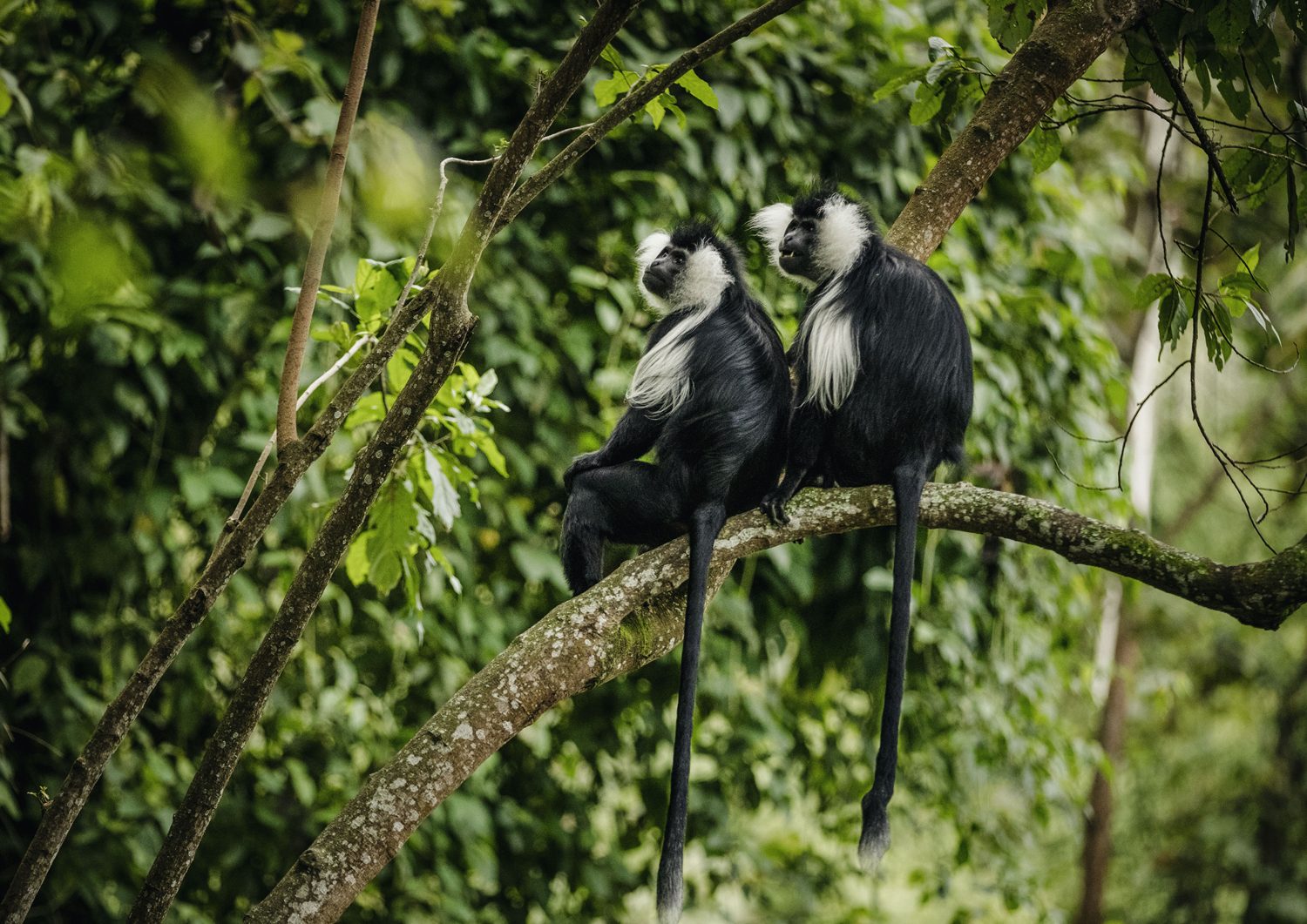
Black-and-white colobus monkey leaping between branches in Nyungwe

What the Colobus Trek Involves

The colobus trek sets out from the park’s trail network around Uwinka and Gisakura, where the habituated troops are found. After a briefing at the trailhead, a guide leads you into the forest along well-worn trails, and the search begins for the troop’s position, usually marked by its rolling calls and the sound of feeding.

Because colobus are canopy animals, the walk is as much about looking up as about walking: your guide reads the movement of the branches, and when the troop is located, you settle in to watch. Treks typically last between two and three hours, and the pace is adjustable to your group’s fitness.

The permitting system is simpler and cheaper than for the chimpanzees, making the colobus trek an easy addition to any Nyungwe visit. Park entry, guiding and permits are all arranged for you when you book the trek as part of a package, so the only decision on the day is which lens to mount.

Do not be surprised to cross paths with chimpanzee trekkers at the trailhead; the two activities share the same forest. Comparing notes over lunch, they envy your relaxed start while you envy the hooting they heard in the distance, and together the two experiences make the case for doing both.

One small note of advice: the colobus move quickly when they choose to, and they choose to fairly often. Follow your guide’s lead rather than the monkeys’, and you will see far more than the people who chase after every leap.

Children love the colobus trek, and the feeling is mutual. The monkeys are endlessly entertaining, the walk is short enough for small legs, and the troop’s sheer size means there is always something happening somewhere. For families weighing up which Nyungwe activity to choose, the colobus trek is the safest bet on the list.

Photographing Black and White in a Green World

The colobus trek is a photographer’s dream and a photographer’s challenge in equal measure. Black-and-white fur against green canopy is a high-contrast subject, and the monkeys never hold still, so success favours fast autofocus, a long telephoto and a willingness to shoot through branches. The reward is some of the most striking wildlife images Rwanda has to offer.

Light is everything. Early morning, when the sun slants through the canopy, turns the white mantles silver and gives the black coats a rich sheen, while the soft overcast of the wet seasons is almost as good, taming the contrast. Bring more batteries than you think you need, keep the camera in a rain cover, and resist the urge to photograph everything: watch for a while, and the best moments will come to you.

Whatever gear you bring, shoot in short bursts and review sparingly. Colobus movement is fast and unpredictable, and a burst of ten frames will usually contain the one that matters; the skill is being aimed when the burst starts. And remember the cardinal rule of rainforest photography: the batteries are always emptier than you think.

Smartphone shooters need not despair: the light of the forest is flattering even for phone cameras, and a pair of binoculars to your eye will beat a camera on the memory card any day.

Timing your visit for mid-morning is a quiet art. The first hour of daylight belongs to the trekkers heading for the chimpanzees, while the colobus, who keep no early appointment, tend to be at their most active a little later, once the canopy has warmed. A later start also gives you the softest light and the quietest trails.

Beyond the Colobus Trek: The Rest of the Forest

The colobus trek moves through some of the richest forest in Africa, and the troop is rarely the only wildlife you will see. L’Hoest’s monkeys watch the trail from the understorey, blue monkeys and grey-cheeked mangabeys feed overhead, and with luck you may hear, or glimpse, the chimpanzees of a neighbouring valley.

Above it all flies Nyungwe’s other great spectacle: the great blue turaco, a bird the size of a crow in electric blue and crimson, and the Rwenzori turaco, equally vivid in green and red. Add orchids by the hundred and the famous canopy walkway, and a morning that began with colobus monkeys ends as a full portrait of the rainforest.

The canopy walkway is a natural extension of the colobus morning. Suspended high above the forest floor, it puts you at the level of the very branches where the monkeys feed, and sightings from above have a completely different character from those at eye level. Most of our Nyungwe itineraries bundle the two, and the combination takes less than a day.
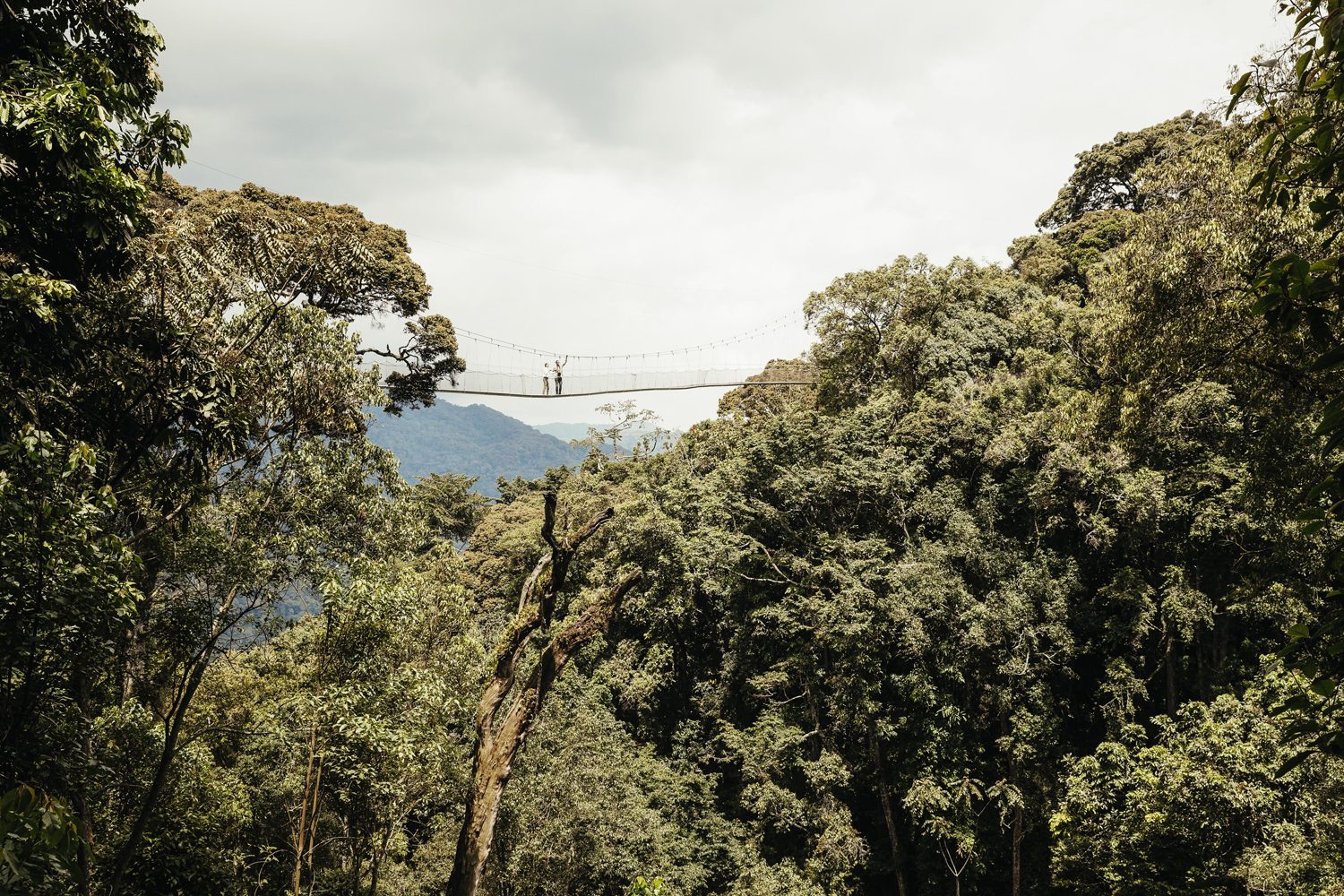
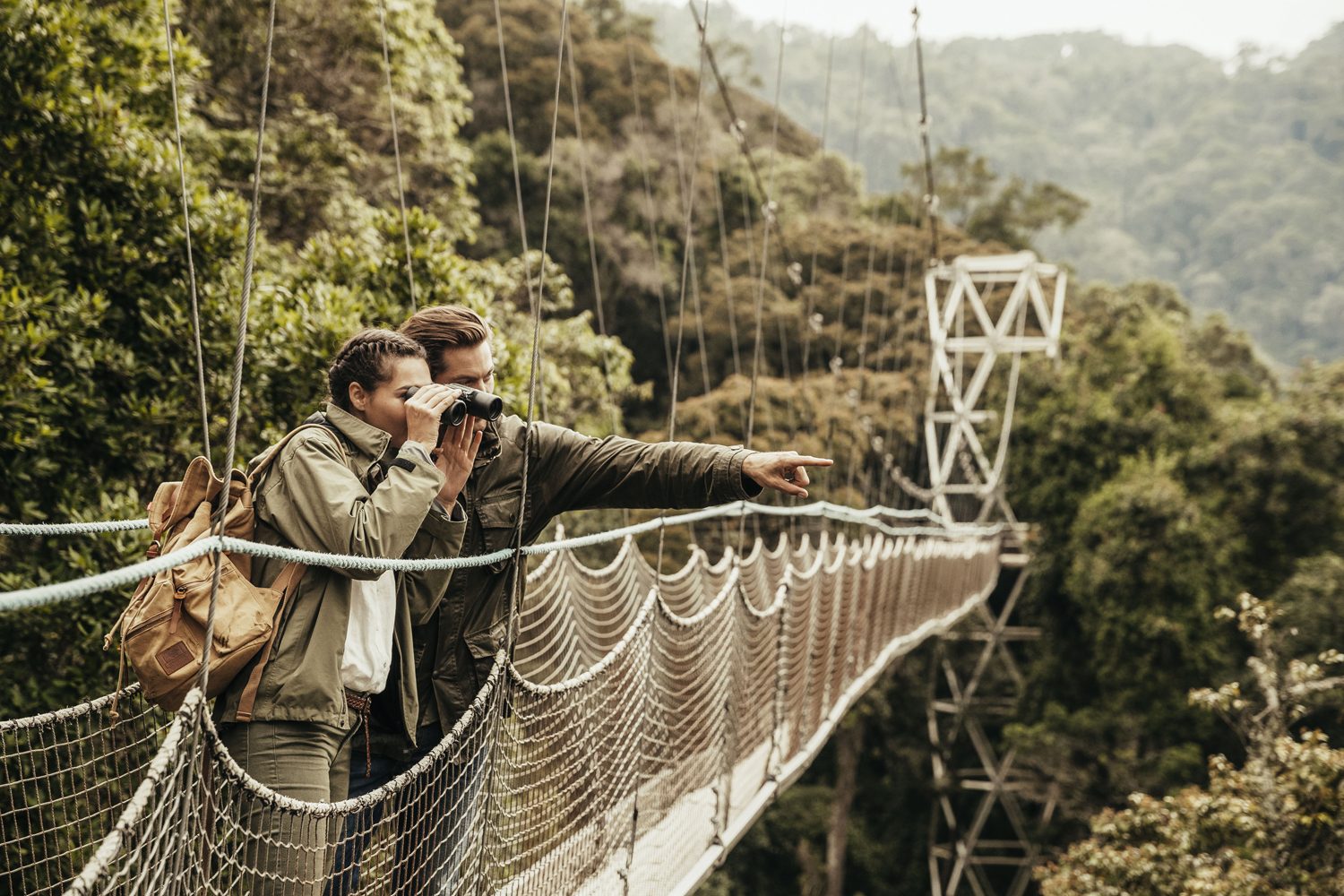
Visitor on the canopy walkway above the Nyungwe forest, home of the colobus

Colobus Trek Practical Details

The colobus trek is accessible to most travellers, and the park’s official website has the current trek schedules and trail conditions. The walking is moderate, the duration is short, and the fitness requirements are far more forgiving than for chimpanzee or gorilla tracking. What matters is standard rainforest kit:

  • Sturdy, waterproof walking boots
  • A rain jacket and quick-drying trousers
  • Long sleeves and insect repellent
  • Water, snacks and sun protection
  • Binoculars and a telephoto lens
  • A dry bag for electronics

As with every trek in Nyungwe, dress in muted colours, keep your voice low, and never attempt to feed or touch the monkeys. The troops are habituated, but habituation depends on visitor conduct, and the park’s rangers enforce the rules firmly. Travel in the dry seasons for the firmest trails, and in the green seasons for the quietest forests.

The colobus trek also makes an excellent second day in the park, pairing beautifully with a chimpanzee morning, a canopy walk or an afternoon of birding on the tea estate roads.

For older travellers and anyone with mobility concerns, the colobus trek is the most accommodating of Nyungwe’s signature outings: the trails are walked at your pace, the guides adjust the distance, and a porter can carry your daypack for a modest fee. It is the rare wildlife experience that can be shaped to the visitor rather than the other way around.

Combining the Colobus Trek with Chimpanzees

The colobus trek is at its best as part of a wider Nyungwe programme. Our 2-day Nyungwe package pairs a chimpanzee tracking morning with a colobus trek and the canopy walkway, delivering four of the park’s headline experiences in two days. It is the most popular way to see the park, and the two treks together show off the full range of the forest’s moods.

For longer itineraries, the colobus trek fits naturally into the 10-day Rwanda primate safari, which also takes in the mountain gorillas and, if you wish, the golden monkeys of the Virungas, covered in our golden monkey guide. The colobus trek is also a superb first taste of Rwanda for families and first-time safari-goers.

Why Nyungwe’s Colobus Matter for Conservation

Every colobus trek sold supports the park’s rangers, and the troops are more than a spectacle: they are the visible evidence that Nyungwe’s protection is working. A forest that can support troops of four hundred leaf-eaters is a forest of immense size and health, and the presence of these monkeys is a daily demonstration of why the park, and the communities around it, defend the trees.

Tourism revenue from the colobus trek flows into park management, ranger patrols and community projects, creating a virtuous circle in which seeing the monkeys pays for protecting them. Every visitor who joins the trek is voting, in the most practical way possible, for more rainforest and fewer chainsaws.

And so the joyful trek turns out to be a serious act. You will leave Nyungwe smiling, your camera full of white mantles and green light, and somewhere in the middle of all that joy you will have helped keep the forest standing for the next generation of travellers. For more on the park and its wildlife, browse our Nyungwe destination guide, and when you are ready to plan your visit, contact our team.

A final image to leave you with: a hundred white mantles moving through green shade, the calls rolling like distant thunder, and a group of strangers grinning at each other in the middle of an ancient forest. That is the colobus trek in one frame. The monkeys will be there, and the forest will be there; all that remains is for you to join them.
The Chimpanzee Habituation Experience in Nyungwe

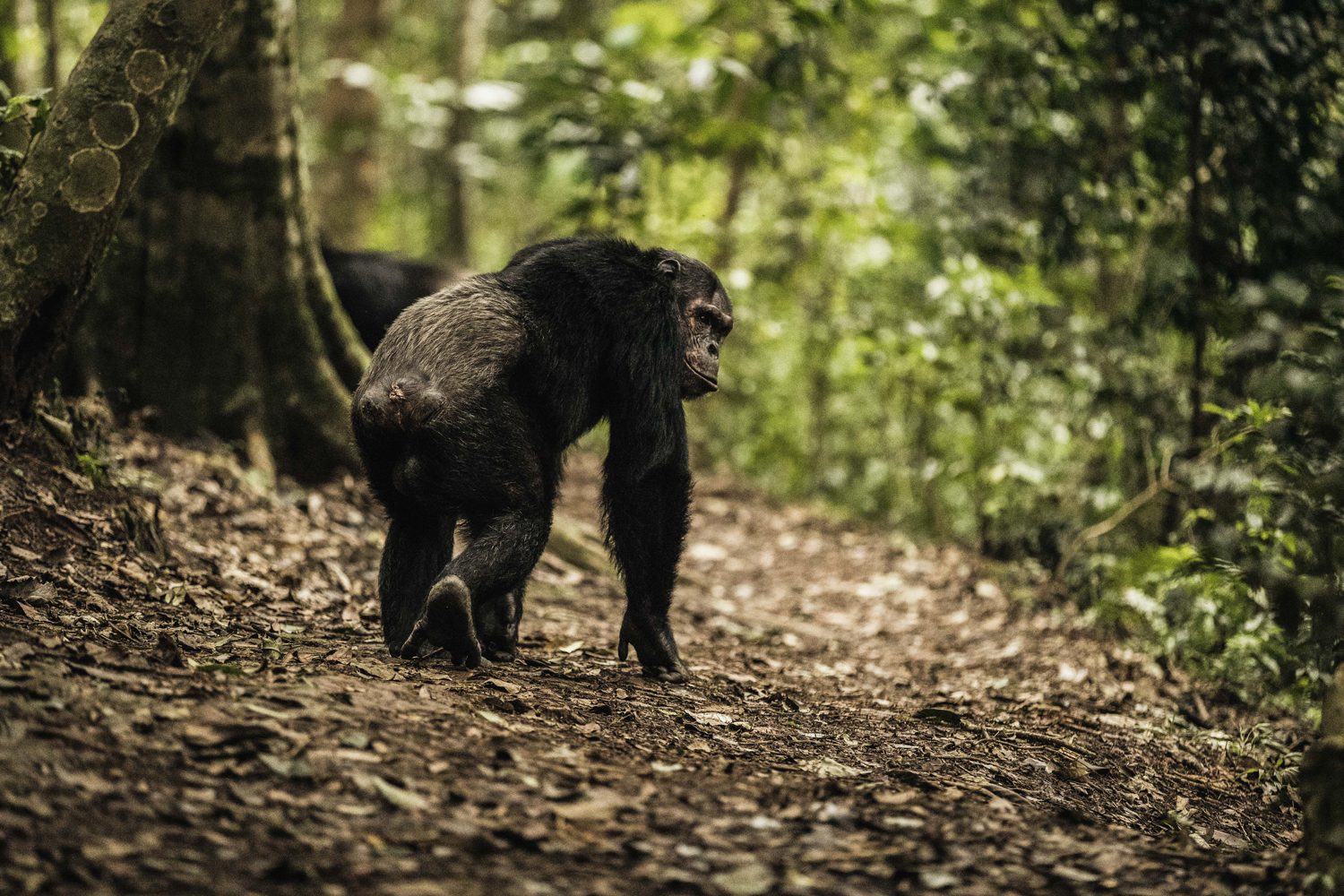
Chimpanzee tracking in Nyungwe National Park gives visitors an hour with our closest living relatives. Chimpanzee habituation in Nyungwe gives them something rarer: a full day inside the daily life of a wild community, in the company of the people whose patient work made the encounter possible in the first place.

Habituation is the long, careful process by which wild chimpanzees grow accustomed to human observers, and in Nyungwe it is both a conservation tool and a window into research. This guide explains what habituation means, what the experience involves on the ground, what you are likely to see, and how to book it.

If you have ever watched a wildlife documentary and wished you could be the person standing quietly at the edge of the clearing, notebook in hand, this is the closest a safari can take you.

There is a second way to think about chimpanzee habituation in Nyungwe: as an education. A standard trek answers the question of what a chimpanzee looks like; a habituation day answers the question of how a chimpanzee lives. For anyone planning a longer African journey, it also builds an understanding of the methods behind all great wildlife encounters, from mountain gorillas to wild dogs.

What Chimpanzee Habituation in Nyungwe Means

Every wild animal is afraid of humans, and with good reason. Habituation is the process of undoing that fear gradually, not by taming the animal but by teaching it, through months and years of neutral daily presence, that people are not a threat. Researchers follow a community every day, staying at a respectful distance, until the chimpanzees come to accept observers as part of the forest scenery.

Crucially, habituation changes behaviour without changing the animal. A habituated chimpanzee is still a fully wild creature that hunts, fights, mates and travels exactly as its unhabituated neighbours do. What has changed is tolerance, and that tolerance is conditional: it depends on visitors behaving predictably, quietly and at a safe distance, which is why the rules of the trek matter so much.

Habituation is also the foundation of modern primate tourism. Without it, no visitor could get near a wild chimpanzee, and without visitors, the forest would earn far less from its wildlife. In Nyungwe, as in Volcanoes National Park, chimpanzee habituation has turned conservation from a cost into a source of local income, and the chimpanzees into the forest’s most valuable residents.

Why Habituation Never Ends

It is worth understanding that habituation is never finished. Researchers observe communities continuously; new infants arrive unhabituated and must learn tolerance from their mothers, and any lapse in visitor discipline can set the process back. The habituation experience is not a spectator sport; it is a contribution to that ongoing work.

The ethical rules of the day are strict, and they exist for the animals’ sake. The guides will ask you to keep your voice to a whisper, to avoid sudden movements, to hold a defined distance, and never to hold eye contact for long, a signal chimpanzees read as a challenge. Far from spoiling the experience, these rules create its intimacy: the chimpanzees accept you precisely because you behave predictably.

How the Nyungwe Chimpanzee Habituation Began

Chimpanzee habituation in Nyungwe began with the studies of the late 1980s, when researchers started the long-term observation programmes that continue today. Following the same communities year after year, they learned the animals’ identities, families and territories, and the communities in turn learned to accept human presence. The habituation of the groups around Uwinka, Gisakura and Cyamudongo is the accumulated result of that trust.

The habituation experience lets visitors participate in that tradition. Rather than arriving at a known location for a fixed hour, you join a small team that sets out to find the chimpanzees in the manner of researchers: reading the forest, listening for calls, and following the trail of fresh feeding signs until the community is located.

Rwanda has become a global reference point for habituation. The same patient methodology that made the mountain gorillas of the Virungas accessible to travellers, documented in our gorilla habituation experience guide, has been applied to chimpanzees with equal success, and Nyungwe is the living proof that the model works.

Chimpanzee Habituation in Nyungwe vs a Standard Trek

The differences between the standard trek and the habituation experience are significant, and worth understanding before you book:

  • Duration: a standard trek grants roughly one hour with the chimpanzees; habituation typically occupies most of the day
  • Pace: the standard trek heads efficiently towards a known group; habituation follows the animals wherever their morning takes them
  • Group size: habituation parties are kept very small to minimise disturbance
  • Contact: with fully habituated communities, observers may share the forest at closer range as the animals allow
  • Spirit: the day is led in the manner of research, with quiet observation and patient waiting at its heart

None of this makes chimpanzee habituation in Nyungwe better in an absolute sense; it is simply deeper. The standard trek is the perfect introduction to chimpanzee viewing, efficient and reliable, while habituation suits travellers who want to understand how the forest actually works and are prepared to give it a full day of their attention.

The Emotional Difference

There is also an emotional difference. In a standard trek you are a guest; in a habituation session you are, for a few hours, part of the reason the chimpanzees are still here. Many participants describe the day as the most meaningful wildlife experience of their travels, precisely because it asked something of them.

If your itinerary only allows one morning in Nyungwe, the standard trek remains the right choice. If you have a full day to give, this is the day to give it.

What you wear matters more than you might expect. The habituation day takes you off the beaten trails, into damp undergrowth and up steep slopes, so boots with serious grip, quick-drying trousers and a rain shell are essential. Dress in muted colours, carry more water than you think you need, and leave the perfume at the lodge; your comfort, and the chimpanzees’ tolerance, both depend on it.

A Chimpanzee Habituation Day in Nyungwe

A chimpanzee habituation day in Nyungwe begins like every forest morning, in the dark. After an early breakfast you drive to the trailhead, meet your guides and the rest of the small party, and receive a briefing on the plan and the rules. Then you enter the forest while the canopy is still black against the sky.

The search is the heart of the day. Your team listens for the first calls of the community, checks the previous evening’s feeding trees, and follows the tracks and signs that chimpanzees leave everywhere: crushed leaves, half-eaten fruit, dung, and the distinctive sounds of movement. This is genuinely exciting work, and the guides involve you in it, explaining every clue as it appears.

Once the team finds the chimpanzees, the session begins in earnest. Unlike the strict one-hour format of the standard trek, habituation observation is open-ended, governed by the animals’ mood and your group’s conduct. You may follow the community as it travels, stop when it stops, and stay as long as the guides judge that the chimpanzees are comfortable. A picnic lunch taken in the forest is part of the deal.

The day ends with the walk back to the trailhead, usually in the afternoon, tired and full of stories. Because the schedule is long and the terrain demanding, a good level of fitness and a patient temperament are the two essential pieces of equipment.

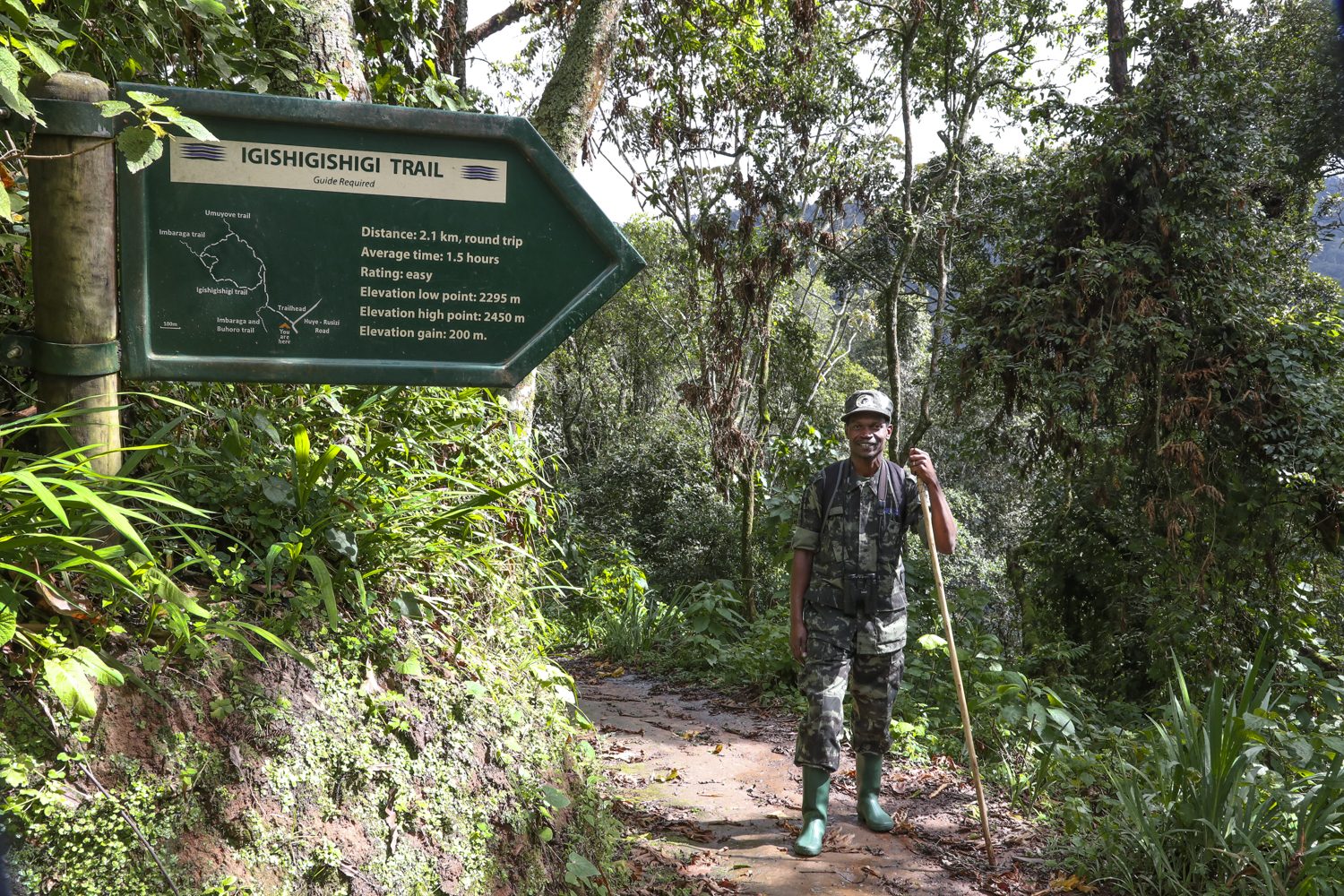
Trail through the forest used by chimpanzee habituation teams in Nyungwe

The Behaviours You Might Witness

A full day in the company of chimpanzees reveals behaviours that the standard hour only hints at. Tool use is the most famous: watch a chimpanzee select a stem, trim it, and fish it into a termite mound with the concentration of a craftsman, or crush leaves to form a sponge for drinking water. Such moments are rare enough in research, let alone in tourism, and the habituation experience offers the best chance of seeing them.

Social life is the constant backdrop. Chimpanzee communities are full of alliance, argument and reconciliation: grooming sessions that go on for hours, pant-hooting greetings when parties reunite, dominance displays that make the forest shake, and the patient teaching of infants by their mothers. If you are very lucky, you may also witness hunting, when the community cooperates to pursue a small monkey through the canopy at astonishing speed.

None of this is guaranteed, and that is precisely the point. Chimpanzee habituation in Nyungwe does not sell sightings; it sells participation in the daily life of a wild community, with all the uncertainty that implies. The guides are candid about this, and the travellers who embrace the uncertainty come away with a deeper understanding than any guaranteed hour could provide.

The Sensory Side of the Day

There is also the sensory layer that no photograph captures: the smells of the forest, the texture of the air, the sheer volume of sound when a community erupts into hooting. Participants remember these details for decades, often more vividly than the sightings themselves.

One of the quiet joys of the habituation day is the picnic. Somewhere in the middle of the forest, with the community resting nearby, the guides unpack lunch and the conversation turns to the morning’s observations: which animals were seen, which alliances shifted, what the calls meant. It is the closest most travellers will ever come to a field researcher’s debrief, and it is unforgettable.

Chimpanzee grooming in the forest during a habituation session in Nyungwe

Who Should Book the Habituation Experience

Chimpanzee habituation in Nyungwe suits a particular kind of traveller: patient, physically prepared and genuinely curious about animal behaviour. Birders, wildlife photographers, researchers and repeat visitors to Africa tend to love it, because it offers what they value most: time, depth and the sense of being let in behind the scenes.

It suits fewer travellers who are short on time, unused to long hikes, or expecting a guaranteed close encounter. The park authorities set minimum age and fitness requirements, and we will confirm the current rules when you book. If you are travelling with older children or less experienced walkers, the standard trek is a gentler introduction, and the habituation day can wait for another visit.

Solo travellers, by contrast, take to the habituation day immediately. Because the party is small and the schedule long, strangers become fast friends, sharing the tracking, the waiting and the eventual triumph of first contact. It is one of those rare travel experiences where the company is part of the product.

For anyone whose travel diary is dominated by wildlife documentaries and biology books, however, this is the experience you have been saving up for. It is the difference between watching an orchestra and sitting inside the rehearsal.

Costs and Practicalities

The park authorities price the chimpanzee habituation day in Nyungwe above a standard permit, reflecting the larger team, the longer day and the smaller group. Even so, it remains a fraction of the price of a gorilla permit, and it is widely regarded as one of the finest value wildlife experiences in East Africa. We will quote the current rate when you enquire.

What the Price Covers

What you get for the money is the full support structure of a Nyungwe day: park entry, expert guiding, the tracking team’s accumulated knowledge, and the logistical convenience of a properly organised outing. The easiest way to arrange it is as part of a package, such as our 2-day Nyungwe itinerary, which also covers your accommodation in the park.

One honest note on booking: habituation sessions are limited in number each day, so they sell out well in advance during the dry seasons. Fix your dates early, book through a licensed operator, and treat the permit as the fixed point around which the rest of your itinerary rotates. Park entry rules are published on Rwanda’s official tourism board website. You will find up-to-date pricing for chimpanzee and gorilla permits alike on our permit page.

Finally, pack for a full day rather than a morning: more water, more food, more patience. The guides will carry the group’s essentials, but your own comfort is your own responsibility, and a well-prepared traveller makes a better observer.

Weather is rarely the deciding factor in Nyungwe, but if you want the driest possible conditions for a long day on the trails, the June-to-September window is your friend, with December to February a close second. In the green seasons the day is wetter and the undergrowth thicker, but the forest is at its most dramatic, and the habituation teams know the trails in every condition.

Combining Habituation with Other Treks

A chimpanzee habituation day in Nyungwe sits naturally inside a larger primate safari. Many of our guests pair a Nyungwe habituation day with a gorilla habituation session in Volcanoes National Park, comparing how the two species were habituated and how their behaviours differ. Our gorilla habituation experience guide explains the gorilla version in detail.

Alternatively, combine the chimpanzee habituation day with a classic gorilla trekking morning, and you get the best of both worlds: the depth of a research day and the theatre of the silverbacks. Our 5-day gorilla and chimpanzee safari is designed to fit both into one seamless week.

Whichever combination you choose, the advice is the same: keep your schedule flexible, protect your fitness, and bring curiosity rather than expectations. The chimpanzees of Nyungwe have been waiting for observant humans for millennia; the least you can do is arrive with an open mind. When you are ready to plan the day, contact our team.

When to See Chimpanzees in Rwanda: Season and Timing

Chimpanzee tracking in Rwanda runs year-round, but the seasons shape your experience in real ways. Ask ten safari guides when to go and you will hear ten variations on the same theme: any time, because the chimpanzees of Nyungwe National Park are resident all year round. Rainforest chimpanzees do not pack up and leave when the seasons change. They are always there, feeding, travelling and calling through the ancient forest of south-west Rwanda.

Chimpanzee Tracking in Rwanda: When to Go

That does not mean the calendar is irrelevant. The seasons of Nyungwe shape your experience in dozens of practical ways. Mud, rain, crowds, prices and permit availability all shift with the calendar. Choosing the right window is really a matter of matching your expectations to the forest’s moods.

This guide breaks down Nyungwe’s seasons month by month. It explains what each one means for chimpanzee tracking, and helps you pick the window that fits your travel style. The honest headline is this: there is no bad month for chimpanzee tracking in Rwanda, only different kinds of good.

One more thing to say at the outset: the answer that matters most is the one that fits your life. A family constrained by school holidays will make one choice. A photographer chasing the dry-season light will make another. A budget traveller with flexible dates will find their own window, and everyone will have a wonderful time.

There is one more consideration that most visitors overlook: your chimpanzee dates do not exist in isolation. The same dry seasons that suit Nyungwe also drive demand for gorilla permits in Volcanoes National Park. A combined itinerary, the kind most travellers want, is easiest to build in the shoulder weeks around the peaks. A 5-day gorilla and chimpanzee safari is a good example, and it works particularly well in June, September and February.

Nyungwe’s Climate: A Rainforest in the Mountains

Nyungwe is a mountain rainforest, and its weather follows mountain rules. The park stretches across altitudes from roughly 1,600 metres to nearly 3,000 metres, and cloud wraps its upper slopes for much of the day. It is one of the wettest parts of Rwanda, with rain in every month of the year. The rain is not uniform: the forest experiences two drier seasons and two wetter ones. The Rwanda Development Board manages the park and publishes the current entry fees.

Temperatures are mild by African standards. Daytime highs sit in the low twenties, and nights can dip sharply, so warm layers matter more than sun cream. The practical effect is simple: the chimpanzees live in a forest that is always damp and often beautiful. The question of best time becomes a question of how much wetness you will embrace.

The wet seasons are not a barrier to tracking, and it is worth saying this loudly. The park’s guides track chimpanzees 365 days a year. The habituated groups around Uwinka, Gisakura and Cyamudongo are located daily, rain or shine. Rain may slow your boots, but it never stops the hunt.

There is one consequence of the climate that surprises many visitors: because Nyungwe is so wet, the dry seasons matter even more than they would elsewhere. A week without heavy rain transforms the trails completely, which is why the firm ground of the dry months attracts so many travellers.

Drone view of the Nyungwe canopy walkway wrapped in morning mist

Chimpanzee Tracking in the Long Dry Season: June to September

For most visitors, the long dry season from June to September is the easiest choice, and the park’s popularity reflects it. Trails are at their firmest, and views of the surrounding hills are at their clearest. The forest floor, while never fully dry, is far more forgiving underfoot. This is also the classic window for the rest of Rwanda’s wildlife calendar.

Chimpanzee tracking in these months typically means brighter mornings and earlier sightings. The chimps are easier to locate when the undergrowth is less dense and the canopy is more open. The trade-off is company. Nyungwe receives more visitors in the dry season, and lodge beds fill quickly. The most experienced guides are in high demand, so book well in advance.

For photographers, July and August offer the best light of the year, with soft morning sun filtering through the canopy instead of grey drizzle. If your goal is the classic image of a chimpanzee backlit by rainforest light, this is the window to aim for. Our 2-day Nyungwe package handles all the logistics, so you can concentrate on the shot.

There is a further argument for the dry season that has nothing to do with weather: the forest is at its most accessible. Waterfalls are still flowing, the canopy walkway is at its clearest, and the full menu of Nyungwe activities, from birding to the colobus trek, operates without interruption.

One caution: the dry season is popular for a reason, and it is not only international visitors who know it. Rwandans travel to their own parks too, especially during school holidays, so July and August can feel lively. If your dates are fixed to those months, book your permits and lodges early. Ideally book several months ahead, and trust your operator to hold the arrangements together.

Chimpanzee Tracking in the Short Rains: October and November

The short rains arrive in October and continue through November. They are exactly what their name promises: showers rather than storms, usually concentrated in the afternoons. Mornings are often fine, which suits chimpanzee tracking perfectly, since the treks begin before dawn and end around midday.

What the short rains lack in glamour they make up for in atmosphere. The forest turns a deeper, glossier green, the waterfalls swell, and the birdlife is at its most vocal. Visitor numbers drop noticeably, lodges become easier to book, and those who do travel find a quieter, more personal park. For seasoned travellers, this is the secret sweet spot of the Nyungwe calendar.

A practical word about the trek itself in the short rains: your boots will get wet. Your morning will start in the dark, and the first hour of walking may be through drizzle. That is also when the forest is at its most private. The guides, who have walked these trails in every weather, take it all in their stride. Pack a warm layer and a waterproof cover for your bag, and you will hardly notice the difference.

Chimpanzee Tracking in the Long Rains: March to May

The long rains from March to May are Nyungwe at its most dramatic. Expect days of persistent drizzle, cloud in the valleys, and trails that turn to serious mud. This is the true low season, and the park is at its emptiest. Accommodation prices are at their most flexible, and travellers with flexible schedules can stretch their budgets considerably further.

None of this stops the chimpanzees, and it should not stop you either, provided you come dressed for it. Waterproof everything, boots with serious grip, and a change of clothes waiting at the lodge turn the long rains into an adventure rather than an ordeal. The chimps are found daily in every month, and the reward for braving the mud is a forest almost entirely to yourself.

There is a particular magic to Nyungwe in heavy rain. The hooting of chimpanzees carries further in wet air, and the canopy walkway becomes a tunnel through cloud. The sense of being inside a living rainforest is overwhelming. Travellers who come in these months often describe the experience as the most immersive of their lives.

Sunbird in the forest at Gisakura, Nyungwe National Park

The December to February Window for Chimpanzee Tracking

The second dry window runs roughly from December to February, and it offers much of the first’s appeal with a different rhythm. December brings the festive holiday rush, when local and international visitors converge on Rwanda’s parks. January and February settle into a calmer, drier stretch that many call the most comfortable of the year.

The chimpanzees remain as reliable as ever, and the combination of manageable trails and warm, clear days makes this a popular choice for families and photographers. If you are planning a Christmas or New Year safari, start your enquiries early. The weeks around the holidays are among the busiest in the Rwandan tourism calendar.

February deserves a special mention. It is often the driest, sunniest month of the year, with the festive crowds departed and the long rains still a month away. Travellers who can arrange their dates for late January or February often find the perfect balance of weather, prices and emptiness.

What the Seasons Change for Chimpanzee Tracking

It helps to separate what the seasons do and do not change. They do not change the chimpanzees’ residency, their habituation, or the basic rhythm of the trek, which runs every morning of every month. What they change is your comfort, the trail conditions, the crowds and the price. In short:

  • June to September: driest trails, clearest light, busiest park, book early
  • October to November: short afternoon showers, deep green forest, fewer visitors
  • December to February: dry and warm, with holiday crowds at Christmas
  • March to May: heavy rain, serious mud, low-season prices and emptiness

The guides’ knowledge absorbs the seasons. Fruiting trees shift the chimpanzees’ movements throughout the year. The tracking teams keep daily tabs on where the parties feed, so sighting rates stay consistent in every month. What changes is the scenery you walk through to reach them, and the character of the forest itself.

It is also worth remembering that dry season and no rain are not synonyms. Even in July the forest can produce a sudden shower, and the guides carry on regardless. What the dry months reliably change are the trail surface and the visibility, and those two factors alone justify the planning.

Time of Day: Why Mornings Matter

Within any chosen month, the time of day matters more than the season. Chimpanzees are at their most active in the first hours after dawn. They feed intensively before the warmth of the day, so tracking begins in the dark. Expect the pre-dawn wake-up, the briefing by torchlight, and the drive to the trailhead while the stars are still out.

This early start has a wonderful side effect for visitors. The forest at first light is one of the great experiences of Rwanda. Mist hangs in the valleys, birds begin to call, and you enter a world that does not know you are coming. It is also the best photographic light of the day, soft and golden rather than harsh.

Plan your itinerary so that nothing pushes your Nyungwe mornings later than they need to be. The hour you spend with the chimpanzees is the fixed point of the day, and everything else, from breakfast to the drive home, should bend around it.

Chimpanzee tracking in Rwanda follows this morning rhythm every day of the year. Your chimpanzee tracking day starts with a pre-dawn wake-up call. The guides locate the groups overnight, so the walk begins with a clear destination. Even in the wettest month, the forest delivers a sighting more often than not.

Chimpanzee tracking in the early morning light of Nyungwe

Planning Around Rwanda’s Peak Season

Rwanda’s travel year peaks in the same months as its dry seasons, which means the chimpanzees share their busy calendar with the gorillas of Volcanoes National Park. If your plan includes both treks, the gorilla permits will drive your dates. They are the first to sell out, often months in advance.

Our advice is to fix your travel window early, then lock in permits before lodges. When you book, note that chimpanzee tracking in Rwanda needs less lead time than gorilla permits. The gorilla trek will drive your dates instead, so book that permit first. A 5-day gorilla and chimpanzee safari or a 10-day Rwanda primate itinerary arranges every permit, transfer and night of lodging. The season then works for you rather than against you.

For up-to-the-minute availability and pricing in your chosen month, contact our team. We track permit availability daily. We will tell you honestly which months are tight and which are wide open, so your dates and budget land in the same place.

A Month-by-Month Snapshot

If you want the whole calendar in one glance, here it is:

  • January: dry, warm and busy from the holidays; excellent tracking
  • February: dry and pleasant; a favourite month for photographers
  • March: the long rains begin; the forest turns lush and quiet
  • April: the wettest month; lowest prices, toughest trails
  • May: the rains ease; the green season at its most beautiful
  • June: the dry season begins; the trails firm up quickly
  • July: peak season; clear trails and a busy park, book early
  • August: peak season continues; ideal conditions, full lodges
  • September: still dry; crowds thin out as the holidays end
  • October: the short rains return; a quiet park and fine mornings
  • November: wet and calm; superb value and very few visitors
  • December: drying again; holiday crowds return for Christmas

The bottom line is simple. Chimpanzee tracking in Nyungwe works in every month of the year, and the differences between seasons are differences of comfort and company, not of the animals themselves. Choose the window that suits your budget and your nerve for mud, book it through a reliable operator, and let the forest do the rest. For official visitor information on Nyungwe and Rwanda’s other parks, visit the Visit Rwanda tourism board.

For more on the park itself, from its trails to its lodges, browse our Nyungwe destination guide. And when you are ready to lock in your dates, contact our team. We will take care of the permits, the transport and the timing. All you have to do is show up before dawn and follow the hooting.

The Primates of Nyungwe: Rwanda’s Monkey Capital

Nyungwe National Park answers a question that very few forests on Earth can: how many kinds of primates can live in a single stretch of rainforest? The answer, in this case, is roughly thirteen species, a richness that makes Nyungwe one of the finest primate destinations in Africa and, indeed, the entire world.

Most visitors arrive for the chimpanzees and stay for everything else: troops of black-and-white colobus that fill the canopy with movement, shy L’Hoest’s monkeys that peek out from the roadside, and grey-cheeked mangabeys whose calls echo across the valleys. Welcome to Rwanda’s monkey capital. This guide introduces the full cast, and explains how to meet as many of them as possible.

Primates have shaped the way we understand Nyungwe. The researchers who came here decades ago to study the chimpanzees stayed to catalogue the monkeys, and their long-term studies have made this one of the best-documented primate forests in Africa, which Rwanda’s official tourism board features among the country’s top parks. The result, for the visitor, is a park where guides genuinely know their animals: not just species names, but families, territories and daily habits.

The primates of Nyungwe are the reason most travellers come, and they are also the reason many stay an extra day. This guide introduces the full cast of primates in Nyungwe and explains how to meet as many of them as possible. The good news is that seeing the primates of Nyungwe does not require luck: it requires a good guide and a little patience.

A Nyungwe Forest Built for Primates

Nyungwe’s wealth of primates is no accident, and, above all, the park’s altitude range is the key to why so many primates live in Nyungwe. The park protects one of the oldest and largest blocks of montane rainforest in East and Central Africa, a thousand square kilometres of forest stretching across altitudes from about 1,600 metres to nearly 3,000 metres. That altitude range creates a ladder of habitats, from dense valley forest through montane woodland to bamboo and open swamp, and each habitat supports its own set of species.

Because the forest is ancient and never froze or dried out during past ice ages, its wildlife has had millions of years to diversify. Fruits, leaves and insects are available through the seasons, which is what allows so many primate species to coexist in one place, each one specialising in a different part of the forest.

Altitude is the key to it all, and it explains the primates of Nyungwe better than any map. The lowest valleys are warm and dense, home to the species that need heat and heavy fruit; the upper slopes are cooler, wetter and more open, where leaf-eaters and bamboo specialists hold sway. Between them lies a gradient of life that a single day of walking can cross, which is why Nyungwe feels less like one forest than a whole series of forests stacked on top of one another.

This layered richness is why scientists describe Nyungwe as one of the most important protected areas in the Albertine Rift, a region already famous as Africa’s evolutionary hotspot, and the Rwanda Development Board manages the park’s tourism. Its size, its altitude range and its sheer age combine to make it a natural laboratory, and every trail you walk is a quiet lesson in how a forest organises itself.

Thirteen Species of Nyungwe Primates and Counting

The primates of Nyungwe span ground dwellers and canopy specialists, and the park’s roughly thirteen species include:

  • The chimpanzee, the park’s only great ape
  • The Ruwenzori colobus, whose troops can number up to four hundred individuals
  • The L’Hoest’s monkey, a shy ground-dwelling guenon
  • The blue monkey, common across the canopy
  • The grey-cheeked mangabey, whose calls carry for kilometres
  • The owl-faced monkey, a rare and striking forest specialist
  • The red-tailed monkey, quick and colourful in the tree tops
  • The vervet monkey, at home on the forest edges and tea estates

Not every species is easy to see: some primates in Nyungwe show themselves readily, and others take real patience, because each one occupies a different slice of the forest: some live at ground level, some in the understorey, and others almost exclusively in the high canopy. A good guide knows where to look, which species move together, and what time of day each is most active.

A word of encouragement for first-time visitors: however, you do not need to see every species to appreciate the park. Two or three good sightings, properly savoured, will stay with you longer than a rushed checklist, and the guides will steer you towards the species that are reliably visible rather than the ones that merely exist on paper. Some of the park’s most wonderful moments, in our experience, come from the common monkeys viewed slowly.

Sightings are governed by simple etiquette: keep your distance, never offer food, and take your photographs quietly. The primates of Nyungwe tolerate human presence because that presence is consistently respectful, and that trust, built up over decades, is easily lost and slowly rebuilt. Your conduct on the trail is therefore more than a matter of enjoyment; it is a contribution to the park’s long-term reputation.

Chimpanzees: The Most Famous Primates of Nyungwe

The chimpanzee, of course, is the star of the show, the most famous primate in Nyungwe, and the species most visitors have crossed the world to see. Nyungwe’s chimpanzees live in fission-fusion communities, splitting into small parties that reunite, split again and travel widely in search of fruiting trees. They are also tool users: stems are stripped and poked into termite mounds, and leaves are chewed into sponges for drinking water.

Meanwhile, tracking the chimpanzees of Nyungwe is a morning expedition led by expert guides, and the one-hour encounter is governed by strict rules that protect both the animals and the experience. The habituated communities around Uwinka, Gisakura and Cyamudongo are your window into their world, and our 2-day Nyungwe package is the easiest way to fit the trek into a short itinerary.

The chimpanzees also teach visitors something humbling about the forest. A party may travel several kilometres in a single morning, and the guides’ ability to anticipate its route, based on the previous evening’s calls and the condition of the fruit trees, is a skill honed over years of daily tracking. Even on the rare day when the chimps lead you on a long chase, you are moving through scenery so beautiful that the pursuit is its own reward.

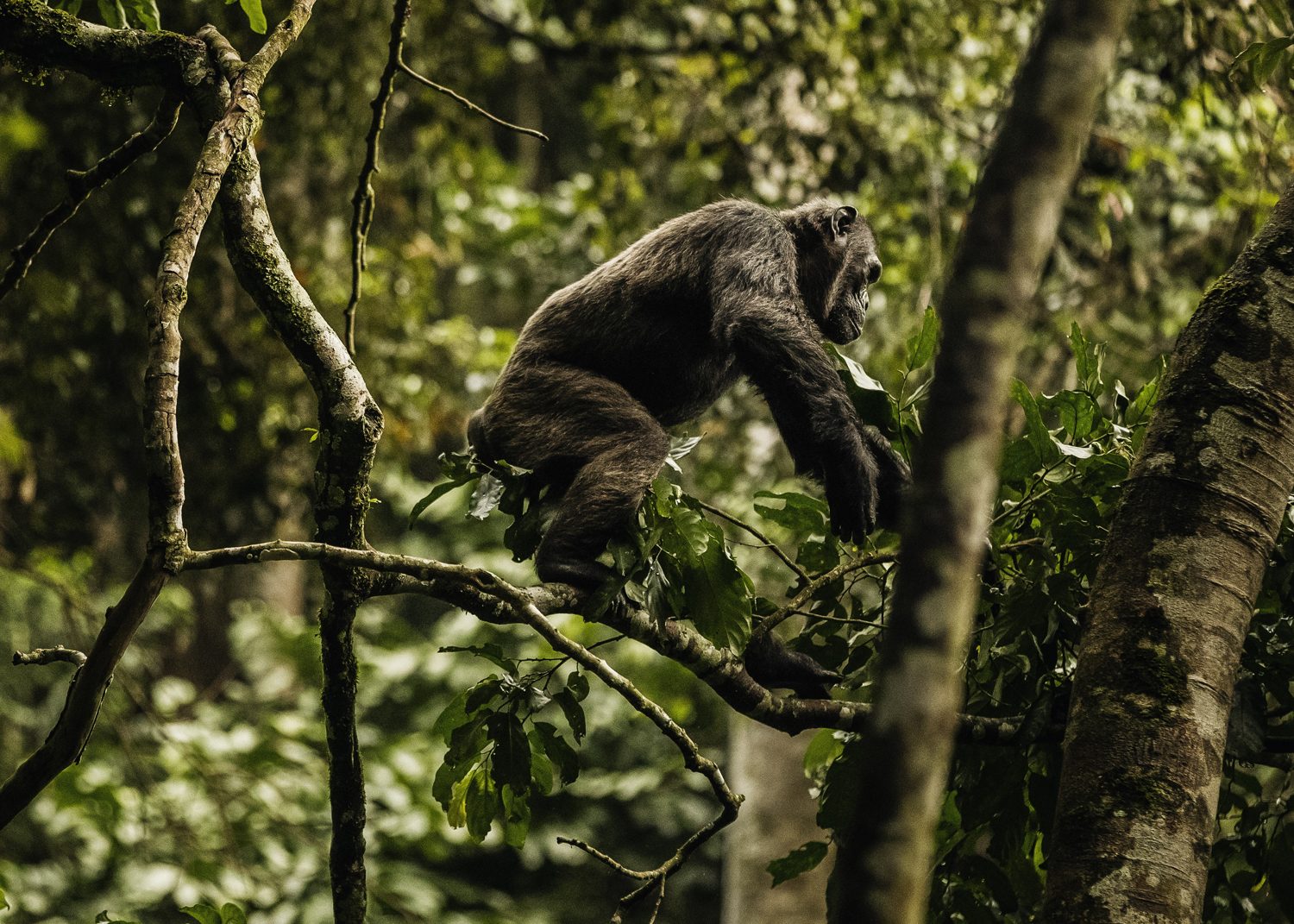
Wild chimpanzee foraging in the trees of Nyungwe National Park

The Ruwenzori Colobus: Giant Primates of the Nyungwe Canopy

If the chimpanzee is the park’s intelligence, the Ruwenzori colobus is its spectacle, and for many visitors it is the most unforgettable sight among the primates of Nyungwe. These striking monkeys are jet black with flowing white mantles and long tails, and they are leaf-eaters, spending most of their lives in the canopy where their complicated stomachs digest foliage that other monkeys cannot touch.

What makes Nyungwe exceptional, however, is the size of its colobus troops. Troops of up to four hundred individuals have been recorded here, among the largest groups of colobus monkeys ever documented anywhere in Africa. When a troop that size begins to move, leaping from tree to tree with their white mantles flashing, the forest itself seems to come alive. You can read more about this extraordinary experience in our guide to the colobus monkey trek.

Colobus troops are noisy neighbours. They produce a rolling, resonant call that sounds almost like thunder running through the trees, and a large troop on the move snaps branches, showers leaves and draws every eye upward. Seeing the white mantles of a hundred monkeys streaming across a single canopy is the kind of sight that makes first-time visitors laugh out loud with pure delight.

Troop of black-and-white colobus monkeys leaping through the Nyungwe canopy

L’Hoest’s Monkeys: The Shy Ground Dwellers

L’Hoest’s monkeys are the quiet souls among the primates of Nyungwe. They are large, dark-furred guenons with a neat white bib, and unlike most forest monkeys they spend much of their time near the ground, moving through the understorey in small troops of a dozen or so individuals. They are shy and wary, which makes every sighting feel like a small triumph.

Your best chances are along the forest trails near Gisakura and the tea estate edges, usually in the early morning or late afternoon. When you do see them, watch for the adults’ deliberate, cautious progress and the way juveniles are kept close; it is the closest Nyungwe gets to a glimpse of monkey family life.

There is a particular pleasure to watching L’Hoest’s monkeys at the forest’s edge. Because they live so close to the ground, they are the monkeys you are most likely to meet by accident, and encounters with them feel less like tourism and more like sharing a morning with the woods. Watch one scratch itself, yawn or scold a juvenile, and you will recognise gestures that would be entirely at home in your own garden.

Even when you do not see them, the signs of their presence are nonetheless everywhere: freshly stripped leaves at forest level, a glimpse of movement in the ferns, and that particular stillness that means a troop has just melted away into the undergrowth. Finding L’Hoest’s monkeys is an exercise in listening, and the park’s guides, who have spent years in these valleys, are masters of it.

The Canopy Crowd: Blue Monkeys and Mangabeys

High above the L’Hoest’s monkeys, the canopy primates of Nyungwe include the blue monkeys and grey-cheeked mangabeys. Blue monkeys are grey-blue in colour despite their name, and they are often the first primates a visitor sees, moving purposefully through the trees with their long tails arched. They regularly associate with other species, sharing fruiting trees in loose mixed-species alliances.

The grey-cheeked mangabey, in turn, is the forest’s loudest resident: its deep, resonant whoop-gobble calls carry across whole valleys, and hearing one at dawn is one of the great sound experiences of Nyungwe. Watch a mixed party of blue monkeys and mangabeys feeding together and you are watching one of the most sophisticated animal networks in Africa.

Mixed-species associations are one of the most fascinating habits in Nyungwe’s forests. Blue monkeys, mangabeys and red-tailed monkeys will travel and feed together for days at a time, each species watching for dangers that the others might miss. For the visitor this is a gift: find one species, and you will often find several, moving through the trees like a single many-headed creature.

The Rarer Faces of the Forest

For patient visitors, the rarer primates of Nyungwe are a badge of honour, and the park also reveals its shy species. The owl-faced monkey, with its pale face framed by dark fur, is a specialist of the deep forest and a species few travellers ever see. Red-tailed monkeys add flashes of colour to the lower canopy, while vervet monkeys patrol the forest edges and the gardens around the tea estates.

Ultimately, seeing the shy species is a matter of time, silence and the right guide. Dawn is the best hour, when the forest is waking and the monkeys are moving to their first feeding trees, and a full morning on the trails will almost always outperform a quick visit.

The owl-faced monkey deserves special mention because it is so rarely photographed. Named for the pale, owl-like pattern of its face, it is a forest interior specialist, and your guide will know the quiet corners where it is sometimes found. Spotting one is a badge of honour among Nyungwe regulars, and it is proof that patience in this forest is always rewarded.

Vervet monkeys, by contrast, occupy a different niche entirely: grey, cheeky and utterly at ease with people, they patrol the tea estates and picnic clearings, and their antics are a constant source of amusement. Seeing the sociable vervets at the forest’s edge and the deeply wild species of the interior on the same day is a reminder of how broad Nyungwe’s habitats really are.

More Than Monkeys: The Wider Forest

Even the most devoted primate fan will be distracted by what else Nyungwe offers. The park holds more than three hundred bird species, including the great blue turaco, whose electric-blue and crimson plumage is one of the finest sights in African ornithology, and the Rwenzori turaco, along with a long list of Albertine Rift endemics found nowhere else on Earth.

Add more than a hundred species of orchids, dazzling butterflies, and the famous canopy walkway suspended high above the valley floor, and you have a destination that rewards far more than a single morning. It is possible to spend days here and never repeat a trail.

In addition, the canopy walkway deserves more than a passing mention. Suspended high above the forest floor, it puts you at the level of the tree crowns, where the light is different, the birds are closer, and the monkeys sometimes seem as surprised to see you as you are to see them. It is the perfect complement to a ground-level trek and a favourite of photographers, and it is included in most of our Nyungwe itineraries.

Aerial view of the Nyungwe canopy walkway crossing the rainforest

How to Experience the Primates of Nyungwe

The best way to experience the primates of Nyungwe is with a guide who knows them intimately, and the practical way to do that is with a structured itinerary. and the practical way to do that is with a structured itinerary. Our 2-day Nyungwe package pairs chimpanzee tracking with a colobus and canopy walkway morning, giving you four of the park’s headline species in two days. For travellers who want the complete picture, our 10-day Rwanda primate itinerary combines Nyungwe with the mountain gorillas of Volcanoes National Park and the golden monkeys of the Virungas, covered in our golden monkey guide.

Whichever option you choose, travel with a light footprint: stay quiet, follow your guide’s instructions and let the monkeys set the pace. Nyungwe rewards patience with sightings no photograph can prepare you for. Contact our team to plan your primate safari, and discover why this corner of Rwanda is the monkey capital of Africa.

Most visitors who try the park for a day end up staying two. The first morning brings the chimpanzees, the second dawns on the colobus, and somewhere along the way the canopy walkway, the birding and the sheer stillness of the forest take hold. Nyungwe is a place that resists hurry, and the travellers who surrender to its pace are the ones who come home with the best stories.

A final thought on visiting responsibly. Nyungwe’s primates are wild animals, and the rules that govern your trek, the distance, the quiet, the ban on feeding, exist to keep them that way. Follow your guide’s instructions, keep noise to a minimum, and the forest will welcome you back again and again. Visit with respect, and Rwanda’s monkey capital will remain a wonder for generations to come.

Chimpanzees or Gorillas? Choosing Your Primate Trek in Rwanda

Chimpanzees vs gorillas: Rwanda offers travellers a decision that very few places on Earth can make – whether to spend your wildlife days on mountain gorillas, on chimpanzees, or on both. The gorillas of Volcanoes National Park have long been the country’s headline act, and deservedly so, but the chimpanzees of Nyungwe National Park have become a serious rival in recent years, and more and more visitors want to see both.

The chimpanzees vs gorillas comparison starts here: the two treks share a magical quality, yet they differ in almost every practical detail: cost, terrain, length, difficulty and the character of the encounter itself. This guide sets out the differences honestly, so you can choose the trek, or the combination, that fits your budget, fitness and travel style.

A note on phrasing before we begin: when we say gorillas in this guide, we mean the mountain gorillas of Volcanoes National Park, the only place in Rwanda you can see them. When we say chimpanzees, we mean the eastern chimpanzees of Nyungwe National Park, an entirely different corner of the country with a completely different forest. The two treks are about as different as two wildlife experiences can be, which is exactly why comparing them is worth your time.

Chimpanzees vs Gorillas: The Two Treks at a Glance

Before we dive into detail, here is the quick comparison every traveller asks for:

  • Species and setting: mountain gorillas in the volcanic Virunga massif; chimpanzees in the ancient rainforests of Nyungwe
  • Permit price: around US$1,500 per person for gorillas; roughly US$90 to US$150 for chimpanzees
  • Time with the animals: one hour with a gorilla family; about an hour with a chimpanzee party
  • Group size: up to eight visitors per gorilla family; similarly small groups for chimpanzees
  • Terrain: farmed foothills rising into steep volcanic slopes; dense, muddy rainforest trails
  • Best for: the once-in-a-lifetime spectacle; the intimate and energetic wildlife encounter

Neither experience is better in any absolute sense. They are simply different, and the trick is to match the trek to your priorities.

If you are weighing chimpanzees vs gorillas, keep two numbers in mind. The first is one thousand five hundred, roughly the dollar price of a gorilla permit. The second is one hundred and fifty, roughly the dollar price of a chimpanzee permit at the top of its range. Everything else, from difficulty to scenery to the character of the animals, flows from that single difference in cost.

The Gorilla Side of Chimpanzees vs Gorillas

A gorilla trek begins in the Virunga highlands of northern Rwanda, where Volcanoes National Park protects a population of mountain gorillas split among habituated family groups. Each family, typically ten to thirty individuals and presided over by a dominant silverback, is followed daily by trackers, and your group of eight will be assigned one family for the morning.

The hike takes you up through a mosaic of farmland, bamboo forest and dense cloud forest. Altitudes climb well beyond two and a half thousand metres, so the air is thin and the paths are steep, but porters are plentiful and the climb usually takes a few hours at most. Then the trackers step aside, the foliage parts, and you meet the gorillas.

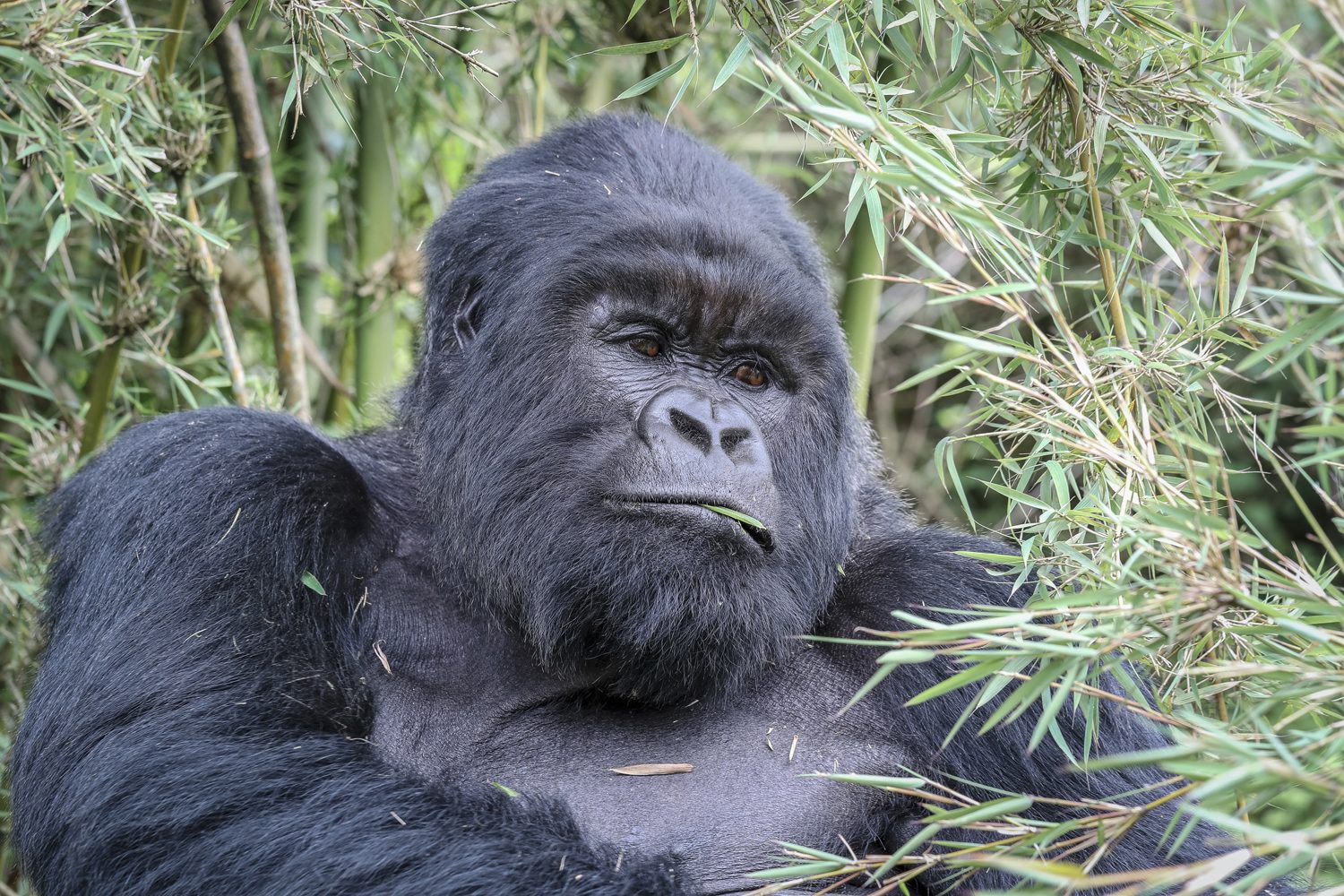
Silverback mountain gorilla resting in the bamboo forest, half of the chimpanzees vs gorillas comparison

What follows is the closest thing wildlife tourism has to theatre: silverbacks that weigh more than ten times your average traveller, infants tumbling through the undergrowth, and females grooming each other within arm’s reach. The gorillas largely ignore you, which is precisely the point. You spend one hour among them, and for most visitors it is the single greatest hour of their African journey.

Part of what makes the gorilla encounter so moving is knowing how close it came to never happening. Mountain gorillas were nearly extinct half a century ago, hunted and displaced as farming advanced up the volcano slopes, and their recovery is one of the great conservation stories of the modern era. Every permit you buy funds rangers, veterinary work and community programmes, which means your hour with a silverback is also a direct investment in the species’ future.

It is also a question of atmosphere. Visitors who complete the gorilla trek often describe a quiet kind of awe, the wonder that comes from standing beside something ancient, powerful and irreplaceable. The silverback does not perform for you; he simply sits, feeding and watching, and your visit becomes a form of respect. For many travellers, that hour in the bamboo forest is the truest moment of their entire African journey.

The Chimpanzee Trekking Experience

Chimpanzee tracking in Nyungwe is a different animal altogether. The day begins before dawn, with a drive to the trailhead and a briefing by torchlight, and the trek itself is a true pursuit: your guides follow calls, tracks and feeding signs through one of Africa’s oldest rainforests until the chimpanzees are found. Once located, you spend about an hour with the party, watching a far more fast-moving, vocal and unpredictable set of behaviours than any gorilla family will show you.

Where gorilla viewing is contemplative, chimpanzee viewing is electric. Chimps travel, feed, groom and squabble constantly; they make tools, fish for termites, and react to each other and to you with transparent emotion. Because the habituated parties in Nyungwe are small, the encounter has an intimacy that the gorillas, for all their drama, rarely deliver.

The setting deserves its own paragraph. Nyungwe is one of the oldest rainforests in Africa, a vast green basin of ancient trees, orchids and more than three hundred bird species, crossed by a famous canopy walkway suspended above the forest floor. Where the gorilla trek is an encounter with a single great animal, the chimpanzee trek is an encounter with an entire ecosystem, and the forest itself steals scenes throughout the morning.

Chimpanzee watching visitors from the rainforest canopy in Nyungwe

Cost and Permit Realities: Chimpanzees vs Gorillas

The financial gap is enormous and, for many travellers, decisive. A gorilla permit from the Rwanda Development Board costs around US$1,500 per person, making it one of the most expensive single wildlife experiences in Africa, while a Nyungwe chimpanzee permit typically runs from US$90 to US$150. For the price of one gorilla permit, you could fund a week of chimpanzee tracking, park entry and lodge nights.

Demand differs too. Gorilla permits for the busiest months sell out months in advance and are allocated to a fixed daily quota, whereas chimpanzee permits are easier to secure at shorter notice. Whichever you choose, book through a trusted operator; the current permit rates for both species are published on our gorilla permit page, and we handle the paperwork for you.

If your budget decides the chimpanzees vs gorillas question, a sensible compromise is to take the gorilla trek and spend the savings on a fuller Nyungwe stay, where the chimpanzees, colobus monkeys and canopy walkway will keep you busy for days.

There is also a softer economic argument for the chimpanzee trek. Because a gorilla permit absorbs so much of a safari budget, many travellers end their trip the day after the gorillas and miss the rest of the country. A cheaper chimp permit frees up money for Nyungwe’s canopy walkway, a boat trip on Lake Kivu or a dedicated birding morning, which is how many of our guests end up seeing more of Rwanda than they ever planned.

Physical Demands: Chimpanzees vs Gorillas Compared

There is no simple answer, because the difficulty is of different kinds. A gorilla trek is a short, steep climb into high altitude, where the thin air and volcanic slopes test your lungs; a chimpanzee trek is longer and more relentless, with several hours of muddy, slippery forest walking at lower but still meaningful altitude.

Both treks are achievable for anyone with a reasonable level of fitness, and both can be eased with the help of porters. Tell your operator honestly about your mobility and stamina, and we will match you with the right trek and pace. Nobody should skip these experiences for fear of the climb.

One further difference is worth naming: the gorilla trek has a definite shape. You reach your assigned family, spend your hour, and descend, so the day is predictable from the briefing onward. The chimpanzee trek does not offer that certainty, because the chimpanzees keep moving, and your guides may lead you for hours over steep terrain before contact is made. If you are the kind of traveller who enjoys a pursuit, that unpredictability is a feature rather than a flaw.

Landscapes: Volcanoes Versus Nyungwe

The settings are as different as the animals. Volcanoes National Park is dramatic, open and mountainous, with bamboo stands, giant lobelias and the jagged silhouettes of the Virunga chain visible for much of the trek. The views are some of the finest in East Africa, and on clear days you can look across the border into the Democratic Republic of Congo.

Nyungwe is enclosed, ancient and dripping: one of the oldest rainforests in Africa, full of ferns, orchids and birdsong, crowned by the famous canopy walkway suspended high above the forest floor. Where the volcanoes reward you with panorama, Nyungwe rewards you with immersion.

Both parks offer more than their headline animal. In Volcanoes you can add the golden monkeys of the Virungas, a separate permit and a walk through sprawling bamboo forest that many visitors rate nearly as highly as the gorillas themselves, and our golden monkey guide covers that trek in detail. In Nyungwe the extras are the colobus monkeys, the birding and the canopy walkway, which means a single Nyungwe visit can feel like three different excursions.

Crowds, Booking and Time

The gorilla trek is the most sought-after wildlife experience in Rwanda, and it shows. In peak months every permit is taken, visitor groups must keep strict distance from the families, and your hour is fixed by regulation. Chimpanzee tracking runs in smaller groups to quieter corners of a much larger park, so the overall experience feels more exclusive and more spontaneous.

Time is another factor. A gorilla trek fits neatly into a 3-day Rwanda gorilla trekking safari from Kigali, while a Nyungwe chimpanzee trek is best paired with an overnight in the park, as our 2-day Nyungwe package demonstrates. If you are short on days, the gorillas are the quicker win; if you have time to spare, the forest rewards the slower traveller.

Booking advice applies equally to both treks: use a licensed operator, confirm the exact permit date before you pay, and leave room in your itinerary for the small delays that mountain roads and rainforest weather can introduce. A professional operator holds your permits, coordinates the briefings and handles the paperwork, so that your only task on the day is to arrive at the trailhead with your boots laced.

Chimpanzees vs Gorillas: Which Should You Choose?

If this is your first visit to Africa and you want the continent’s most iconic moment, choose the gorillas. Nothing photographs, or lingers, quite like a silverback. If you are a wildlife enthusiast on a budget, choose the chimpanzees: you will see more behaviour, more movement and more of the forest for a fraction of the price.

Families should note that both treks carry minimum age rules, usually fifteen years, so check current regulations when you book. And if you cannot decide, you do not have to: the majority of our guests now choose to see both animals on one itinerary, and most describe the pairing as the defining experience of their Rwanda holiday.

Photographers face a genuine dilemma, because the two animals demand opposite techniques. Gorillas sit still, which rewards slow, careful composition; chimpanzees never stop moving, which rewards fast autofocus, a long lens and the courage to shoot through branches. Bring the longest telephoto you can carry, protect it from the rain, and you will come home with two very different portfolios.

There is no wrong answer in the chimpanzees vs gorillas choice, and no shame in letting your wallet decide for you. A traveller who sees chimpanzees in Nyungwe and returns a year later for the gorillas will enjoy two completely different holidays, while a traveller who sees both in a single week enjoys the greatest wildlife double-header Rwanda has to offer. Choose the animal that makes your heart beat faster, and let your operator handle everything else.

Do Both: The Ultimate Primate Safari

Rwanda is small, and its two great primate experiences sit at opposite ends of a drive that takes about a day. A combined itinerary lets you compare a silverback’s stillness with a chimpanzee’s cunning, and you will leave with two completely different stories to tell. Our 5-day gorilla and chimpanzee safari and our 10-day Rwanda primate itinerary are designed for exactly this purpose.

The permits, the park logistics and the transport all become our problem, not yours. If you would like help deciding, or simply to lock in your dates, contact our team and we will put together the perfect primate adventure for you.

Whichever you choose, remember that both treks are privileges that millions of travellers will never experience. Whether you spend your hour with a silverback or your morning chasing chimpanzees through an ancient forest, you will return with stories that make every other holiday feel like a warm-up. The only wrong answer is never going at all.

Chimpanzee Tracking in Nyungwe: The Complete Guide

Nyungwe National Park rises out of the far south-western corner of Rwanda like a vast green cathedral. Its layered canopy wrapped in mist for much of the year. This is one of Africa’s oldest rainforests. A surviving remnant of the forests that once covered the Albertine Rift. It shelters the best chimpanzee tracking Nyungwe has to offer. A population of wild chimpanzees. For travellers who have dreamed of meeting our closest living relatives in the wild. A chimpanzee trek in Nyungwe is one of the most profound wildlife experiences the continent has to offer.

Yet for all its wonder, chimpanzee tracking in Rwanda remains a quieter. More intimate affair than the country’s famous gorilla treks. Permits cost a fraction of the price. Visitor numbers are strictly limited. The forest sees a fraction of the crowds. In this complete chimpanzee tracking Nyungwe guide, we walk you through everything you need to know: the park itself, the habituated chimpanzee groups, what a tracking morning actually feels like, how permits work, when to visit and how to book with total confidence.

Chimpanzee tracking is the sort of experience that sits on the calendar for months and lives in the memory for decades. It is also an experience that rewards preparation, meaning a reasonable level of fitness, the right clothing and boots, and a willingness to let the forest set the pace. With the right planning, the trek is not the hardest part of a Rwanda holiday. The hardest part is leaving the forest behind.

Nyungwe: One of Africa’s Great Rainforests for Chimpanzee Tracking

Nyungwe National Park protects one of the largest and best-preserved blocks of montane rainforest in East and Central Africa. Covering roughly a thousand square kilometres of highland forest on the Albertine Rift. Scientists describe it as a refugium. A place where ancient forests survived the great climatic shifts that swept the continent. The trees and the creatures that depend on them have been evolving together here for millions of years. Walk into the forest and you are walking through deep time.

That evolutionary depth shows in the numbers. The park is home to around thirteen species of primates. More than three hundred species of birds. Some of the highest concentrations of endemic orchids and butterflies in Africa. Many of Nyungwe’s birds, such as the Albertine owlet and the Rwenzori turaco, are found nowhere else on Earth. The forest’s health matters far beyond its borders. The rain that falls here feeds both the Congo and the Nile river systems.

For many visitors, chimpanzee tracking in Nyungwe is the quieter half of a Rwanda primate safari. It is also. Crucially. A working forest. The famous canopy walkway. Suspended high above the valley floor. Draws visitors who never expected to care about monkeys and leaves them converted. The chimpanzees give the park its greatest tourism magnet. Understanding Nyungwe means understanding why protecting an old rainforest matters.

The story of Nyungwe is also a story of protection. The forest has been formally guarded for more than a century, first as a colonial forest reserve and later as a national park. That long protection has allowed the trees and their wildlife to survive in a region where the surrounding hillsides have long been converted to farmland and tea plantations. Walk the boundary trails and you will see the tea estates creeping to the forest’s edge. A reminder of how precious this unfarmed wilderness has become.

The Chimpanzees of Nyungwe: Our Closest Relatives

Meeting them is the whole point of chimpanzee tracking in Nyungwe. Chimpanzees share more than ninety-eight per cent of their DNA with humans. Watching them for even a few minutes makes that kinship impossible to ignore. They plan, they play, they grieve, they argue and they reconcile. Nyungwe’s chimpanzees live in fluid fission-fusion societies. Splitting into small parties during the day and gathering in larger numbers at night. Is one reason every trek feels different from the last.

Roughly several hundred chimpanzees are thought to live in Nyungwe. Making the park one of the most important strongholds for the eastern chimpanzee in the Albertine Rift. These are wild animals in every sense. Feeding on fruit. Leaves and insects. Using stems to fish for termites. Occasionally hunting small monkeys in coordinated group raids that take place at astonishing speed.

Chimpanzees spend more than half of their waking hours feeding. Most of the rest grooming. Resting and moving between feeding sites. Watching a community go about its day is like watching a drama unfold in slow motion. Alliances form and break. Juveniles test boundaries. Mothers discipline their offspring. The hooting of one party echoes across the valley as another answers. It is no wonder researchers have devoted entire lifetimes to following these families.

Chimpanzee resting in the canopy of Nyungwe National Park

Where Nyungwe’s Habituated Chimpanzees Live

The answer to where to go chimpanzee tracking in Nyungwe has two parts. The first is the forest around Uwinka and Gisakura. The traditional heart of the park. Researchers have followed the chimpanzees for decades and where the terrain offers classic Nyungwe scenery. Dripping canopies. Mossy ridges and valleys full of hooting chimpanzees.

The second is Cyamudongo, a remnant forest patch lying about an hour’s drive from Gisakura. Close to the border with Burundi. This small. Isolated block supports its own habituated community of chimpanzees. Its remoteness means you may have the encounter almost entirely to yourself. Because the habituated groups are small, generally numbering a few dozen individuals each, the time you spend with them feels personal in a way that few wildlife experiences can match.

Habituation in Nyungwe has been a patient, decades-long process. Researchers and trackers have spent years following the same communities day after day. Letting the chimpanzees grow accustomed to human presence until a small. Respectful group of visitors can share the forest with them. The result is a controlled intimacy. The chimpanzees accept your presence. They remain utterly wild. Is exactly as it should be.

What a Chimpanzee Tracking Morning in Nyungwe Looks Like

Expect an early start on any chimpanzee tracking morning in Nyungwe. Chimpanzees are most active in the first hours of daylight. Most treks begin with a pre-dawn wake-up. A quick breakfast. A drive to the trailhead while the sky is still dark. There you meet your guides. Park rangers and fellow trekkers. Attend a short briefing on the rules and the plan. Then step into the forest.

Tracking is part science, part art. Your guides follow the previous evening’s calls and feeding signs. Listen for the sound of breaking branches. Sometimes receive updates from trackers already in the field. The walking can be steep. Muddy and wonderfully quiet. First contact often arrives with heart-stopping suddenness. A loud hoot. A shower of leaves. Then dark shapes moving through the canopy above you.

Every part of the morning is choreographed for the welfare of the animals. The briefing covers the essential rules. Keep quiet. Stay together. Never chase a chimpanzee. Maintain a respectful distance at all times. Your guides also know the trail network in detail. Including the ridge lines and shortcuts that make it possible to follow a fast-moving party without exhausting anyone. They carry the radios that keep them in touch with trackers elsewhere in the forest.

The One-Hour Encounter

When you reach the chimpanzees, the magic begins. That hour is the reason most people book chimpanzee tracking in Nyungwe at all. The rules are simple and strictly enforced. Keep your voice low. Follow your guide’s signals. Never surround the animals and never use flash photography. You will spend approximately one hour in their company. This limit keeps the encounter calm and protects the chimpanzees from stress.

That hour passes quickly. You might watch a mother groom her infant, or juveniles wrestle noisily, or a big male feeding in the canopy, occasionally glancing at you with unsettling intelligence. Every visit is different, and that is precisely the appeal. The chimpanzees decide what you will witness; your job is simply to be present for it.

After the hour ends, the group withdraws slowly and quietly. Leaving the chimpanzees to their day. The walk back to the trailhead is usually more relaxed. Full of excited conversation and the first excited sorting of photographs. It often produces sightings of other forest life. L’Hoest’s monkeys in the undergrowth. A great blue turaco crashing across a clearing. Or the far-off shriek of a grey-cheeked mangabey high above.

Chimpanzee Tracking Permits, Prices and How to Book

Permits for chimpanzee tracking in Nyungwe are among the best-value wildlife experiences in Africa. A chimpanzee permit for Nyungwe typically costs between US$90 and US$150 per person. A tiny fraction of the price of a gorilla permit and one of the best-value wildlife experiences in Africa. Permits must be arranged in advance through the official system run by the Rwanda Development Board, and they are issued for small trekking groups of no more than a handful of visitors. Availability is limited even when the park is otherwise quiet.

The simplest way to handle everything is to book through a tour operator. We take care of permits, transport, park entry, guides and accommodation. Your only job is to enjoy the forest. Our 2-day Nyungwe package covers the classic version of this experience end to end. You can compare costs with a Volcanoes National Park gorilla trek on our gorilla permit page before you decide.

You will also want to budget for the park entry fee and. If you are not travelling on a package. For transport. Guiding and a porter. Booked as part of a safari. These details are included and managed for you. Is why so many travellers prefer a structured package. The only decision you will face on the day is how many photographs to take.

When to Go Chimpanzee Tracking in Nyungwe

Nyungwe is one of the wettest parts of Rwanda. Rain can fall in any month. The forest conditions each season are summarised by Rwanda’s official tourism board. The two drier windows, roughly June to September and December to February. Offer the most comfortable conditions and the best chances of clear trails. The wetter months bring quieter forests. Lush green light and lower prices. Chimpanzee tracking in Nyungwe runs year-round. The guides know the forest well enough to find the chimps in any weather.

For most travellers the long dry season is the easiest choice. Those who can travel in the green seasons are rewarded with fewer visitors and some of the most dramatic. Misty rainforest scenery in Africa. Whatever month you choose. Waterproof layers and grippy boots should be non-negotiable items in your bag.

Temperatures in Nyungwe are mild throughout the year. Thanks to the altitude. Daytime highs rarely rising far beyond the low twenties and nights that can feel distinctly cold. The forest floor is often damp even on dry-season mornings. The light filtering through the canopy is soft and beautiful. Particularly in the first hours after sunrise when the chimpanzees are at their most active.

Suspended canopy walkway above the Nyungwe rainforest

What to Pack for Nyungwe Chimpanzee Tracking

Pack for chimpanzee tracking in Nyungwe as you would for any rainforest trek. Packing well makes the difference between a memorable trek and a soggy one. Your checklist should include:

  • Sturdy, waterproof hiking boots that are already broken in
  • A lightweight rain jacket and waterproof trousers
  • Long trousers and long sleeves for comfort and protection
  • A small daypack with water, snacks and sunscreen
  • Insect repellent and any personal medication
  • A camera with a telephoto lens, plus spare batteries

Trekking poles, binoculars and a dry bag for electronics are all worth considering. Leave the perfume and bright colours at the lodge. Dress in muted tones. Remember that a porter hired at the trailhead is a direct boost to a local family’s income.

Finally, remember that Nyungwe sits at altitude, so the sun is fierce even on cool days and dehydration is a real risk on a long trek. Carry more water than you think you need. Eat a proper breakfast. Pace yourself on the hills. The guides have walked these trails for years. Tell them honestly how you feel. They will match the pace to you rather than the other way around.

Combining Chimpanzees with Gorillas

The great gift of Nyungwe is that it sits within a country small enough for you to do both of Africa’s signature primate encounters in a single trip. Many travellers start with a gorilla trek in the Virunga volcanoes and finish with the chimpanzees of Nyungwe. Or run the trip in reverse. Our 5-day gorilla and chimpanzee safari and our 10-day Rwanda primate itinerary do exactly this, and both are proven crowd favourites.

Whichever order you choose, the contrast is unforgettable. The hulking presence of a silverback one week. The lightning intelligence of a chimpanzee the next. If you are ready to begin planning, contact our team and we will build the itinerary around your dates, fitness and budget. The chimpanzees of Nyungwe are waiting.

Your first chimpanzee trek in Nyungwe will not be your last. Every visitor we have guided into this forest has come out changed. Carrying new respect for the intelligence that shares our planet. Whether you come for a day or for a week. The forest will give you exactly what you give it. Attention. Patience and time. In return it will hand you a morning you will talk about for the rest of your life.

The Nyungwe Canopy Walkway: A Walk Above the Rainforest

For most of the time you spend in a rainforest, you see the forest from below: the trunks of the giants, the curtains of the lianas, the flood of light far above your head. In Nyungwe, Rwanda has built a way to change that view. The Nyungwe canopy walkway is a suspension bridge of about 160 metres, strung some 70 metres above the forest floor, crossing a deep gorge at the level of the treetops in one of Africa’s oldest rainforests.

The walkway is the highest structure of its kind in the wider region, and it has become the symbol of the park, the image on every postcard and every itinerary. But no photograph prepares you for the moment you step out onto the deck: the slow sway of the bridge, the ocean of green canopy far below you, the birds flying at eye level, and the long quiet of the forest around you.

This guide covers the walkway in detail: what it is, what the crossing feels like, what you will see, the practical details of visiting, and how the canopy fits into a wider exploration of Nyungwe and Rwanda. For the bigger picture of the park’s trails, waterfalls and wildlife, our Nyungwe destination guide is the ideal starting point.

What the Nyungwe Canopy Walkway Is

The Nyungwe canopy walkway is a long suspended footbridge that carries visitors across a forested gorge at the height of the tree crowns. The bridge measures about 160 metres in length and stands roughly 70 metres above the floor of the forest below, high enough that the canopy looks like a solid, rolling plain from the deck. It is built from timber planks, strong cable and rope, suspended between the great trees of the gorge and engineered to move gently with the wind.

The bridge sits at the end of the Igishigishigi trail, a beautiful twenty-minute walk through the forest from the Uwinka visitor centre. The trail climbs gradually to the rim of the gorge, where a safe platform gives onto the bridge itself, and the crossing leads into the forest on the far side before the path loops back through the trees. The full circuit, trail plus bridge, takes about two hours at a relaxed pace.

The bridge was built with a double purpose. The first is access: before it existed, the forest canopy at Nyungwe was effectively unreachable, an entire habitat of birds, monkeys and plants visible only from below. The second is conservation: the walkway gives the park an unforgettable attraction whose future depends on the forest staying intact, and the visitor fees it generates help protect the very trees it crosses. Rarely has tourism and preservation worked so closely together.

Looking along the Nyungwe canopy walkway from the platform

Crossing the Nyungwe Canopy Walkway

A view from the high deck of the Nyungwe canopy walkway

Stepping onto the Nyungwe canopy walkway is the moment you remember. The deck is firm underfoot, but it moves: a slow, easy sway that sets into a rhythm as you walk, and through the gaps between the planks you see the forest floor a long way down. For most people the first steps are the hardest; for almost everyone, the far half of the crossing is pure delight. The sway becomes soothing, the height becomes a privilege, and the green world of the canopy opens up around you.

The views are the whole point. From the deck you look across the gorge at the crowns of the great trees, each a platform of leaves and flowers; below you the forest falls away in layers to the stream at the bottom of the gorge; and all around, the birds move at your level, a perspective that no amount of ground-level walking can ever give. In the mornings, when the mist hangs in the valley, the bridge appears to float above the clouds, and the photographs are unforgettable.

The crossing is carefully managed. Groups are kept small, the bridge is crossed in single file, and the rangers are firm about the simple rules: no running, no jumping, nothing dropped, and no drones or selfie sticks at the height. The height is genuine and the sway is genuine, and visitors who are nervous should know that the structure is engineered to the highest standards and crossed by the rangers many times every day. Most people who are hesitant on the first step are smiling by the far side.

Life in the Canopy

The canopy is the busiest habitat in the rainforest. It is here, among the crowns of the great trees, that most of the forest’s fruit and flowers are found, and it is here that its animals do almost all of their living, energy concentrated in the leaves and light above the shaded floor. From the Nyungwe canopy walkway you are a guest at the table of the canopy: monkeys move through the branches at your level, birds pass close enough to hear their wings, and the whole soundscape of the forest surrounds you.

The monkeys are the stars. Black-and-white colobus leap between crowns with ease, their long white tails streaming behind them, and troops of blue monkeys chatter their way across the bridge line. If you are lucky, and quiet, you may see the chimpanzees making their way through the trees, or catch the passing of a great blue turaco as it crosses the gorge. A pair of binoculars and a little patience turn the ten minutes on the bridge into the richest hour of the day.

The plants of the canopy are just as remarkable. Every large branch is hung with ferns, mosses and orchids, the epiphytes that live entirely in the air of the treetops, and the ancient trees themselves support whole gardens in their crowns. From the bridge, for the first time, you understand the forest not as an assembly of trunks but as a layered world: floor, understorey, canopy and sky, all of it interconnected and alive.

The Trail That Leads to It

The Igishigishigi trail that brings you to the bridge is one of the finest short walks in the park in its own right. It climbs through old-growth forest where some of the tallest trees in Nyungwe stand, crosses clear streams on small bridges and gives a proper sense of the forest’s scale before you step out above it. The path is easy and well maintained, and the ranger leading the group will point out the medicinal plants, the nesting birds and the tracks of the animals along the way.

Plan the crossing for the morning. The light is level and soft then, the birds are at their most active, and the mist that gathers in the gorge makes the bridge into something out of a story. The whole excursion, the drive from the gate, the trail, the crossing and the return, fits easily in half a day, leaving the afternoon free for lunch among the tea or for another trail in the forest.

Planning Your Nyungwe Canopy Walkway Visit

The Nyungwe canopy walkway is reached from the Uwinka visitor centre in the heart of Nyungwe, itself reached by a scenic drive through the tea country of the far west of Rwanda. The park and its trails can be visited for a few hours or a few days; a single park entry covers the first day, and the canopy is usually booked as part of that same entry to make the most of the time. Permits and ranger fees are sorted by your tour operator, or check the park’s official website for current entry details; the walkway is the most straightforward of the park’s activities to arrange.

Because Nyungwe sits high, the weather on the bridge changes fast: cool and misty in the morning, warm and sunny at midday, with the chance of rain at almost any hour. Dress in layers, wear sturdy shoes for the short woodland walk, and carry a light rain jacket even if the sky is blue. The forest makes its own weather, and a downturn on the bridge in light drizzle, with the leaves turned to silver, is one of the experiences you will not forget.

The bridge is suitable for most visitors, including children and older, well-mannered travellers; the walk is short and the structure is secure. It is less suitable for those with a serious dread of heights: the height is real. If you are at all uncertain, walk the trail for the forest and watch the crossing from the platform; the forest itself is, after all, a gift, and the canopy is a privilege rather than a test.

What to Bring

  • Sturdy, comfortable shoes for the short forest walk
  • A rain jacket; the forest weather changes quickly even on blue mornings
  • Binoculars, to be a courteous guest of the canopy on the crossing
  • A camera with a good zoom for the kingfishers, the colobus and the view
  • Water and light snacks for the two-hour circuit
  • A secure pocket or lanyard for your phone, and a little cash for snacks and the ranger tip

No special gear is needed for the walk: no harness, no helmet, no climbing school. Leave drones and selfie sticks at base, secure anything that could fall from the bridge, and bring the list above and nothing more. The forest and the bridge will do the rest, and the view has a way of doing the whole lifting itself.

How the Nyungwe Canopy Walkway Is Built

The Nyungwe canopy walkway is a suspension structure of boards, steel spans and support towers, long enough to cross the gorge in a series of linked sections. The deck sags and gives beneath your feet, which is the point: the whole platform moves with the treeline, swaying gently in the air. Maintenance is checked each morning by the park, and because the system is inspected to a very high standard, the walk is safe even for people who do not love heights, provided they keep their eyes on the canopy and off the gap.

Visitors cross in small groups led by a ranger, and the pace is leisurely. The wooden deck creaks as you walk, the wind moves the trees, and above the gorge a great column of air separates the bridge from the streams of the forest floor far below. The numbers matter less than the sensation of walking through the top of the forest rather than simply above it, with the crowns of the trees at the level of your chest and the bird calls rising all around you.

The walkway is a small part of a much larger park, and for many visitors it is the bright introduction to Nyungwe’s network of trails. Combine the visit with the longer walks and the chimpanzee trek, and book your Nyungwe day through our team so the timing of the walkway and the rest of the forest is in good hands.

Nyungwe Beyond the Walkway

The Nyungwe canopy walkway steals the headlines, but it is only the most famous of a range of ways to know the forest. The park offers long day trails to waterfalls, lakeside viewpoints and the quiet stretches of the canopy, and the best rhythm for a visit is one highlight per day: a morning on the walkway, a day on the trails, a chimpanzee trek. The Nyungwe National Park guide sets out all of it, and the two-day chimpanzee tracking safari adds the great primate day to a walking itinerary.

Two days in Nyungwe is the comfortable minimum for a rounded visit, and three allows the park to show its full range. The canopy walkway gives the forest its famous image, and the trails give it its depth; together they make one of the best walking destinations in Africa. Book your walkway crossing with our team, and then climb down from the canopy to meet the rest of the forest on its own terms.

The Canopy and the Rest of Nyungwe

The Nyungwe canopy walkway is the headline, but the forest of Nyungwe has many highlights, and the canopy fits naturally into a longer stay. The classic combination is the walkway on one morning and a chimpanzee tracking session on another; the two are the great experiences of the park, treetops one day, apes the next. Our two-day Nyungwe chimpanzee safari centres on the apes, and the walkway is easy to add to the schedule on the drive in or out.

The waterfall trails and the summit walks of the park lie within reach of the same base, and a couple of full days in Nyungwe lets you meet the forest in all its moods. For travellers building a bigger Rwandan itinerary, the eight-day Rwanda best adventure safari combines the rainforest with the volcanoes of the north and the lakes of the Kivu region in the right order. The lessons of the canopy, the forest, the water and the mountains together make a picture of Rwanda that is hard to beat.

Standing on the bridge in the morning, with the mist above the green ocean and the calls of the forest sounding from below, is one of the defining images of Rwanda. The canopy walkway is quick to visit and impossible to forget, a few minutes above the trees that stay with you for years. Book your Nyungwe day with our team, walk the Igishigishigi trail, and step out over the gorge; the forest has been waiting a long time to show you this view.

The Trails of Nyungwe: Waterfalls, Canopies and Old-Growth Forest

Nyungwe forest trails and waterfalls define the green heart of south-west Rwanda: a vast rainforest that has stood on the mountains of the western rift for millions of years, making it one of the oldest forests in Africa. Its surface is rugged, its rainfall is generous and its interior is one of the richest storehouses of life on the continent: a forest where waterfalls, swamps and valleys lie beneath a great canopy, and where the calls of chimpanzees echo through the morning mist.

The forest is protected as a national park, and the best way to enter it is on foot. Unlike the open savannah of the east, Nyungwe is a world of close trees and bright streams, and its great gift to the visitor is a network of marked forest trails: paths that lead into the interior, past giant trees and hanging orchids, beneath the canopy and beside the roar of the waterfalls. The trails of Nyungwe open up a whole country of walking.

People often come to Nyungwe for the chimpanzees, but it is the forest itself they remember. This guide covers the walking side of the park: the principal Nyungwe forest trails, the waterfalls, the canopy walkway, the wildlife you will meet and the practicalities of planning your days on foot. For an overview of the park and its animals, our Nyungwe National Park guide is the best place to begin.

Nyungwe Forest Trails: A Forest That Outlasted the Ice Ages

Nyungwe is not just a forest; it is a survivor, and its forest trails and waterfalls are, in fact, the best way to meet it. Scientists describe the rainforest here as one of the oldest in central Africa, a block that persisted through the great swings of climate that turned much of the continent to savannah. This is the ecological memory of the region, a place where the mountain passes have stood as a refugium for hundreds of thousands of years while the forests around them shrank and grew.

The park covers close to a million hectares wrapped around the crest of the rift, lying between about 1,600 metres in its valleys and close to 3,000 metres at its highest summit. Its position on the water divide, moreover, makes it vital to the whole country: the rain that falls on Nyungwe drains in two directions, toward the Congo basin in the west and the Nile system in the east, supplying springs, rivers and wetlands for millions of people and animals beyond the park.

That mix of age, altitude and isolation has produced extraordinary richness. Nyungwe is home to more than a thousand species of plant, several hundred species of birds, dozens of mammals and more than a dozen species of primates, among them chimpanzees, several kinds of monkey and the notable colobus. Every step on the trails passes species that have been living in this forest since before humans set foot in it.

The Network of Nyungwe Forest Trails

The greatest strength of Nyungwe as a hiking destination is, for example, its forest trails and waterfalls, which let visitors choose their own level of adventure. The walks range from short loops of an hour or two to full-day expeditions, and each one leads through a different face of the forest: the deep and quiet of the primary forest, the bright clearings and their ferns, the steep ravines of the big streams.

  • The Igishigishigi Trail, the short climb into a deep forest gorge, site of the canopy walkway
  • The Isumo Trail, the walk along the ridge and down to the park’s great waterfall
  • The Kamiranzovu Trail, a plateau route through the mysterious valley of the Kamiranzovu stream and swamp forest
  • The Bigugu Trail, the long climb to the highest summits of Nyungwe with views out over the whole park
  • The Banda, Cyamudongo and Karamba Trails, a family of quieter walks along the forest edges and the tea frontier

Between them, indeed, these trails cover the full range of the forest experience: the gorge of Isumo and its thunder, the open, secret valley of the swamp, the altitude and the wind of the summits, and the deep nave of the old-growth forest. Each is led by a park ranger, the convention across Nyungwe, and the rangers are a walking encyclopaedia: they know where the chimps have moved, where the colobus feed, and where the light comes through the canopy best.

Trailheads and the Uwinka Base

Most of the trails begin from the Uwinka volunteer base high on the ridge, reached along the road that cuts through the forest between the tea estates of the park and the agricultural valleys. The scale of the place is hard to take in at once: the forest stretches to every horizon, the air is heavy and green, and the noise of the day comes from the trees themselves.

Forest trail through the rain trees of Nyungwe National Park

Waterfalls on the Nyungwe Forest Trails

The most beloved waterfall on the Nyungwe forest trails, however, is the Isumo falls, a route that leads steadily down through the forest toward the roar that grows ahead. Isumo is not a modest stream; it is a great watercourse, a broad ribbon of water that falls from the escarpment into a pool of green, its sound filling the whole valley. In the wet season it speaks anew, and the point where the path meets the falls, with the mist on the forest and the light playing on the water, is one of the most memorable in Rwanda.

On the plateau above, meanwhile, the Kamiranzovu trail tells a different story. Here the ground opens in the valley of a slow stream and the forest gives way to a broad swamp, a place where the water spreads wide and birds go about their work: the reeds with nests, the edges and the calls. It is the launch for the most patient of bird watchers and for the walker who enjoys the moody landscape that the sun cannot entirely dominate.

Water, in fact, is the thread that pulls the Nyungwe forest trails together, and waterfalls mark its loudest moments. The streams that cross the trails take the rain from the high forest on their way to join the headwaters of the great rivers, and where the trail strikes water it does so with bridges and stepping stones, usually at the point where the current is easiest. Walking Nyungwe is always walking with water, between the splashing of the streams at the bottom of the valleys and the big rain that returns to the canopy.

Rainforest canopy viewed from the upper trail network of Nyungwe

The Canopies and the Walkway

No account of the trails is complete, however, without the canopy walkway, the spectacular bridge that swings above the forest gorge at the end of the Igishigishigi trail. The bridge spans about 160 metres and hangs some 70 metres above the forest floor, carrying you across the gap at the level of the crowns of the trees. It gives ten minutes of the best view in the park and the truest, most level of the forest.

Walking the region’s trails lets you stand on the high of the canopy, where the leaves of the treetops look like a solid, rolling plain, and where the birds and sleeping monkeys level off around you; the photographs from this bridge improve everywhere you look. Our canopy walkway guide has the full practical detail; in addition, the crossing makes a perfect answer to a day of the forest, particularly when teamed with a morning on the great areas. For those who would rather stay on the ground, the viewpoints from the far side of the gantries are wholly enough.

The Primates of Nyungwe

Nyungwe’s primates are the headline for many visitors. The chimpanzees, the high-jacked stars of the park, are best met on a special fellowship and tracking system inside the forest, and a morning walk with researcher-led trackers is one of the finest wildlife experiences in Africa. The chimpanzees of the park have been studied for decades and are partly habituate, so the encounters are frequently intimate while always on the animals’ terms.

The ordinary trails are the place to meet the other residents. Along the paths, for example, you may meet the long-nosed colobus moving through the crowns, family groups of blue duikers, the shy of the trees and, with patience and a quiet, golden and other monkeys. The forest is not shy of its own mystery; the rangers will share that they are loaded with the habits of the animals they have followed for a lifetime, and their eyes find the movement that a visitor would miss. Do not be surprised to spend an hour which to grow nothing but then everything, all from the same spot of the trail.

Nyungwe’s nick-name among the park rangers is the forest of the big forest, and it is earned: the trails of the national park are the only way to be empty of crowds. You will share the forest with the trackers, with monkeys and birds, and with very little else; this is a forest of immense age and perfectly satisfying riches that has grown used to the occasional, respectful visitor.

Planning the Walking Days

Above all, make the walking days the heart of your plans: Nyungwe forest trails and waterfalls are the reason to linger. A day of the trails covers sixteen to twenty kilometres if you combine the canopy bridge with the Isumo trail, or the forest loop with the sunset; a full day around the base of the canopy and the headquarters covers the ground a visitor rarely finds. The park is walker friendly and the rangers are superb; the challenge is the choice, and the memory.

Please be ready for the season of the forest. Nyungwe’s altitude, above 1,600 m in its trails up to 2,950, brings rain almost every the day, and the visibility in the forest is limited to the arms of the hour. The layout: plan a proper fit, to arrive at the trail head at the hour of open, with your rain jacket; they walk with your head up. The falls and the streams are best in the morning, the truer of the afternoon may beat the planets over the canopy.

The practical fact is superb: a single entrance fee covers your time in the park, permits are sorted by your operator, the ranger instructs the trail and goes with you, and the trails are secure. The park also offers a lodging at the gate and in the near forest, so a walker can take two or three full days in the park and sleep in the rim of the forest, waking to the chimpanzees on the boundary of the canopy.

What to Bring on the Nyungwe Forest Trails

  • Sturdy walking shoes with a good grip; the trails are rooty and often wet
  • A rain jacket, and a dry layer, whatever the forecast
  • Long trousers and insect repellent for the forest
  • Plenty of water and energy snacks for the long days
  • A camera with a zoom for the birds, the monkeys and the canopy
  • Binoculars, a compact swiss army knife, and a sense of adventure

The seasoned walker of Nyungwe will not mind that the answer is alive with rain; the water is indeed the forest’s strongest asset, and the trails reward those who walk in the open, warm jacket. The forest bag follows the advice of the rangers, and the forest itself is the joy of the walking.

Weather, Seasons and the Walking Days

Nyungwe receives rain in every month of the year; however, these forest trails and waterfalls are walkable year-round with good timing. The drier stretches fall between June and September and again in the short dry pause of December, when the trails hold their shape and the forest opens to the light. In the rains, which concentrate around March to May and October to November, the paths are slippery and the river crossings rise, but the waterfalls are at their loudest and the forest is a brilliant loud green, and the rangers simply route the day around the downpour.

Whichever season you choose, start early. The rangers open the trails at dawn, the morning is the coolest for climbing, and the primate groups, which feed in the early hours, are most visible in the first hours of light. Carry rain gear whatever the season, take a second bottle of water, and let the guide set the pace. The forest is forgiving of extra time and unforgiving of bad preparation, and the reward for patience is measured in birds, monkeys and the quiet of the great canopy.

The day trails described on this page are the heart of a Nyungwe visit, and they combine naturally with the park’s signature experiences. The Nyungwe National Park destination guide puts the whole forest in context, and the two-day Nyungwe chimpanzee tracking safari, in addition, adds the best of the forest’s wildlife days to your trail plans. Let our team plan the walking days for you, so the timing of the park, the camps and the seasons works in your favour.

Bringing It All Together

Nyungwe is the climactic part of any Rwanda itinerary, and the trails are its beating heart: the waterfall trails, the canopy bridge, the swamp forest, the summit, the chimpanzees encountered along the way are the summit of the whole western journey. Many visitors travel straight from the park to the Congo River Nile lake of the trail and the lakes; few stretch to go from the volcanoes to the forest and the Kivu shore in one trip. For a specialised time in the forest, the two-day Nyungwe chimpanzee safari combines the tracking with the best trails, and the full country is covered in our eight-day Rwanda best adventure safari, which gives Nyungwe the two things the forest really deserves: time and mileage.

You can afford to travel the park in a version of the name is long and old and green. Give it at least a couple of days; take the rangers’ advice; and be prepared, above all, for the canopy of the great forest, which is the hardest of any in Africa on a walking scale. The trails of Nyungwe are the finest walking in Rwanda, and the forest that holds them is close to the best in the story of the continent. Entry fees and trail news are published by Rwanda’s official tourism board.

The Musanze Caves: Underground Rwanda

The volcano country of northern Rwanda is famous for what rises above the ground: the great cones of the Virunga chain and the mountain gorillas that live in their forests. But beneath this same landscape lies a different kind of wonder, hidden in the dark. The Musanze Caves are a network of volcanic tunnels formed by the lava flows of the Virunga volcanoes, and a guided walk into their cool darkness is one of the most atmospheric experiences in the country.

These are lava tubes. When the mountains erupted in the distant past, rivers of molten rock poured across the land. The surface cooled into a crust while the centre stayed liquid and drained away, leaving long natural tunnels behind. The Musanze system is among the largest and best preserved of its kind in the region. It runs for a considerable distance beneath the farmland and forests at the foot of the park.

The caves were known to local people for generations as a place of shelter and legend. They opened to visitors only in recent years, and quickly became a favourite stop on the northern circuit. This guide covers the geology, the legends, the tour itself, the wildlife of the underground and how to combine a visit with the mountains and gorillas above. For the practical details of the area, see our Musanze caves page and the Volcanoes National Park destination guide.

Entrance to the basalt tubes of the Musanze Caves

The Musanze Caves: Tunnels Born of Fire

The Musanze Caves are a textbook volcanic formation. When one of the nearby cones of the Virunga chain erupted, lava streamed down the slopes in rivers. The rivers lost heat on the surface and hardened into a crust, while the molten centre continued to flow beneath. When the eruption ended and the liquid drained away, an open tunnel remained under the hardened crust. This lava tube is roughly circular in section, and sometimes tall enough to stand up in.

The main system opened to visitors runs for around two kilometres beneath the foothills. It shows all the signatures of its volcanic birth. Look for smooth, glassy rock on the walls, irregular floors of solidified stone, and roofs that curve like the inside of a wave. In places the roof has collapsed, opening skylights through which trees reach down and shafts of light fall onto the cave floor.

Because the tubes formed underground, they stay remarkably stable. The temperature inside is cool and constant year round. The air is still and damp, and the sounds of the forest above recede into a deep silence. The geology of the Virunga chain is young by the standards of the earth. Standing in the caves, you are inside one of the most recent chapters of the range’s story. The same volcanic forces that built the mountains also hollowed out their feet.

Legend and Memory in the Musanze Caves

The caves carry more than geology. For the people of the region they have long been a place of refuge and story. They were a shelter in times of conflict, a cool storeroom for the harvest, and a hideaway in the wars that rolled across the hills. The tunnels were part of the landscape of memory long before they became a tourist attraction. The rangers who lead visits are proud to tell the stories their grandparents told them.

Some of the lore is pure legend. Villagers say the tunnels run all the way to the shores of Lake Kivu, or that they connect to the Congo. Travellers are told of the people who once sheltered here for weeks at a time. Like all good legends, these are impossible to prove and impossible to resist. Standing in the darkness at the end of a tunnel, the idea that it might go on forever feels entirely plausible.

In more recent memory the caves played a sobering role. During the genocide against the Tutsi in 1994, many people hid in these tunnels seeking safety, and some did not survive. A visit to the caves today is therefore also a place of remembrance, and the guides speak of it with gravity. It is a reminder that the landscape of Rwanda is woven into the country’s history, in both its light and its dark.

Touring the Musanze Caves Beneath the Volcano

Entering the Musanze Caves at the foot of the volcanoes

A visit begins at the entrance to the caves, where rangers brief the group, hand out helmets and headlamps, and lead you down a short path to the mouth of the tunnel. The transition is immediate. One moment you are in the green, warm daylight of the foothills. The next you are in the cool, still air of the underground, guided only by the pools of light moving ahead of you.

The walk itself is a genuine cave experience rather than a museum one. The floor is uneven stone, and the roof is close in places and high in others. The light of the headlamps picks out the textures of the lava rock and the occasional drip of water. The route is well maintained and safe, and the rangers manage the pace. Most visits last about an hour, which is enough time to feel the scale of the place without feeling rushed.

For guests who want more, some sections of the cave system are more adventurous, requiring stooping and careful footing. The guides will tailor the route to the group’s comfort. A few reminders make the experience better for everyone. Stay with the group, avoid touching the fragile walls, and keep your camera flash away from the bat colonies. The creatures of the cave are its true residents.

Bats and the Life of the Caves

The most famous residents of the Musanze Caves are the bats. Colonies roost in the ceilings of the tunnels, clinging to the rock in dense clusters. They are usually quiet and invisible in the dark, yet their presence is unmistakable. Listen for the faint high-pitched calls, the occasional sound of wings, and the signs they leave on the floor. The rangers know where the colonies hang and will point them out without disturbing them.

The bats are not the caves’ only life. The tunnels support a small ecosystem of their own. Cave insects, spiders and fungi live on the wet rock. Mosses and ferns gather beneath the skylights where sunlight falls through. This underground world is fragile, which is why the park asks visitors to stay on the route and keep hands off the rock. Every visitor who passes through leaves the cave a little different, and the park works hard to keep the impact small.

There is also, simply, the atmosphere. The caves are cold, dark and still in a way that few places on the surface can match. For the hour you are inside, the world above becomes a distant idea, with its hills, its animals and the noise of travel. Many visitors say the silence is what they remember: a silence so complete that you can hear your own heartbeat and the drip of water from the roof.

Musanze Caves: Practical Information for Visitors

The Musanze Caves sit on the outskirts of Musanze town, in the same hill country as the Volcanoes National Park gates. They are easily reached from Kigali, with a drive of roughly two or three hours along good roads. The drive is a pleasant introduction to the northern highlands. The Rwanda Development Board manages the park and the caves. The caves operate during daylight hours, and the park rangers recommend a visit in the morning, when the light is at its best and the site is quiet.

Entry to the caves requires a modest fee and a guided visit, and the ranger, the helmet and the headlamp are all included in the price. Booking is straightforward, through a licensed operator or at the site itself. Arrive early in the day in the high season. The visit suits families and travellers of all ages: the walking is easy, the cave is cool, and the reward is a memory of the underground.

Because the caves sit at the foot of the volcanoes, they combine naturally with everything else on the northern circuit. A classic day pairs the caves with a walk to one of the nearby crater lakes, with an afternoon drive past tea and eucalyptus, or with the golden monkey trek when those are running. The region’s tour operators, including our team, package the caves easily into a full agenda of the northern trails.

Whoever you travel with, the Musanze Caves fit easily into the day. The Musanze Caves tour needs no booking months ahead, unlike gorilla permits. You can simply arrive in the morning and join the next group. It is one of the most relaxed add-ons on the northern circuit.

What to Wear and Bring

  • Sturdy walking shoes, because the cave floor is uneven
  • Long trousers and a long-sleeved shirt, because the rock is rough and the cave is cool
  • A warm layer, as the temperature underground is noticeably colder than outside
  • A spare torch or headlamp, even though one is provided
  • Your camera, for the skylights and the entrance, without a bright flash inside
  • Cash or card for the entry fee, the guide’s tip and the market in town

A visit to the cave is not a strenuous activity: it is an hour of easy walking in the dark, so there is no need for hiking boots or special gear. The main requirements are comfortable shoes, a warm layer and an open mind. Leave your expectations of polished corporate cave tours at home; this is a raw, honest, ordinary underground world, and that is exactly why it is worth visiting.

Geology Below the Frozen Lava

The Musanze Caves are lava tubes. This type of cave forms when a river of molten rock flows downhill and crusts over on the surface while the interior continues to move. When the eruption that helped build the Virunga chain halted, the empty tube was left behind. It is a long, cathedral-like corridor of smooth basalt, with dripper walls, smooth floors and occasional skylights where the roof collapsed. These lava tubes are among the longest in East Africa, and walking through one is a rare chance to see the anatomy of a volcano from the inside.

The tubes follow the slope of the volcano, so the descent is gradual. The floor is mostly firm rock rather than mud, which is why the walk suits families. In places the chamber widens into great vaulted rooms, and in others you must duck beneath low arches. The guide will point out the markings of the flows, the rounded boulders rolled along by the moving lava, and the patches of broken rock that tell you how the eruption ended. It is geology you can literally walk through.

The caves sit on the edge of Volcanoes National Park, and they make a perfect counterpoint to the mountains above them. If you are also planning the climbs of the park, the mountain hiking guide on this site covers Bisoke, Karisimbi and the rest of the volcanoes, and the gorilla permits page explains how to book the trek at the same park gate. A morning in the caves and a day on the mountains is one of the fullest ways to see the Virunga chain.

Who the Caves Suit Best

The Musanze Caves are unusual in the park circuit because they ask nothing of your fitness. You do not need to climb, camp or cover long distances. The walking tour lasts about half an hour. It suits families, senior visitors and anyone returning from a hard day on the slopes. The cave floor is uneven in places, so sure shoes and a rested day help. The route is short, dry and under cover, which makes it a brilliant option when jungle weather interrupts the mountains.

Because the caves are so close to the town of Musanze, they slot easily into any northern circuit. Pair them with the twin lakes of Bulera and Ruhondo above the town, or with a day on the volcano trails, and you have a rounded day of close contact with the country above and below the ground. We can arrange the cave guide, the transfers and the permits together with your whole northern itinerary, and our team is happy to plan a day that fits the pace of your holiday.

Combining the Caves With the Mountains

The caves make a perfect piece of a northern itinerary built around the volcanoes and the gorillas. A two-day gorilla trekking tour can be paired with a cave visit on an off day. Travellers hiking the volcano trails, whether Bisoke, Karisimbi or Sabyinyo, will find the caves a welcome contrast. Where the mountains test your lungs, the caves exercise your imagination. The two experiences sit within an hour of each other, and together they show the full scale of the volcano country.

The twin lakes of Bulera and Ruhondo are close by, offering a quiet afternoon afloat to balance the dark of the caves. The tea estates and farmland of the surrounds are a landscape in themselves. For visitors working out the details of a full northern trip, our mountain hiking guide covers the climbs in depth. Our gorilla trekking packages put the great wildlife days in place with the logistics handled.

The caves ask very little of their visitors and give a great deal back. They are quick to visit, simple to arrange and unlike anything else in Rwanda. This is a genuine walk into the underworld of the Virunga chain, complete with bats, legend and the long silence of the rock. Add them to your northern circuit, go down with your headlamp, and come back up with a story. For official visitor information, see the Visit Rwanda tourism board. Contact our team if you would like help planning the day.

Cycling in Rwanda: The Land of a Thousand Hills by Bike

Cycling in Rwanda is an invitation rather than a warning: the country calls itself the Land of a Thousand Hills, and every hard-won summit repays the rider. The country’s roads climb and fall through an endless landscape of green ridges, tea plantations, lakes and volcanic peaks, and every hard-won summit is repaid with a view that would be the highlight of most cycling trips anywhere in the world. Add smooth, well-maintained roads, light traffic away from the main highways and a cool, dry climate at altitude, and you have one of Africa’s finest cycling destinations.

Rwanda has also embraced cycling as a culture. The Tour du Rwanda has grown into one of the continent’s major stage races, professional teams train in the hills between seasons, and village children line the roads when riders pass. Everywhere you ride you are met with enthusiasm: local riders fall in alongside you for a stretch, farmers pause to wave from the fields, and the country’s own cyclists are proud to share the roads they love.

This guide covers the best of cycling in Rwanda: the signature routes, what the riding really feels like, the seasons and conditions, the packing list, and how to combine a cycling holiday with the country’s wildlife highlights. For the full picture of the lake you will ride beside, our Lake Kivu destination guide has everything you need.

Cycling in Rwanda works for every level of rider, from first-timers on the lakeshore to racers chasing the Tour du Rwanda’s climbs. This guide covers the routes, the seasons, the hire options and the practicalities, and it is the closest thing to a complete cycling Rwanda handbook you will find. Whether you want a single day in the saddle or a full two weeks, the hills are waiting.

Cycling in Rwanda on the Congo Nile Trail towards Lake Kivu

Why Rwanda Is Made for Cycling

Start with the roads, which are the first reason cycling in Rwanda is exceptional: Rwanda has invested heavily in its road network over the past two decades, and the quality of its main routes is exceptional for the region: smooth, well-drained, well-marked and safe to ride. Away from the major arteries, quiet district roads thread through the hills and valleys, and on the slopes behind the lakes and volcanoes the traffic all but disappears, leaving you with tarmac, hills and silence. For a cyclist this is the difference between a pleasant ride and a memorable one.

Then add the altitude, which is the second reason cycling in Rwanda feels so good. Most of Rwanda sits between about 1,400 and 1,800 metres above sea level, which means cool air, strong sun and remarkably comfortable riding temperatures. The climbs are hard, but the descents are fast and shady, and even at midday the hills provide pockets of shade and breeze. It is a country made for cycling in the way other countries are made for sailing or skiing, and riders who come for the wildlife often leave converted to the wheel.

Finally, add the scale. Rwanda is small enough that you can cross most of it in a few days of pedalling, connecting the volcanoes of the north, the lakes of the west and the rainforest of the south by road, yet big enough that touring never feels rushed. Every stage ends in a village or town with a guesthouse, food and cold water, and every morning brings fresh tarmac and new hills.

Cycling Rwanda’s Congo Nile Trail by Bike

Cycling the Congo Nile Trail beside Lake Kivu

The Congo Nile Trail is the showpiece of cycling in Rwanda: roughly 227 kilometres of rolling, lake-facing riding between Rubavu in the north and Rusizi in the south, with the lake as your companion the whole way. The route follows the shore of Lake Kivu through tea fields, fishing villages and forest, and the lake is your companion the whole way, its blue water appearing and disappearing through the green. Most cyclists plan for four to six days on the trail, with daily stages of between forty and sixty kilometres.

The riding sits in a sweet spot, which is why most cyclists who try cycling in Rwanda start on the northern half of the trail: demanding enough to feel like an achievement, manageable enough for a touring holiday. The hills are short and stiff rather than long and gradual, the surfaces mix smooth tarmac with firm earth, and the reward is a rhythm that few long-distance routes can match. On good days you spin along the lakeshore with the islands and the Congolese hills mirrored in the water; on hard days you grind up a ridge and are handed the whole valley in return. Both kinds of day end at a village bed, a cold drink and a swim.

The trail’s overnight stops have grown up with it: guesthouses and beach camps welcome riders, luggage can be transferred between stages, and local guides know every climb. Many riders tackle the northern half of the route, which offers the most dramatic scenery and the easiest logistics, and leave the full length for a later, longer trip. The trail is best ridden slowly rather than fast, because the tea pickers, the fishermen and the lakeside villages are what make it memorable.

Cycling Routes Across Rwanda

North of the lake, cycling in Rwanda reaches its most dramatic landscapes around the Virunga volcanoes, where the roads around Musanze climb through the hills at the foot of the peaks, with the cones of Bisoke, Sabyinyo and Karisimbi rising above the farmland. These are some of the most beautiful riding roads in Africa, and they lead naturally to Volcanoes National Park, whose official website covers the park’s attractions, where the same forests hold the mountain gorillas. A day in the saddle here is a day spent in the shadow of the chain’s great peaks.

Around Kigali, cycling in Rwanda has its cultural heart: the hills roll without mercy, and the capital has become the centre of Rwandan cycling culture: weekend pelotons, training camps and a growing network of riders. The roads climbing out of the city are the training ground for the country’s professionals, and the descents into the tea-scented valleys to the north reward anyone willing to earn them.

To the south, the roads between the Nyungwe forest and the southern shores of Kivu combine forest climbs, tea country and a warm lakeside finish, while the gentler terrain of the east offers easier spins for riders building their confidence. The whole country is, in effect, one great route sheet, and the days you spend in the saddle connect the country’s landscapes better than any other way of travel.

What Cycling in Rwanda Is Really Like

The rhythm is the first thing a newcomer to cycling in Rwanda absorbs, and it is why Rwanda’s official tourism board markets the country as a cycling destination. There are no Alpine passes and no desert headwinds; instead the road rolls over ridge after ridge in short, sharp climbs and welcome descents, and the trick is to pace yourself to the day rather than fight it. A route that looks relentless on paper becomes manageable once you settle into the cadence of the hills.

The welcome on the road is one of the great gifts of cycling in Rwanda. You are greeted at every village: children sprint alongside you for a few hundred metres, farmers stop work to wave, and drivers give you generous room. Local riders will fall in beside you for a stretch, and in the market towns your arrival is an event. For a visiting cyclist, Rwanda is one of the most welcoming countries in the world in which to turn the pedals.

Be ready for the small realities of the terrain: the strength of the sun at altitude, the cool rush of the descents and the afternoon build-up of rain in the hills. Riders new to Africa are often surprised by how little traffic they encounter; the real demands are the sun, the climbs and your own legs. Dress for the morning cool, protect yourself from the midday sun, and you will find the riding as comfortable as it is beautiful.

Bike Hire and Practicalities for Cycling Rwanda

You do not need to bring your own bike for cycling in Rwanda, because hire quality has improved greatly as the country’s cycling scene has grown. Kigali, Musanze and the towns along Lake Kivu all have hire bikes, and the Congo Nile Trail has operators who deliver well-maintained mountain bikes to Rubavu and collect them at the end of the route. The quality of hire bikes has improved greatly as the country’s cycling scene has grown, and a decent mountain bike is the right tool for most of the trail.

Support is available at every level of cycling in Rwanda. Self-guided riders carry their own luggage or use the transfer services of the guesthouses along the trail; supported riders travel with a vehicle that carries the bags, provides spares and water, and has a guide who handles the logistics. The supported option is popular with first-timers who want the riding without the planning, and it lets you cover more ground in less time.

Two good habits will serve you well: Rwanda drives on the right and the roads are shared with motorbikes and minibuses, so ride defensively and single-file in the hills, and the Rwanda Development Board publishes the trail conditions each season; and the sun at altitude burns quickly, so carry sunscreen and drink constantly. Water can be refilled at almost every village, bananas and grilled plantains are the fuel of the road, and at the end of the day there is usually a lake within reach.

When to Ride

The dry seasons, roughly January to February and June to September, are the best months for cycling in Rwanda, offering the best riding conditions: firm trails, clear mornings and reliable views of the hills and lakes. The Congo Nile Trail is at its most enjoyable in these months, when the surfaces are dry and the swimming is perfect at the end of the day. It is also when the country’s own racing season is at its peak, so you may share the roads with training groups.

In the rainy seasons the trails are muddier and the afternoons bring regular showers, but the country is at its greenest and the hills are quieter. Many experienced riders enjoy the wet-season riding precisely because the roads are empty and the landscape is vivid; a good rain jacket and a willingness to get muddy are all it takes. For most riders, though, the dry months are the safest bet.

Whichever season you choose, the mornings are the golden hours: the air is cool, the views are clear and the roads are quiet. Plan your riding for the early part of the day, take a break through the hottest hours, and use the late afternoon for shorter loops or a swim. Rwanda’s altitude keeps the climate mild all year, and there is rarely a month when the riding is not worthwhile.

What to Pack for the Roads

  • Cycling shorts and jerseys with pockets for food, phone and a light layer
  • Helmet and fingerless gloves, for the fast descents and the strong sun
  • A waterproof shell for the afternoon showers of the hills
  • Sun cream, arm sleeves and a cap for the exposed climbs
  • Two bottles, because the climbs are long and the villages are not always close
  • Spare inner tubes, a pump and a multi-tool
  • Leg warmers for the cool mornings at altitude
  • A small lock and a power bank for the evenings
  • Cash for bananas, grilled food and guesthouse beds

Pack small and ride light; everything unnecessary is extra weight on the climbs. The essentials above cover both the supported and the self-guided trip, and the local shops will supply whatever you forget. Bring a good attitude and a sense of humour: the hills of Rwanda give back exactly what you invest in them, and riders who embrace the climbs are rewarded with the country’s best views.

Etiquette, Safety and the Character of the Roads

The mountain roads of Rwanda are shared, and the etiquette of cycling in Rwanda takes minutes to learn. Cyclists ride on the right, pass on the left, and ride single file when a vehicle appears, which on the Congo Nile Trail is constantly on the descents. Villages are busy with people, bicycles, motos and market stalls, so slow down and sound a polite warning before you reach a crowd. Schoolchildren love to shout greetings, and the friendliness of the road is one of the great gifts of riding in Rwanda, but it also means you must keep your eyes up at all times.

The big descents are where most accidents happen. The gradients on sections of the trail let you comfortably reach high speeds, and with potholes, gravel and the occasional herd of cows, that is a speed to resist. Brake early, take the corners wide, and always hold your position between heavy trucks, which share these routes. Plan each day so you climb in the cool of the morning and take the long downhill in the afternoon, when the light is warm and the traffic on the lakeshore road is at its quietest.

For the full Lake Kivu experience in the saddle, the Lake Kivu destination guide on this site describes every stage of the lake, and the six-day Rwanda gorilla trekking and Lake Kivu safari ends where the riding begins. Whether you come for a single stage or ride the whole trail end to end, book your fully supported ride with our team and we will handle the transfers, the luggage and the good guesthouses that make the hills a pleasure rather than a punishment.

Combining Cycling With Gorillas, Lakes and Forests

Cycling in Rwanda is also the perfect skeleton for a wider safari. The country is small and the roads are good, so a riding trip can be built around the wildlife: the Congo Nile Trail by bike, then a short transfer to Volcanoes National Park for gorilla trekking, then south to the rainforest of Nyungwe. For travellers who want both the riding and the animals, our six-day Rwanda gorilla trekking and Lake Kivu safari strings the trail and the lake together, and the eight-day Rwanda best adventure safari adds the volcanoes and Nyungwe to the mix.

The classic combination is a few days on the trail followed by a day with the gorillas: the saddle legs are an excellent warm-up for the walking, and the wildlife days provide a welcome rest for the wheels. In the north, the climbs around Musanze bring you to the park gates; in the south, the forest roads of Nyungwe are themselves worth riding. The lake, the volcanoes and the rainforest are all within reach of the pedals.

Whatever your plan, measure your fitness honestly and start smaller than you think you need. The support is there when you want it, from the trail operators and the guesthouses to our own team, and the hills make every day a story. Contact our team to book a fully supported ride, and give yourself the time to enjoy the Land of a Thousand Hills at the speed it deserves.